From a financial perspective, the pieces seemed to be falling into place.
The sustainability team at Epic Investments, which manages a 35-year-old office tower at Bloor and Yonge streets in Toronto on behalf of an institutional client, knew the owners were interested in decarbonization. The building’s gas-fired boilers were at the end of their usable life.
As of 2024, the policy signals from the City of Toronto and the federal government, via the now defunct carbon levy, also looked promising.
There was, however, a technical wrinkle, recounts Nada Sutic, Epic’s vice-president of sustainability and innovation: the 17-storey glass-clad building, at 33 Bloor St. E., lacked sufficient transformer capacity to support a shift from gas to electric heat.
“So,” she says, “we looked at what can we do that can get us a good portion of the way there.” Epic’s engineers identified a secondary air conditioning “loop” used to cool several kitchens year-round. They proposed installing a heat recovery system instead of just venting the warm air. That move, Ms. Sutic explains, allowed Epic to install higher-efficiency gas boilers that are 40-per-cent smaller than the previous ones.
“We’re modelling about a 56-per-cent reduction in carbon emissions. It also gives us a bit of an opportunity to hedge on utilities, where I would say we’re feeling less certain about the price of electricity going forward.”
Is now a good time to buy or sell a house? Ask our real estate reporters your questions
This project is showcased in a new study from the Canada Green Building Council (CAGBC) on the state and economics of the “deep retrofit” sector – the market for ambitious carbon-reduction renovations to buildings. There are 15.5 million buildings in Canada, about 11 million of which need to accelerate their retrofitting. Overall, buildings account for 18 per cent of the country’s emissions, making it the third most carbon-intensive sector, after oil and gas as well as transportation.
“We need to retrofit about 45,000-50,000 large buildings in Canada to capture those carbon emissions,” says CAGBC CEO Thomas Mueller, describing the transition as “formidable.” (A large building is defined as being larger than 25,000 square feet.) CAGBC’s study is based on an evaluation of about 1,700 large buildings conducted by Purpose Building, a building performance consulting firm and accelerator.
It estimates that asset managers can expect a $10 per sq.-ft retrofit cost to achieve a 40-per-cent emissions reduction by 2040 – a target that puts such buildings on track to achieve net zero by 2050. For 33 Bloor, the retrofit outlay generated a 5 1/2-year payback.
Retrofit proponents argue the return lies in lower operating costs, higher rents and stronger resale values. In 2022, Ottawa, via the Canadian Infrastructure Bank, launched a $1-billion retrofit loan program to support such projects.
Yet the investment calculus has become much more daunting in the past year or so, owing to the Liberal government’s decision to cancel the federal carbon levy, economic uncertainty and corporate backsliding on ESG.
“When the accelerator launched in 2024,” says Purpose principal Eric Chisholm, “there was a clear, consistent language about decarbonizing Canada’s buildings. There was an awareness that this is a big lift, but it’s time to get going.”
N.B. redevelopment breathes new life into Saint John waterfront
When Mr. Chisholm’s team surveyed asset managers, many were well aware of the need to undertake these changes. But, he adds, “the conversation was a lot easier two years ago.”
Ms. Sutic agrees, and says her executive team might not have greenlit the 33 Bloor project in the current economic environment. “We’d have a much more difficult time getting to yes today, just because it feels like the world has shifted so much.”
The retrofit story tracks differently in the multiunit residential world. “There’s a lot happening,” says ERA Architects principal Graeme Stewart. Because of hefty federal retrofit grants to affordable housing organizations, he’s seen a proliferation of projects, as well as new specialized equipment suppliers based in Canada and more technical expertise.
Compared to five years ago, Mr. Stewart adds, “we can confidently say that the industry in Canada is now beyond the pilot stage. We have capacity and confidence to deliver these projects.”
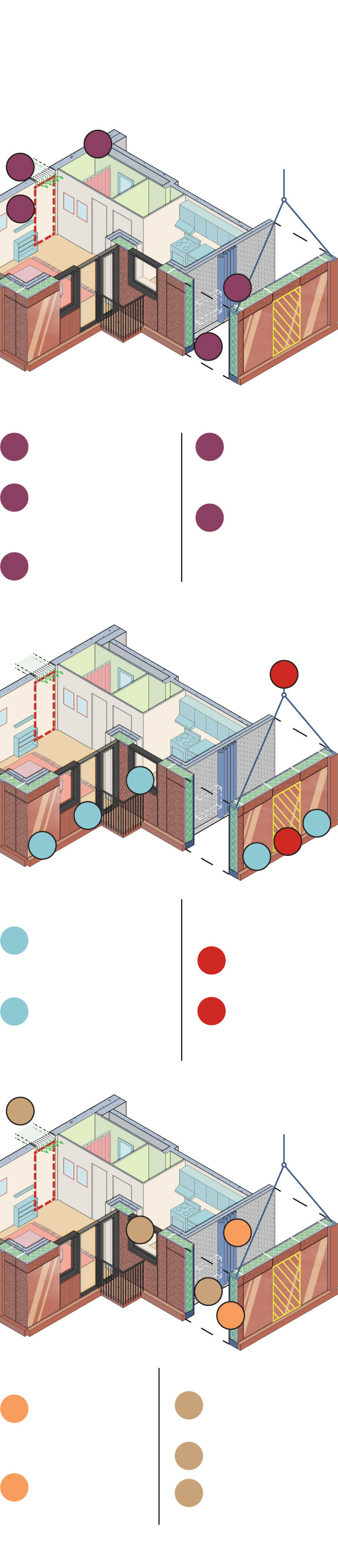
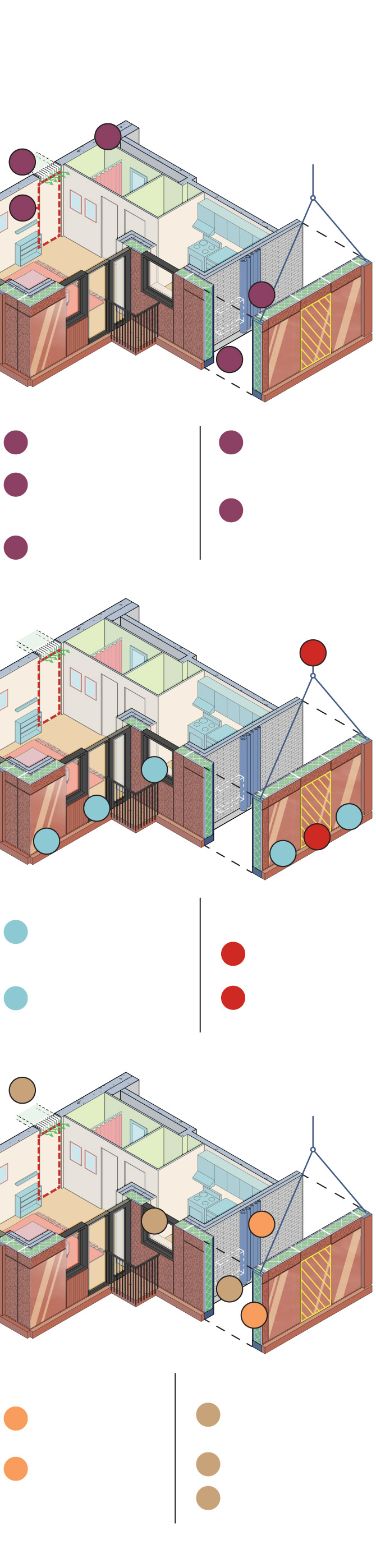
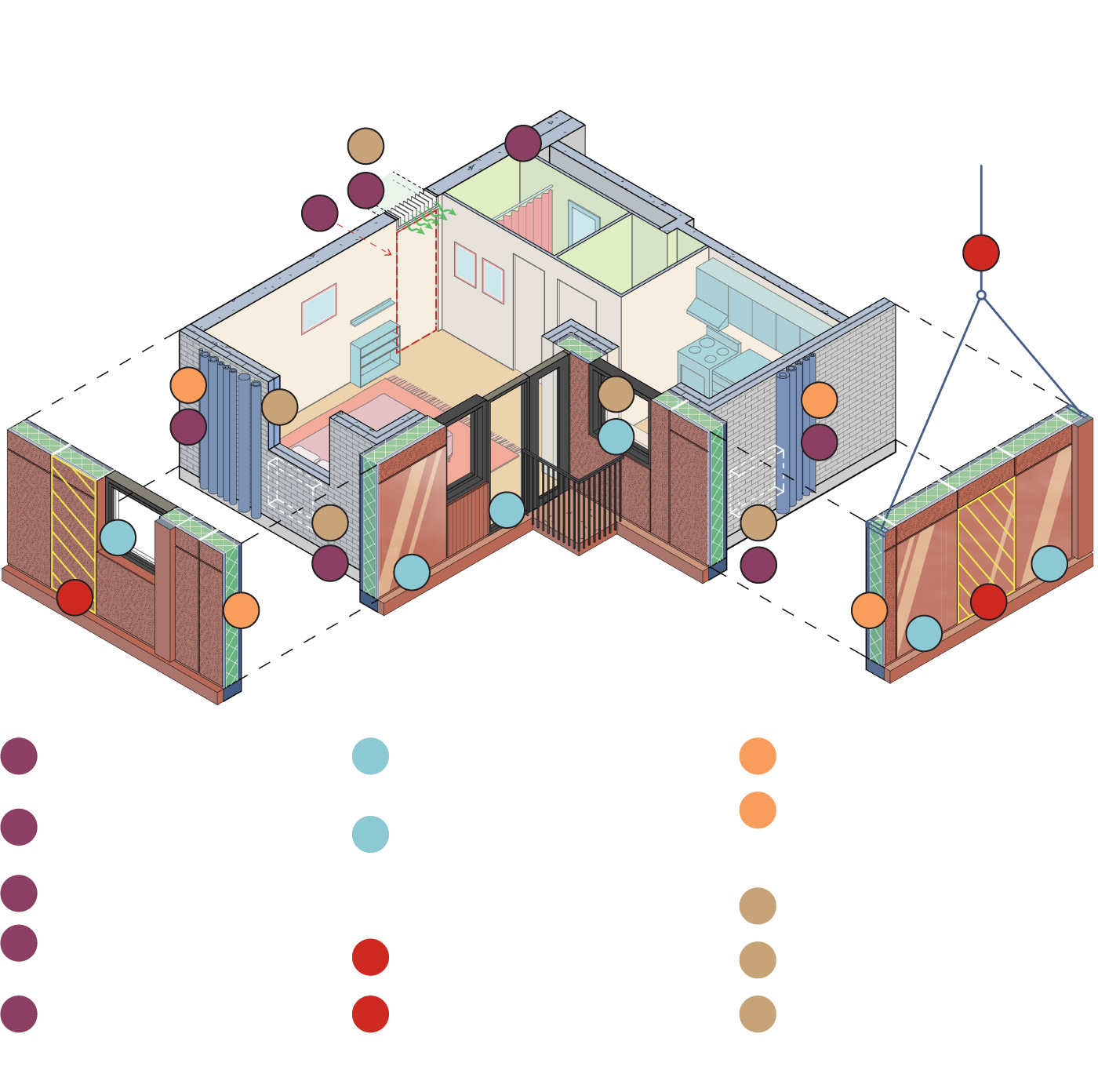
Case in point: a 170-unit WoodGreen tower in Toronto’s east end, at 444 Logan Ave.
Rebuilt to last
Diagram shows the elements and installation process for a retrofit of a 170-unit, affordable housing tower in Toronto’s east end, at 444 Logan Ave.
D
C
E
B
A
Systems
A
D
Energy recovery
ventilator (ERV) units
Suite exhaust
connected
to central HRV
B
Facade-integrated
mechanical and
electrical risers
E
Door seal
C
Direct fresh air
H
F
F
G
I
G
G
Envelope
Constructability
and maintenance
F
Window-
integrated
facade panel
H
Panel hoisted
into place
I
G
Removable
access panel
Photovoltaic-
integrated
facade panel
3
5
1
F
4
2
Interior work
Exterior work
Connect suite to
central fresh air
3
Install
mechanical
riser
1
Install ERV units
4
Install facade
panels
2
Remove interior
windows
5
SOURCE: ERA ARCHITECTS
Rebuilt to last
Diagram shows the elements and installation process for a retrofit of a 170-unit, affordable housing tower in Toronto’s east end, at 444 Logan Ave.
D
C
E
B
A
Systems
A
Energy recovery
ventilator (ERV) units
Suite exhaust
connected
to central HRV
D
Facade-integrated
mechanical and
electrical risers
B
Door seal
E
Direct fresh air
C
H
F
F
G
I
G
G
Constructability
and maintenance
Envelope
Window-integrated
facade panel
F
Panel hoisted
into place
H
Removable
access panel
Photovoltaic-integrated
facade panel
I
G
3
5
1
F
4
2
Exterior work
Interior work
Connect suite to
central fresh air
3
Install mechanical
riser
1
Install ERV units
4
Install facade
panels
2
Remove interior
windows
5
SOURCE: ERA ARCHITECTS
Rebuilt to last
Diagram shows the elements and installation process for a retrofit of a 170-unit, affordable housing tower in Toronto’s east end, at 444 Logan Ave.
D
3
C
E
H
1
5
1
5
B
F
B
F
4
4
F
A
G
A
G
I
I
2
2
G
Exterior work
Systems
Envelope
Install mechanical riser
A
Energy recovery
ventilator (ERV) units
Window-integrated
facade panel
1
F
Install facade panels
2
Facade-integrated mechanical
and electrical risers
B
Photovoltaic-integrated
facade panel
G
Interior work
Direct fresh air
C
Constructability and maintenance
Connect suite to central fresh air
3
Suite exhaust connected
to central HRV
D
Panel hoisted into place
H
Install ERV units
4
Remove interior windows
Removable access panel
Door seal
5
I
E
SOURCE: ERA ARCHITECTS
ERA recruited the Triumph Group, a Mississauga-based manufacturer of building components, to fabricate and install insulated panels with high-performance windows throughout the building to reduce heat loss. The panels, which have integrated solar cells, cover a network of new exterior pipes that distribute heat generated by electric boilers.

A rendering of the net-zero retrofitted building at 444 Logan Ave. in Toronto's east end.ERA Architects
The $25-million project, due to be completed next year, is designed to minimize tenant disruption and use Canadian suppliers. Half of the investment went toward the deep retrofit, and the rest went to routine maintenance. The result is a net-zero building, says Mr. Stewart.
Yet without access to the kind of subsidies available to non-profits, the managers of privately owned apartment buildings face a tougher path justifying stem-to-stern retrofits, even though many are now facing tough decisions about major renovations, says Daryl Chong, president and CEO of the Greater Toronto Apartment Association (GTAA).
About 84 per cent of GTA purpose-built apartment buildings are private, and more than three-quarters were constructed before 1980. “Our age and vintage is significantly older than commercial office and other condos,” he says. “So our starting point is different. The level of retrofits is significantly deeper, and the cost of doing so is significantly higher.”
While many owners have reclad buildings to fix aging façades, more far-reaching retrofits – such as unit-by-unit heat pumps or full electrification – remain financially and technically out of reach. “You’re trying to balance age, the logistics of fully occupied units and pretty tight income streams,” Mr. Chong says, referencing rent increase caps of 2.5 per cent. “It’s tough to make the numbers work.”
However, Ms. Sutic notes that capital spending is down across the real estate sector, and not just with sustainability projects. Still, she adds, “there’s plenty of low-hanging fruit. In Canada, there’s a number of buildings that have checked all the [retrofit] boxes. [But] when you look at the whole scope of the industry, there’s a lot that hasn’t been touched. So there’s still work to do, and there’s still work that makes financial sense.”
Do deep retrofits raise a property’s resale value?
The short answer is, it depends.
As a growing number of homeowners and landlords invest in energy retrofits, such as heat pumps or insulated cladding, many do so with a business case in mind: lower operating costs associated with energy savings, improved indoor air quality and, in the case of commercial buildings, the potential to boost rental income because these properties appeal to tenants with their own ESG goals.
Less clear is how such investments alter an asset’s appraised value and its resale prospects. As the Appraisal Institute of Canada points out, every structure is different, not just in terms of its infrastructure but also maintenance, tenant mix, location, etc.
Also, because many deep retrofit projects to date involve public-sector buildings, there are few examples involving commercial deals. A 2025 study published by Italian scholars in Buildings, an academic journal, looked at two comparable apartment buildings, in Italy and France. The researchers concluded they were “more attractive to potential buyers, who are willing to pay a premium of 13.5 per cent over properties in pre-retrofit conditions.” However, the sample is tiny, and constitutes more of a case study than a broader evaluation.
Editor’s note: This article has been updated to correct the name of Canada Green Building Council (CAGBC).