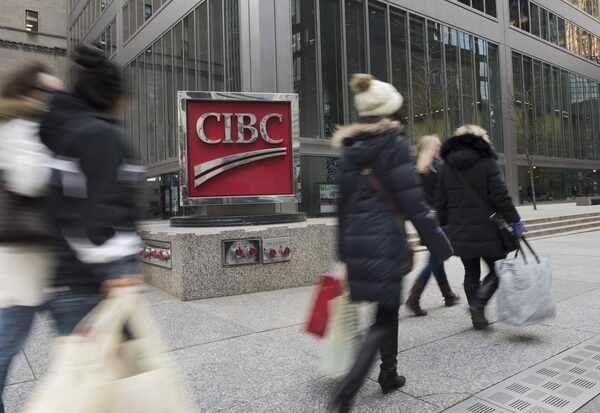
CIBC, headquartered in Toronto, saw profit from its U.S. commercial-banking and wealth-management unit soar 362 per cent.
Canadian Imperial Bank of Commerce outshone expectations to lead off reporting season for Canada's big banks, reinforcing an already rosy outlook for fiscal first-quarter results.
A robust economic climate and rising interest rates helped drive Canada's fifth-largest bank by assets to strong returns from all of its core businesses. And CIBC got an added shot in the arm as its strategy to push back into the U.S. banking market through its US$5-billion purchase of Chicago-based PrivateBancorp Inc. began to pay off.
As expected, growth in the bank's mortgage portfolio slowed as some prospective buyers find it harder to qualify for home loans under a new stress test mandated by Canada's banking regulator. But CIBC's retail banking arm still expanded its loans and deposits while shrinking its expected loan losses and keeping credit metrics stable, even as Canadians pile on more debt.
CIBC's profit dipped when compared with a year ago because of one-time items, but chief executive officer Victor Dodig noted on a Thursday conference call that CIBC "delivered strong results across all of our strategic business units." And that underlying strength in its core activities bodes well for the banking sector as its rivals report results over the next week.
"As the first bank reporting, we see strong read-throughs for the rest of the bank reporting season," said Scott Chan, an analyst at Canaccord Genuity Group Inc.
CIBC's profit for the quarter that ended Jan. 31 was $1.33-billion, or $2.95 a share, down 5.6 per cent from $1.41-billion, or $3.50 a share, a year earlier.
But when adjusted to exclude certain items – including a $299-million gain on the sale of real estate a year ago, and an $88-million writedown attributed to U.S. tax changes this year – CIBC said it earned $1.43-billion, or $3.18 a share.
Analysts polled by Bloomberg LP were expecting an adjusted profit of $2.83 a share.
Revenue rose to $4.5-billion, from $4.2-billion a year ago, and CIBC also hiked its quarterly dividend by 3 cents to $1.33 a share.
A dip in anticipated loan losses was a major factor lifting CIBC's profit, as the bank's provisions for credit losses – the money set aside to cover soured loans – fell 28 per cent from a year ago, to $153-million.
For the first time, banks are reporting quarterly results under a new accounting standard, known as IFRS 9, that will make expected loan losses more volatile over time. This quarter, the new accounting model helped lower CIBC's expected loan losses, but the bank also cited better economic conditions and lower writeoffs in its credit-card and personal-lending portfolios.
One cause for concern entering first-quarter reporting came from continuing uncertainty dogging the housing market. Bank executives had warned that they may issue 5 per cent to 10 per cent fewer new home loans as a result of tougher regulations applied to uninsured mortgages since Jan. 1, which was designed to cool rapidly rising housing prices in Canada's biggest cities.
CIBC draws added scrutiny because it has expanded its mortgage portfolio faster than its peers, partly because of changes in its sales force. In the first quarter, the bank's mortgage portfolio grew to $203-billion – 9-per-cent larger than a year ago, but an increase of only 1 per cent during the three months that ended Jan. 31. The bank originated $9-billion in new mortgages, down from $12-billion in the same period last year.
"The market is slowing, it's been slowing for a while. So you would expect to see mortgage growth moderate," said CIBC chief financial officer Kevin Glass, in an interview. "I think there'll be volatility – this is a slow quarter."
Yet Christina Kramer, the head of Canadian personal and small-business banking, said Thursday that it's still "too early" to tell what the impact of new mortgage rules will be. Profit of $656-million from personal and small-business banking in Canada fell 19 per cent from the first quarter a year ago. Yet once again, after adjusting for the same one-time items, profit of $658-million surged 17 per cent higher as special promotions helped CIBC boost its loans and deposits, even as they squeezed profit margins ever so slightly.
CIBC's efforts to diversify outside of Canada are also bearing fruit. Profit from the U.S. commercial-banking and wealth-management unit soared 362 per cent, to $134-million, thanks in large part to the acquisition of PrivateBancorp, which has since been rebranded CIBC Bank USA.
Prior to the deal, Mr. Dodig had often heard compalaints that CIBC was "too Canadian-focused." But the bank now has a target to nearly double the share of its profits coming from the United States to 17 per cent by 2020, and is expecting a boost from recent cuts to U.S. corporate taxes.
Capital-markets profit fell 7 per cent to $322-million, facing a tough comparison with the first frame of 2017, when a surge in activity and high volatility after the U.S. election produced a major spike in profit. But first-quarter trading was more lively than expected as activity among clients picked up, and group head Harry Culham described the results as "very strong."
In Canadian commercial banking and wealth management, rising revenue outpaced increases in costs, pushing profit up 14 per cent to $314-million, compared with the first quarter of 2017.