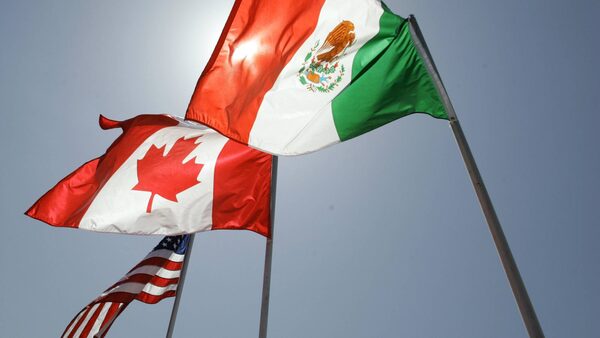
The flags of the United States, Canada and Mexico fly in the breeze at the Louis Armstrong International Airport in New Orleans, on April 21, 2008.Judi Bottoni/The Associated Press
As NAFTA negotiations enter the second round of talks this week, the duty-free threshold for e-commerce purchases could provide some negotiating leverage for Canada, some observers say.
It's not clear yet whether the duty-free or "de minimis" threshold will be on the agenda when talks on the North American free-trade agreement (NAFTA) resume on Friday, but in July, the United States revealed its desire for Canada and Mexico to increase their thresholds to $800 (U.S.), on par with the current American limit. Canadians are currently able to buy up to $20 worth online without paying duties. In Mexico, the limit is $300 for postal shipments and $50 for courier deliveries.
However, the Bank Of Nova Scotia put out a report last week that suggested that raising the threshold to $200, instead of $800, while eliminating any exemptions from sales taxes could be a happy medium for all parties.
For subscribers: Mexico warns Trump to back off of NAFTA withdrawal threat
Explainer: Could Trump really pull the U.S. out of NAFTA?
"This could provide a valuable bargaining chip in the NAFTA renegotiations, benefit Canadian consumers and businesses, and create a more level playing field between domestic and foreign retailers, without implying any major changes to Canadian government revenue," Scotiabank economist Adrienne Warren wrote in the report.
Online retailers such as eBay have lobbied the Canadian government for years to raise the threshold, suggesting it would benefit consumers and small businesses that import goods from the United States and have pointed to a C.D. Howe Institute report from last year that said the government spends $166-million collecting duties and taxes under the current threshold while only collecting $39-million in revenue. The report looked at the implications of raising the threshold to $80, $100 and $200 and ultimately concluded that raising the threshold would be "neutral or positive for Ottawa."
The Retail Council of Canada and the Canadian Federation of Independent Business have spoken out in the past against raising the de minimis threshold, saying it provides an unfair advantage to retailers outside of Canada.
Mexican Economy Minister Ildefonso Guajardo also told reporters earlier this month that raising Mexico's threshold to $800 "opens a completely unnecessary door" to imports of goods from outside NAFTA.
The Canadian government says it is open to discussing changes to Canada's duty-free rules as part of the NAFTA negotiations, but any decision will take into account the potential impact on Canadian businesses. Adam Austen, a spokesperson for Foreign Affairs Minister Chrystia Freeland, said in an e-mail on Monday that Canada will consider the impact on Canadian businesses in any discussions related to import duties.
"Broadly speaking, with respect to the de minimis threshold, our government recognizes that as a trading nation, it is important Canada be able to keep goods moving. While we're supportive of streamlining customs processing and import regulations, when it comes to waiving duties and taxes, it is important to consider the impact on Canadian businesses and families," he wrote. "As negotiations have only recently begun, and as Minister Freeland has stated, it is not beneficial to put all of our cards on the table at this time. We will continue to discuss this issue during the course of our ongoing consultations with Canadians."
Jayson Myers, an economist and the former president and chief executive officer of the Canadian Manufacturers and Exporters industry association, sees little negotiating opportunity with the de minimis issue.
"It's a very, very sensitive issue for the retail sector. The people that will be affected by this will be main street businesses like Canadian Tire or Home Hardware," Mr. Myers said. "For politicians to make a big issue about this, there would have to be a big consumer push for this. Just in terms of the strategy, I don't see how it would add value because the Canadian negotiators would have to spend negotiating capital to get there. "
Darrel Pearson, the co-head of international trade and investment law at Bennett Jones LLP, says the threshold could present an opportunity for Canada in the renegotiation talks, but not as much as one may think.
"It does give Canada a chance to trade this ask off of something else but I don't think it has that much weight, in the dollar sense," Mr. Pearson said. "The currency exchange rate has a much bigger impact than duties do when talking about cross border e-shopping. People are just generally moving from brick and mortar to e-shopping. It's a pretty hollow ask."
While it is an American demand, Mr. Myers questions whether raising the duty-free limit is high enough on their agenda for all parties to reach an agreement in time.
"It's a short negotiating timeline here and there are a lot of objectives. If the Americans really want a deal by the end of the year, it'll be hard to achieve all the objectives they have set out," he said.
With files from Bill Curry in Ottawa
International duties for express shipments:
Canada
$20 (Canadian); $16 (U.S.)
United States
$800 (U.S.)
Mexico
886 pesos, or 5,318 for courier/postal shipments; $50 or $300 (U.S.)
Sources: Scotiabank Economics, Global Express Association