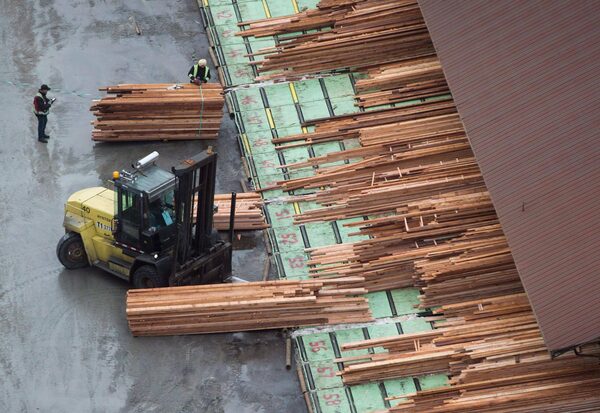
Workers sort and move lumber at the Delta Cedar Sawmill in Delta, B.C., on Jan. 6, 2017.DARRYL DYCK/The Globe and Mail
Canadian softwood producers face paying roughly $1.3-billion in U.S. duties in 2018 should the cross-border trade fight persist through the year, but strong lumber prices will take away some of the sting, the Conference Board of Canada says.
The forecast for tariffs is based on "current estimated export levels of softwood lumber and assuming no additional changes to the duty rate," the board said in an e-mailed statement on Tuesday.
Lumber prices have surged close to record highs as Canadian producers pass along most of the U.S. tariffs to buyers. After slight clerical revisions to reduce the tariffs, the final countervailing duty of 14.19 per cent and final anti-dumping duty of 6.04 per cent means a weighted average rate of 20.23 per cent levied against most Canadian lumber exporters.
Board economist Robert Meyer-Robinson notes that the total amount of duties paid in 2018 could change, depending on other factors. For instance, total duties might decrease if the growth in U.S. housing starts is weaker than expected, which would mean lower Canadian lumber shipments south of the border.
He issued a 15-page softwood report on Tuesday, cautioning that while high lumber prices recently hit levels near the records set in 2004, the commodity's rally could lose steam by 2019.
"The current high prices are already leading to a pickup in U.S. domestic production, and other countries are exporting more to the U.S. to fill the gap left by Canadian imports. Ultimately, this should keep future price growth more modest over the next couple of years," Mr. Meyer-Robinson said in the report.
The Department of Commerce in Washington decided earlier this year to penalize Canadian producers with preliminary tariffs, first with countervailing duties starting on April 28 for what the United States sees as subsidized Canadian lumber and then anti-dumping duties beginning on June 30 for what the Americans deem to be softwood sold below market value.
Michael Burt, the Conference Board's director of industrial trends, said Canadian producers benefited in 2017 from robust demand and weakened supply for softwood, despite having to pay what will amount to at least $500-million in U.S. duties this year.
"Lumber prices are at their highest levels in over a decade due to a perfect storm of factors, including supply constraints in B.C. from the wildfires this summer, and increased demand from a recovering U.S. housing market and rebuilding efforts in hurricane-affected regions," Mr. Burt said in a statement.
RBC Dominion Securities Inc. analyst Paul Quinn said new residential construction numbers for November show jumps in American housing starts and permits, especially in the key U.S. South market. "Housing starts in the U.S. South look to have regained some strength after the recent hurricanes," he said in a research note.
Mr. Quinn added in an e-mail that U.S. lumber duties paid by Canadian producers in 2018 could be roughly double the total amount of tariffs from this year.
The U.S. lumber industry targeted four mandatory respondents from Canada: Resolute Forest Products Inc. of Montreal and three B.C.-based producers – West Fraser Timber Co. Ltd., Canfor Corp. and Tolko Industries Ltd.
The Commerce Department reduced final tariffs slightly for West Fraser and Canfor, imposing a combined duty of 23.56 per cent against West Fraser and 20.52 per cent on Canfor. Tolko faces a final combined duty of 22.07 per cent, Resolute 17.90 per cent and voluntary respondent J.D. Irving Ltd. of New Brunswick 9.92 per cent.
Other Canadian producers will pay the weighted average of 20.23 per cent.
New anti-dumping rates kicked in on Nov. 8 while final countervailing rates are expected to take effect in late December or early January.
Canada has filed appeals under the Chapter 19 dispute resolution mechanism of the North American free-trade agreement and also through the World Trade Organization.
"Lumber tariffs on Canadian shipments of softwood lumber to the U.S. have resulted in a sharp decline in sawmill exports, which prior to the duties had been the key driver of the industry's strong export performance," according to the Conference Board's softwood report.