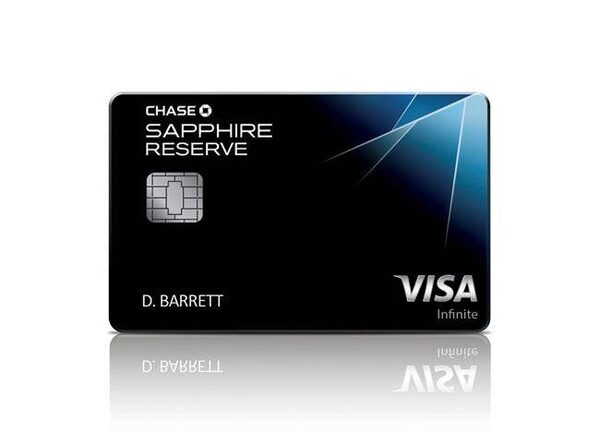
Chase’s Sapphire Reserve Card was introduced in August last year with a 100,000-point sign-up bonus, worth $1,500 using Chase’s rewards program, a $300 annual travel credit and no foreign-transaction fees, among other perks.The Associated Press
Shoppers with means who want a lot of high-end rewards on their credit cards have plenty of options – at least right now.
Since JPMorgan Chase & Co. launched the $450 (U.S.)-a-year Chase Sapphire Reserve Card a year ago, joining the market created by the American Express Platinum Card, companies such as U.S. Bancorp and UBS have jumped in with similar cards. Citigroup's Prestige card, which gives the unique benefit of a fourth night free at hotels, already existed.
The increased competition could help customers. Banks sometimes waive annual fees or offer additional points for certain types of spending in order to drive business. And analysts say the companies' desire to keep their cards distinctive may mean they offer more benefits. But whether enough people want to hold these cards may determine how sustainable the profusion is.
Chase's Sapphire Reserve Card was introduced in August last year with a 100,000-point sign-up bonus, worth $1,500 using Chase's rewards program, a $300 annual travel credit and no foreign-transaction fees, among other perks. Even with the huge fee, customers ate it up. Demand was so high that Chase temporarily ran out of the metal alloy used to make the card.
Banks had previously thought the market for luxury credit cards, while lucrative, would be small – roughly the top 10 per cent of U.S. households, and mainly older customers. And the number of people who would carry more than one would be even smaller.
But the demographics have changed. Younger consumers have been keen on the new generation of luxury cards – perhaps because, as analysts posit, they are willing to pay the large annual fee for access to experiences and travel that they prize more highly.
Some customers who now have both an Amex Platinum and Chase Sapphire Reserve are paying a combined $1,000 a year in fees for them. The argument among the passionate is that each provides different benefits. Amex's airport-lounge access is broader, while Chase offers more liberal ways of accumulating points.
The early adopters of the Chase Sapphire Reserve card will be deciding soon whether to renew and once again pay the $450 annual fee. While the card gets strong reviews from users, it's not clear whether that will be enough to assuage the sticker shock of the annual fee, analysts say.
And with more options, they also may want to give one of the newer cards a try for different benefits. Amex has tried to gear its Platinum Card toward a younger audience, recently rolling out a $200 a year credit on ride-hailing app Uber.
The generous benefits may also end up pressuring the companies pursuing those customers.
Industry analysts said they did not believe Chase's 100,000-point Sapphire promotion was sustainable, and the company did cut its sign-up bonus to 50,000 points roughly six months after the launch. Chase has said it was never meant to be permanent. But there have been other signs the card may be too generous. The Wall Street Journal reported this month that JPMorgan was looking to cut costs in the department.
"We will have to see how that plays out," said Sanjay Sakhrani, an analyst with KBW who covers the credit-card companies.
Running a luxury credit-card program is expensive. In order to pay for the points programs and sign-up bonuses, banks need customers to charge substantial sums to their cards in a year, often tens of thousands of dollars a year. Even if customers are carrying two cards now, their potential overall spending likely hasn't changed much.
But if the competition gets too fierce, or makes the cards too expensive to run, banks could cut back on things such as lounge access, or points redemption, as they have in the past. And fewer benefits may start a spiral of even fewer customers to keep the cards afloat.