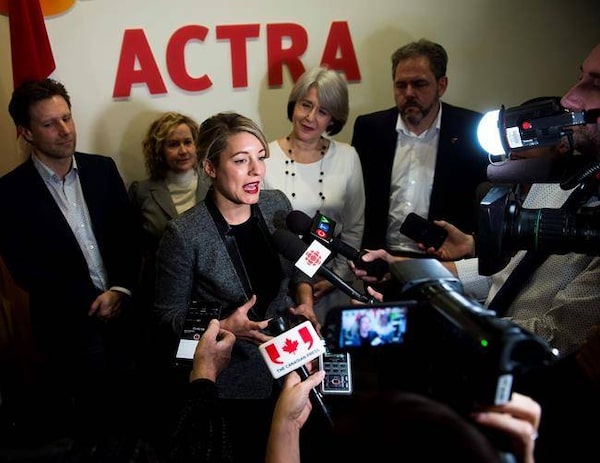
Heritage Minister Melanie Joly addresses the media after two meetings to discuss harassment in the film, TV and theatre worlds in Toronto on Wednesday, January 17, 2018.Nathan Denette/The Canadian Press
The Trudeau government is refusing to address calls for more transparency around deals some of Canada's biggest TV providers have struck to accept payments from RT – the Kremlin-controlled news channel described by U.S. intelligence authorities as part of Russia's "propaganda machine" – in order to guarantee distribution to Canadian viewers.
In December, The Globe and Mail reported that RT, formerly known as Russia Today, pays to be included in some TV packages, according to sources familiar with the agreements. RT's interest in paying for carriage is to secure the widest possible viewership for its news programs and shows, which frequently take an anti-Western stance. Russian President Vladimir Putin has said that RT's mission is to "break the monopoly of the Anglo-Saxon global information streams." RT comes bundled in some Canadian TV packages that exclude many other international news channels.
The Globe's reporting on RT's payment for carriage deals prompted the Conservative Party's foreign affairs critic, MP Erin O'Toole, and its heritage critic, MP Peter Van Loan, to call for action to require TV distributors to disclose such arrangements, involving payments to carry a foreign state-run news service such as RT.
"Certainly that's the kind of information I think Canadians and cable subscribers have a right to know," Mr. Van Loan said in a recent interview.
"Now that we know that this is taking place … how can we have a degree of transparency that I think Canadians would expect?" Mr. O'Toole told The Globe recently, suggesting that he and Mr. Van Loan would discuss raising the issue at the standing committee on Canadian heritage.
Simon Ross, press secretary for Heritage Minister Mélanie Joly, declined multiple requests for an interview on the subject, saying that regulating and supervising the Canadian broadcast system is the responsibility of the Canadian Radio-television and Telecommunications Commission.
While it is true the CRTC operates at arm's length from the government, the Heritage Minister's portfolio includes setting policy that affects how the regulator oversees the industry. Ms. Joly has chosen to use that power before. In August, for example, she referred a number of recent renewals of TV licences back to the CRTC, asking it to reconsider the spending requirements it set for original Canadian programs.
In an interview at the time, Ms. Joly characterized the move as a "strong message" to the regulator about her government's priorities for supporting Canadian content while allowing broadcasters to remain competitive. Ms. Joly is conducting a review of the Broadcasting Act and has said she is open to modifying the mandate of the CRTC.
The Heritage Minister has the authority under the Broadcasting Act to issue directions on policy to the CRTC.
"In view of the autonomy of the CRTC, concerns related to the programming broadcast by Russia Today or its carriage in Canada should be directed to the CRTC," a spokeswoman for Heritage, Natalie Huneault, said in an e-mail earlier this month. Mr. Ross also directed questions about the matter to the CRTC.
The CRTC declined requests for an interview on the subject, but in an e-mailed statement said it has no plans to respond to calls for more transparency around the deals with RT.
"Under the current approach to wholesale agreements, cable and satellite companies must file all affiliation agreements with the CRTC. The agreements are kept in strict confidence given their competitively sensitive nature," spokesman Eric Rancourt said in an e-mail. "The CRTC is satisfied that its approach is effective and maximizes the diversity of voices available to Canadians in the broadcasting system. We trust Canadians to use their discretion and have given them tools (i.e. pick and pay) to subscribe only to the services they want."
It is not unprecedented for channels to pay TV distributors to be included in subscription TV packages. However, it is rare: Usually, collecting subscriber fees from the distributors is an important part of a channel's revenue. For foreign channels distributed here, it is the only revenue, since their signals are not modified for beaming into Canada, and therefore they do not sell advertising in this market.
While Canadian channels must report financial information to the CRTC, foreign services such as RT are not required to disclose details about their broadcast agreements, nor are their Canadian distribution partners.
Partly as a result of its payment for carriage deals, RT is distributed to more than half of all TV subscribers in Canada, reaching six million to seven million homes, according to sources.
None of Canada's biggest TV providers responded to requests for comment on this story.
Representatives for BCE Inc. and Rogers Communications Inc. did not respond to questions about their deals to carry RT. Bell Fibe advertises RT on its website among the lists of channels that are included at no cost in its TV packages, with the exception of its least expensive option – including packages where international news channels such as CNN and BBC are left out unless subscribers pay more to add them. Rogers's "Premier" cable package lists RT as part of its bundle of channels, while other international channels such as Al Jazeera English, BBC World News, MSNBC and Fox News cost extra.
Previously, Videotron and Cogeco Inc. have said that they have never carried RT, and Shaw Communications Inc. said it recently stopped its practice of including the channel at no cost in some of its TV packages; however, it does still provide RT for subscribers to order à la carte. Telus's website does not list RT as included in its major TV packages, but would not respond to questions about whether it accepts payment to carry RT.