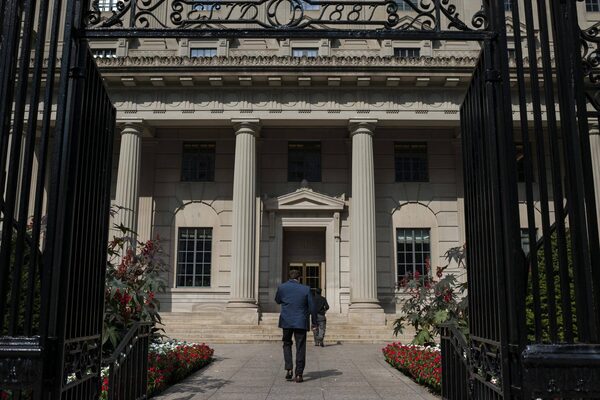
A man walks into Manulife Insurance headquarters in Toronto on Wednesday, Sept. 27, 2017.Christopher Katsarov/The Globe and Mail
Because interest rates remain so low and profits are subdued, Manulife Financial Corp. has been debating what to do with certain parts of John Hancock, its struggling American business. Rumours of a sale or spin-off of Manulife's struggling units, particularly those that pay annuities, have swirled for a while.
Adding fuel to the fire, Roy Gori, the insurer's new chief executive officer, has suggested Manulife has capital tied up in the United States that could be better used.
Yet for all that, there's been no news. If anything, the probability of action seems to be falling. A new sale of a rival U.S. life insurer might explain why.
On Monday, Talcott Resolution, a unit of Hartford Financial Services Group, announced its sale to a group of six institutional investors for $2.05-billion (U.S.). Talcott was created as a special division of the larger company after the global financial crisis, and the unit is stuffed with annuities that are troublesome in an era with astonishingly low interest rates. Returns to backstop these contracts are hard to generate, and Hartford spent many years figuring out what to do with the unit.
Although the company finally made a decision, it's paying a dear price to make the deal happen. Hartford said it will book a $3.2-billion after-tax loss on the sale. Talcott is responsible for more than $40-billion worth of variable-annuity contracts, and these tend to guarantee policy-holders a fixed-return or payment.
The good news: The sale suggests there could be buyers out there for similar types of contracts in Manulife's John Hancock unit. The rub: Manulife may have to sell them at a deep discount, or spin out the businesses that generate these annuities at bargain prices.
Talcott's buyers are paying roughly 0.4 times book value, or six times trailing core earnings, according to National Bank Financial analyst Gabriel Dechaine.
"Despite different accounting regimes, we do not believe these valuation levels are supportive of a similar spin-out or sale transaction by [Manulife] of its legacy U.S. assets," he wrote. "We believe the market has valued these at closer to 0.6 times to 0.7 times book value in scenario analysis exercises."
And because Hartford is absorbing such a large loss on the deal, its leverage ratio will jump. The same could happen at Manulife if John Hancock is sold at a deep discount, yet Mr. Dechaine said the insurer's current balance sheet leverage ratio of 29.5 per cent "does not offer as much flexibility to absorb a large loss on sale of its legacy business."
It could come down to just how badly Mr. Gori wants a clean slate. New CEOs tend to like wiping out problems they've inherited early in their tenures, and Mr. Gori hasn't sugar-coated the existing struggle. "We generate returns from those legacy businesses which are less than what we believe to be acceptable," he said in a Globe and Mail interview this summer. "Our shareholders are expecting a better return for our capital."
At the same time, he's got a lot on his plate. Mr. Gori has spoken candidly about the need to automate and simplify much of the insurer's business. "Anything you want to do today pretty much can be done with your mobile phone and with a few clicks of a button," he said. "Our industry has not evolved at all and has not embraced that transformation. If anything, we are as complex, or more complex, than we were 15 years ago."
Tackling this, while also building out Manulife's surging wealth and asset management groups in Asia, could be enough to keep him busy. Couple that with a soft market for the U.S. assets and a sale or spin-off may not be worth it.