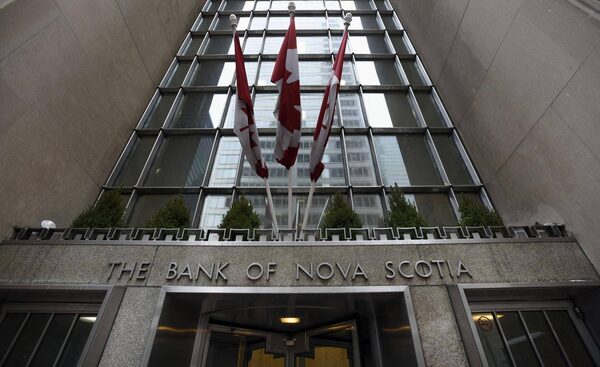
The King St. West entrance to the Bank of Nov Scotia building in Toronto pictured on Jan 12 2015.Fred Lum/The Globe and Mail
Lower provisions for credit losses, higher trading revenue and a big tax adjustment fuelled a surge in capital markets profit at Bank of Nova Scotia in the second quarter.
Net income in Scotiabank's global banking and markets division, which includes capital markets, rose 60 per cent year over year to $517-million for the quarter that ended April 30.
Money set aside for bad loans fell to $2-million, compared with $118-million in the same quarter last year, mainly due to improvements in the energy sector.
Read more: Scotiabank profit tops expectations on strong international performance
Trading revenue on a tax equivalent basis jumped 28 per cent to $518-million, compared with $404-million. The bulk of those gains came from a $337-million tax adjustment in equities trading. In an interview, chief financial officer Sean McGuckin said Scotia Capital Inc. was particularly active during the quarter, facilitating share buybacks for clients, which carry considerable tax benefits for the bank-owned dealer.
"We had a higher level of requests by clients to facilitate some of their share repurchases," he said. "These trades … drive a certain amount of tax-exempted dividend income that helps offset some trading losses that you may have on these transactions."
Trading in share buybacks for clients was so pronounced that it pushed the bank's overall effective tax rate in the quarter down to 13.9 per cent from 21.8 per cent year over year.
Elsewhere in capital markets, fees from underwriting and mergers and acquisitions (M&A) advice fell slightly year over year to $140-million, compared with $143-million. One of the bank's biggest investment-banking mandates during the quarter was co-leading a $575-million bought deal of shares in Enbridge Income Fund Holdings Inc. alongside BMO Nesbitt Burns Inc. and CIBC World Markets Inc.
Scotiabank's capital markets results stand somewhat in contrast to the other big four large bank dealers, which reported relatively lacklustre trading figures but stellar underwriting and advisory numbers.
Expenses at Scotiabank's capital markets arm were up slightly due to higher compensation, technology and regulatory costs.