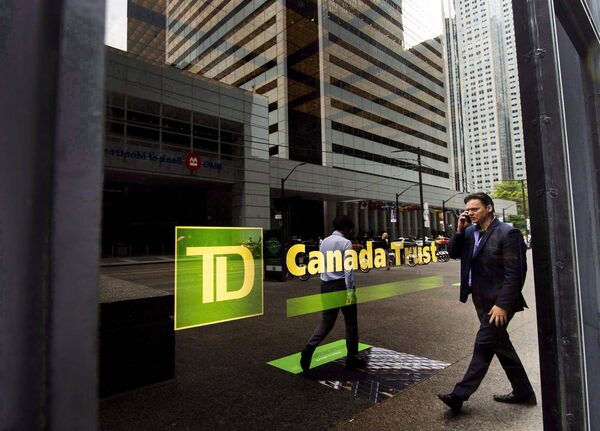
A TD Canada Trust branch is shown in Toronto’s financial district.Nathan Denette/The Canadian Press
Toronto-Dominion Bank expects to take a $400-million (U.S.) hit to its first-quarter profit due to changes to the U.S. tax code, but anticipates higher earnings in the long run.
The one-time writedown is anticipated as the bank adjusts its deferred tax assets and liabilities in the U.S., as well as the carrying balances of some investments, to reflect the new marginal corporate tax rate of 21 per cent, which was lowered from 35 per cent in a sweeping bill passed before Christmas by American legislators.
As a result, the bank expects its capital levels to dip slightly, with the adjustments lowering its common equity tier 1 (CET1) ratio by an estimated nine basis points. (100 basis points equal one percentage point). At the end of the fourth quarter, TD's CET1 ratio stood at a solid 10.7 per cent.
TD will report its first-quarter earnings on March 1, for the three-month period ending Jan. 31.
The impact on profit that TD has estimated appears similar to projections previously made by Bank of Montreal, which expects to write down its net deferred tax asset – an accounting measure tied to the timing between a bank booking a tax loss and realizing its benefit – by $400-million. With one-time writedowns out of the way, the tax reforms are expected to be a major positive for Canadian banks that do business in the U.S., but some other lenders have yet to release estimates.
"While the Tax Act will require a one-time charge to earnings in the first quarter of fiscal 2018, the lower corporate rate is expected to have a positive effect on TD's future earnings," the bank said in its statement.
A December research report by analysts at Citigroup Global Markets Inc. predicted that earnings per share at four of Canada's largest banks will rise by 1 to 3 per cent. TD's earnings per share are expected to increase by 2.3 per cent, according to the Citi report.
Other factors could dampen some of the lift in profits, including adjustments to the Base Erosion Anti-Abuse Tax (BEAT), which limits certain tax-deductible payments made to foreign affiliates.