Oil rout takes toll
Unemployment in Canada is going from bad to worse by the month.
Claims for jobless benefits are spiking in several provinces, as is the number of recipients.
While the total number receiving Employment Insurance benefits was little changed in January from a month earlier, seven of the provinces recorded a rise, Statistics Canada said today.
Among them, of course, where the commodity provinces of Alberta, Saskatchewan and Newfoundland and Labrador, but others, as well.
Year over year, the national number has now climbed by 7.1 per cent, or almost 36,000 people, primarily because of how the collapse in oil prices has shaken Alberta, the statistics agency said.
In Alberta, the number rose 2 per cent to almost 64,000. The number of recipients rose 2.4 per cent in Edmonton and 1.7 per cent in Calgary.
And here’s one ugly number from today’s report: The number of beneficiaries in Alberta is now up by 91 per cent from January of last year.
Claims for EI also remained flat on a national basis in January.
But again, that nation number masks the 3.7-per-cent rise in Alberta and the 4.1-per cent jump in Nova Scotia.
Other provinces are faring far better, of course: The number of recipients is down in Quebec and British Columbia, for example, while claims fell almost 4 per cent in Ontario on a monthly basis.
They slipped, too, in Saskatchewan and Newfoundland and Labrador, where the number of recipients is up.
Canada’s jobless rate has been climbing as the economy has soured.
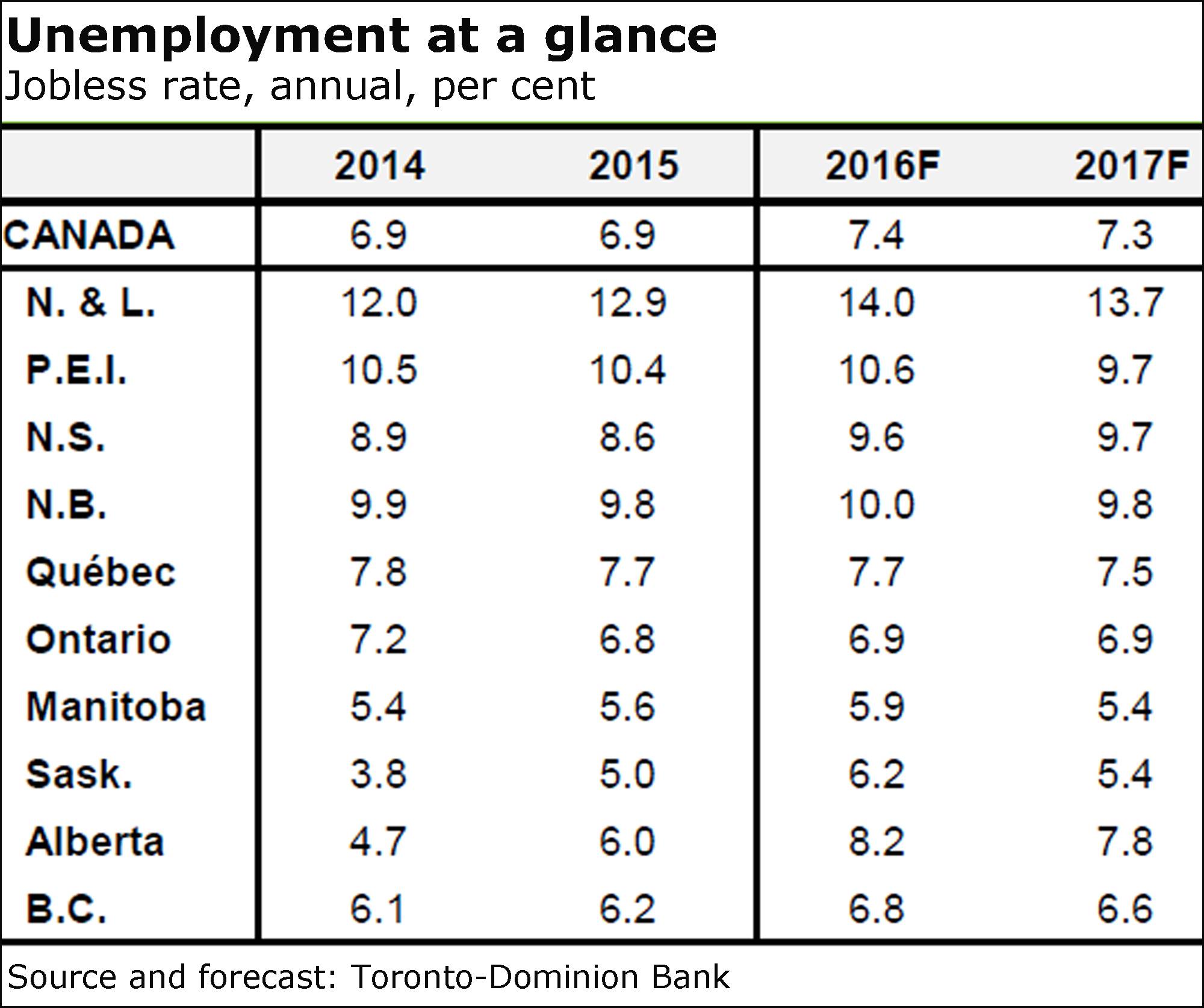
In the commodity provinces specifically, unemployment has surged and is forecast to rise higher still, as these projections from Toronto-Dominion Bank yesterday suggest.
“This year has already started on a soft note, with job losses in the first two months and an unemployment rate of 7.3 per cent, up from last year’s low of 6.6 per cent,” TD economists said in their report.
“The movements are capturing a sharp deterioration in the oil-producing provinces, as oil-consuming regions in B.C., central Canada and Atlantic Canada have recorded stable-to-slightly declining jobless rates.”
They noted the spike of 2.5 percentage points in Alberta’s jobless rate, driving it higher than the national average for the first time in about 30 years.
“Increased migration from the weaker to the stronger job markets within Canada should help stabilize provincial joblessness as the year unfolds, but the national rate has likely not yet topped out,” they said, forecasting it will hit 7.5 per cent by mid-2016 before inching down again.
What Greece must think of Canada's budget ...

“Just a few years of deficit?”
The next step
Before the Liberals embark on their fiscal journey, they have to kill off the short-lived balanced budget of the Conservatives.
There are the obvious reasons, of course, notably that it’s a thorn in the side of Prime Minister Justin Trudeau, who plans a string of deficits that are the result of an oil-shocked economy and his government’s stimulus plans.
“The balanced-budget legislation enacted under the previous government is inconsistent with the government’s plan to return to balanced budgets responsibly and in a manner that supports economic growth,” the government said in the budget unveiled Tuesday by Finance Minister Bill Morneau.
“An immediate return to balance in 2016-17 would require fiscal consolidation in the order of 1 per cent of nominal GDP.”
Thus, it will propose repealing the act.
There’s a lot in the Tory law that would kick in if it’s not killed.
Under the law, which has hardly seen the light of day, a finance minister would be hauled before a Commons committee to explain himself or herself and deliver a plan to get back in the black.
There are different scenarios, as well.
If there were a deficit because of a recession or “extraordinary situation,” no operating budget could be increased to fund pay hikes. Compensation for the prime minister, ministers and deputies would also be frozen.
Extraordinary could be a natural disaster or other surprise emergencies, or “an act of force or violence, war or threat of war, or other armed conflict.”
If there’s no recession or anything extraordinary, the prime minister gets a pay cut of 5 per cent. So do the others.
A recession, by the way, is defined as two or more straight quarters of negative economic growth. Which, by the way, doesn’t fit the definition of most observers these days.