Briefing highlights
- How tariffs could hurt U.S.
- Markets at a glance
- Toronto home prices rise
It's quite apparent that President Donald Trump blames Canada.
For his fat trade deficit. For the trouble on his farms. For the woes of his steel industry. Next thing you know, he'll claim there are termites in his imported softwood lumber.
And because we done him wrong, he's bragging on Twitter about how Canada won't escape his 25-per-cent tariffs on steel and 10-per-cent levies on aluminum until he gets a new, fair North American free-trade agreement.
"Although the headlines always seem to read about how the trade tensions are really about China, the reality is that the President, for whatever reason, has a bee in his bonnet about Canada," said David Rosenberg, chief economist at Gluskin Sheff + Associates.
"Maybe it's because nobody ever wanted to stay at his hotel on Bay and Adelaide."
I recall someone else blaming Canada, too, in a 1999 scene and song actually nominated for an Oscar.
So with apologies to Parker & Shaiman, who wrote that really catchy tune for South Park: Bigger, Longer & Uncut, here's a partlially recast version.
We reject allegations that we killed Kenny, as the late Robin Williams would have had you believe during the Academy Awards at the time. But when the promised tariffs go into effect, you'll have to blame someone when:
They won't obey their parents
They just want to fart and curse
They lost their jobs in Texas
And they're on the public purse
Blame Canada!
Blame Canada!
Mr. Rosenberg: "Let's examine the claim that 'protecting' industries that employ 400,000 people in a workforce of 130 million will not cause any damage. After all, nearly 7 million Americans work in industries that will be negatively affected by the tariffs. Well, the economic impact will actually take 10 to 20 basis points off annual real GDP growth. The job loss will range anywhere from 190,000 to 380,000 – as the gains in Ohio and Pennsylvania will be swamped by declines in the states most sensitive to the cost run-up in other segments of the industrial economy such as Indiana, Texas, Louisiana, South Carolina and Alabama … all states that Mr. Trump carried in the 2016 election."
Should we blame the matches?
Should we blame the fire?
'Cuz we have to pay more now
As tariffs push costs higher?
Heck, no!
Blame Canada!
Blame Canada!
Douglas Porter, chief economist, Bank of Montreal: "In isolation, the net effect of U.S. tariffs will likely be sharply higher domestic metals prices, and mostly hit the U.S. consumer; our initial estimate is that [inflation] will be bumped 0.2 percentage points by the tariffs … This arises at the very point at which markets had suddenly become much more attuned to inflation risks and equity volatility had taken a big step higher. With stocks already sagging again, the trade news was, shall we say, downright tariffying."
It seems that everything's gone wrong
Since Canada came along
Do we blame the government
Or the central bank?
'Cuz interest rates are rising
And our stocks are in the tank?
Blame Canada!
Blame Canada!
John Higgins, chief markets economist at Global Economics: "The U.S. economy is now close to full employment, so imposing tariffs on more imports would mainly drive up inflation rather than output. That in turn would necessitate even tighter monetary policy, increasing the risk of a recession down the line."
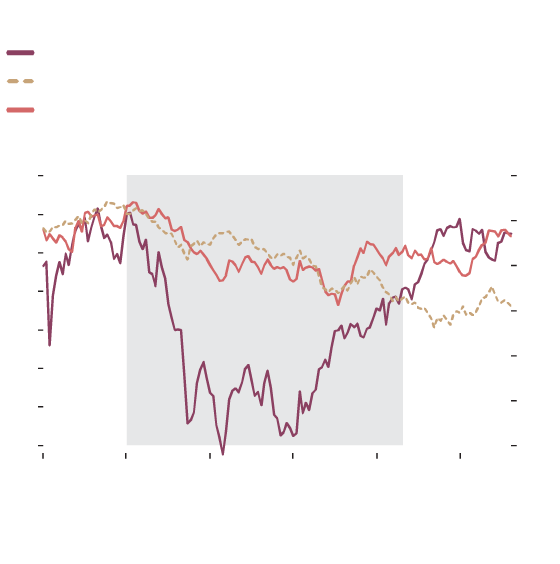
Daniel Hui and Maoko Ishikawa, JPMorgan Chase: "There are thankfully few historical episodes to benchmark currency performance amid U.S.-provoked trade wars, but from our limited sample size, general expectations are that the USD weakens against other reserve assets, and high beta and trade-sensitive currencies … The closest parallel to [last] week's trade announcements,was George W. Bush's five-year 8-30-per-cent gradiated tariffs on steel imports … [The chart below] presents performance of the trade-weighted dollar, the S&P, and [yields on 10-year U.S. treasuries] during, and in the six months before and after Bush's tariffs were imposed and then repealed, all of which declined notably immediately after the tariff announcement."
BUSH’S 2002 STEEL TARIFFS
S&P 500 index
USD index
U.S 10-year treasury yield (right scale)
USD index and S&P, tariff announcement = 100 (left scale)
105
6%
STEEL TARIFFS IN PLACE
100
5
95
4
90
3
85
2
80
1
75
70
0
Sept.
2001
March
2002
Sept
2002
March
2003
Sept.
2003
March
2004
SOURCE: JPMORGAN
BUSH’S 2002 STEEL TARIFFS
S&P 500 index
USD index
U.S 10-year treasury yield (right scale)
USD index and S&P, tariff announcement = 100 (left scale)
6%
105
STEEL TARIFFS IN PLACE
100
5
95
4
90
3
85
2
80
1
75
0
70
Sept.
2001
March
2002
Sept
2002
March
2003
Sept.
2003
March
2004
SOURCE: JPMORGAN
BUSH’S 2002 STEEL TARIFFS
S&P 500 index
USD index
U.S 10-year treasury yield (right scale)
USD index and S&P, tariff announcement = 100 (left scale)
6%
105
STEEL TARIFFS IN PLACE
100
5
95
4
90
3
85
2
80
1
75
0
70
Sept.
2001
March
2002
Sept.
2002
March
2003
Sept.
2003
March
2004
SOURCE: JPMORGAN
Don't blame me,
For my son Stan
He was the CFO
But he got canned
Blame Canada!
Blame Canada!
Goldman Sachs: "Downward pressure on margins is the first-order implication of tariffs. Some companies may be able to pass through higher input costs to customers while other firms will experience a margin squeeze leading to negative [earnings per share] revisions … Steel is the primary material used by automobile manufacturers Ford (F) and General Motors (GM). Based on 2017 production mix, if the proposed tariff of 25 per cent on imported steel translates into a similar magnitude of increase in steel prices, it would impact each firm by roughly $1-billion, representing 12 per cent and 7 per cent of their 2017 adjusted operating income, respectively. Machinery stocks would also face margin headwinds from higher input costs."
We need to form a full assault
It's Canada's fault
Retaliate they will, themselves
They'll treat us like it's 1812
Blame Canada!
Blame Canada!
Foreign Affairs Minister Chrystia Freeland: "We will always stand up for Canadian workers and Canadian businesses. Should restrictions be imposed on Canadian steel and aluminum products, Canada will take responsive measures to defend its trade interests and workers."
Bipan Rai, executive director of macro strategy, CIBC World Markets: "If implemented, it's unclear as to whether other countries can successfully challenge the steel and aluminium tariffs in [World Trade Organization] courts given that the Trump administration is using the national security loophole. Given that challenges can take months or years, these countries may not elect to wait until the WTO adjudicates to launch retaliatory tariffs. This would mark the next salvo in a trade war."
European Commission chief Jean-Claude Juncker: "So now we will also impose import tariffs. This is basically a stupid process, the fact that we have to do this. But we have to do it. We will now impose tariffs on motorcycles, Harley Davidson, on blue jeans, Levis, on Bourbon. We can also do stupid."
We must blame them and cause a fuss,
Before somebody thinks of blaming us
Trump's team is busy reading Pravda
When they should be fixing NAFTA
Blame Canada!
Blame Canada!
Gluskin's Mr. Rosenberg: "Now if NAFTA is abrogated (I see no reason why the amigos to the north and south would be keen on sustaining the talks which aren't going anywhere, in any event, after no fewer than seven rounds of discussions), the estimate I have seen from Moody's Analytics is 1.8 million jobs lost. That isn't Canada. That isn't Mexico. That is 1.8 million jobs lost in the United States. And if the White House is wrong on its gamble and there is global retaliation, a full global trade war would generate a decline in U.S. employment of nearly 4 million. So any of these two scenarios, with obvious nontrivial risks at this point, would create the conditions for an outright recession."
With all their hockey hullabaloo
They may be rich, but we are, too
If we get poor now, we oughta sue
Blame Canada!
Blame Canada!
CIBC's Mr. Rai: "The U.S. stands to lose given that national savings is below investment, and that savings is low because of the propensity to consume. The direct costs of increased tariffs are borne by consumers – especially those in the lower wage brackets. Additionally, increased tariffs lead to low growth and high inflation – hardly reasons to be long U.S. assets."
Read more
- Adrian Morrow: Trump waves threat of steel tariffs over NAFTA talks
- U.S. says time running short for NAFTA talks, floats bilateral deals
- Ian McGugan: In Trump’s tariff war, it’s the U.S. that will be in the crosshairs
- Campbell Clark: Big-dog trade talk could come back to bite the U.S.
- David Rosenberg: The amateurism at the White House is absolutely astonishing
- How a savage trade war could scorch Canada, loonie, stocks and more
- Adrian Morrow, Sean Silcoff: Canada waging full-court press against U.S. steel, aluminum tariffs
- David Shribman: Trump’s tariff gambit to face first political test in heart of steel country
- Campbell Clark: With tariffs, Trump aims at China but hits Canada
- Trump tweets: ‘Trade wars are good, and easy to win’
Markets at a glance
Read more
Toronto home prices rise
Average home prices in the Toronto region climbed more than 4 per cent last month as buyers began to absorb the impact of tougher new mortgage qualification rules introduced in January, The Globe and Mail's Janet McFarland reports.
Data from the Toronto Real Estate Board showed home prices rose 4.2 per cent in February compared to January to an average of $767,818, marking the strongest month-over-month price gain since September.
Despite the increases, average prices were down 12.4 per cent in February compared to the same month last year, when sales were booming prior to a price correction that began in May last year, TREB said.
Read more