Briefing highlights
- Aging parents cost kids big time
- Coach to buy Kate Spade
- Shorting of loonie at record levels
- What to watch for this week
- Home Capital bleeding deposits
$3,300
Direct annual expense of parent care
The easiest way to look at it is that Canada now has more parents and fewer kids, as a percentage of the population, and that the kids are paying big time.
Indeed, says a new study from Canadian Imperial Bank of Commerce, the cost is $33-billion a year in direct expenses and lost work and vacation time.
It’s not an equal burden, either, falling largely on the shoulders of lower-income earners and women, the research by CIBC economists Benjamin Tal and Royce Mendes finds.
And those costs are only going to mount, they said in the report released today.
“Combining those direct and indirect costs, we are talking about an estimated $33-billion annually, and that will only grow over time,” Mr. Tal and Mr. Mendes said in their study, based partly on a poll.
“In fact, in real dollars, we estimate that costs will mushroom by more than 20 per cent over the next 10 years due solely to the changing demographics,” they added.
“Add in the fact that costs associated with the elderly are already rising faster than the pace of inflation because of the high demand for such goods and services ... and you can see that this will be a major consideration for a number of Canadians.”
(Please don’t tell my kids that. I grew up listening to The Who singing My Generation and urging our parents to f-fade away.)
As this chart shows, the 65-and-up crowd is living longer and, thus, accounting for an ever-larger percentage of the population. And going forward, this will see “explosive growth” in that group, with both the percentage and pace of the rise picking up.
(Given that we’re talking about my g-g-g-generation, I can live with that.)
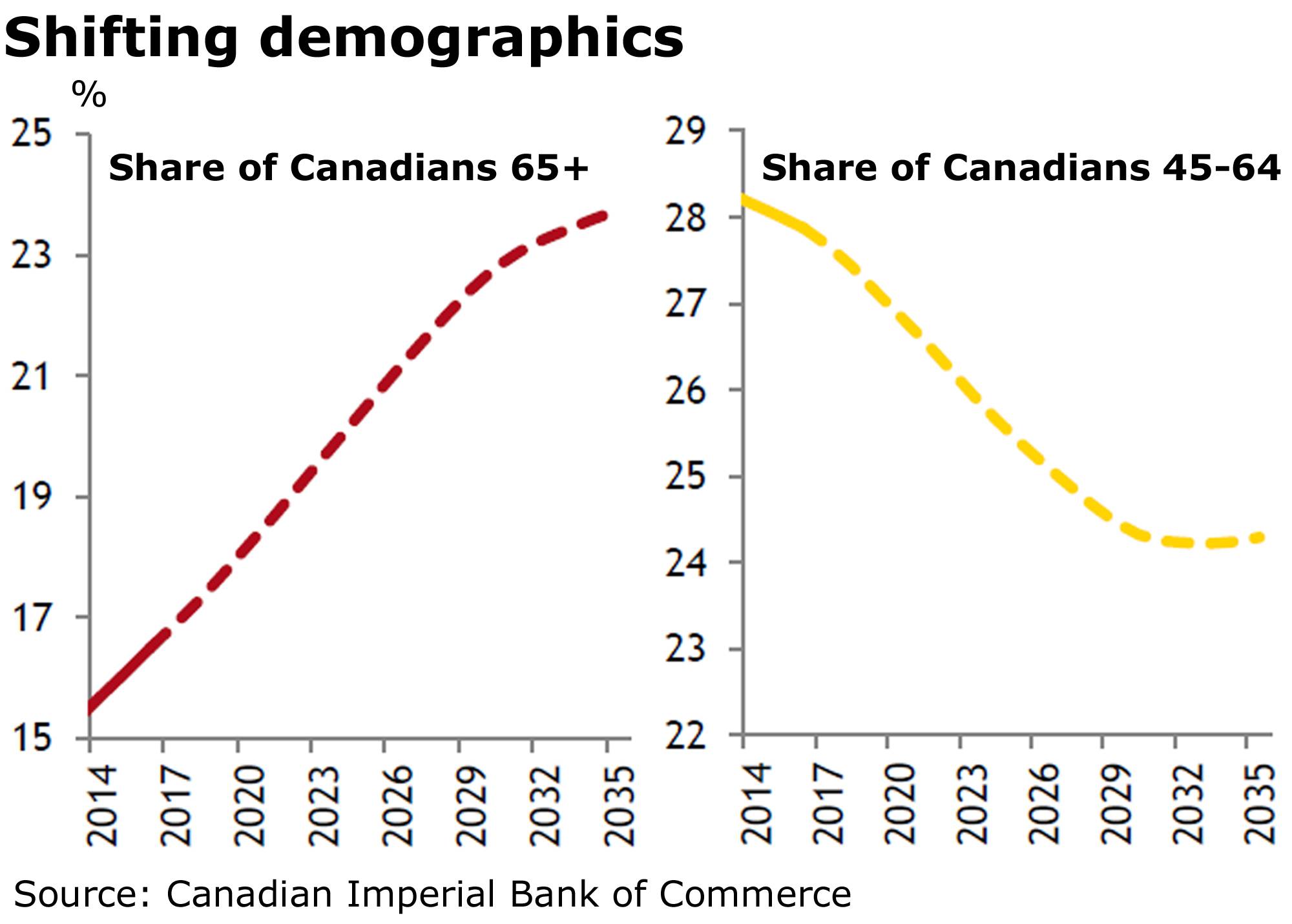
The economic Impact will be sweeping, said Mr. Tal and Mr. Mendes, noting that the number of caregivers will shrink alongside.
“Everything from interest rates to consumer preferences will see an impact,” the CIBC economists said.
“There will be a number of costs for these Canadians to bear, including both out-of-pocket expenses and loss of labour income due to time spent caring for aging parents,” they added.
(Oh, if only Dylan knew then what we know now about old roads rapidly agin’.)
About 14 per cent of Canadians whose parents are 65 and up, or almost 2 million people, pay direct annual costs averaging $3,300 to take care of their folks. That’s a hit of more than $6-billion, and probably a low-ball one at that.
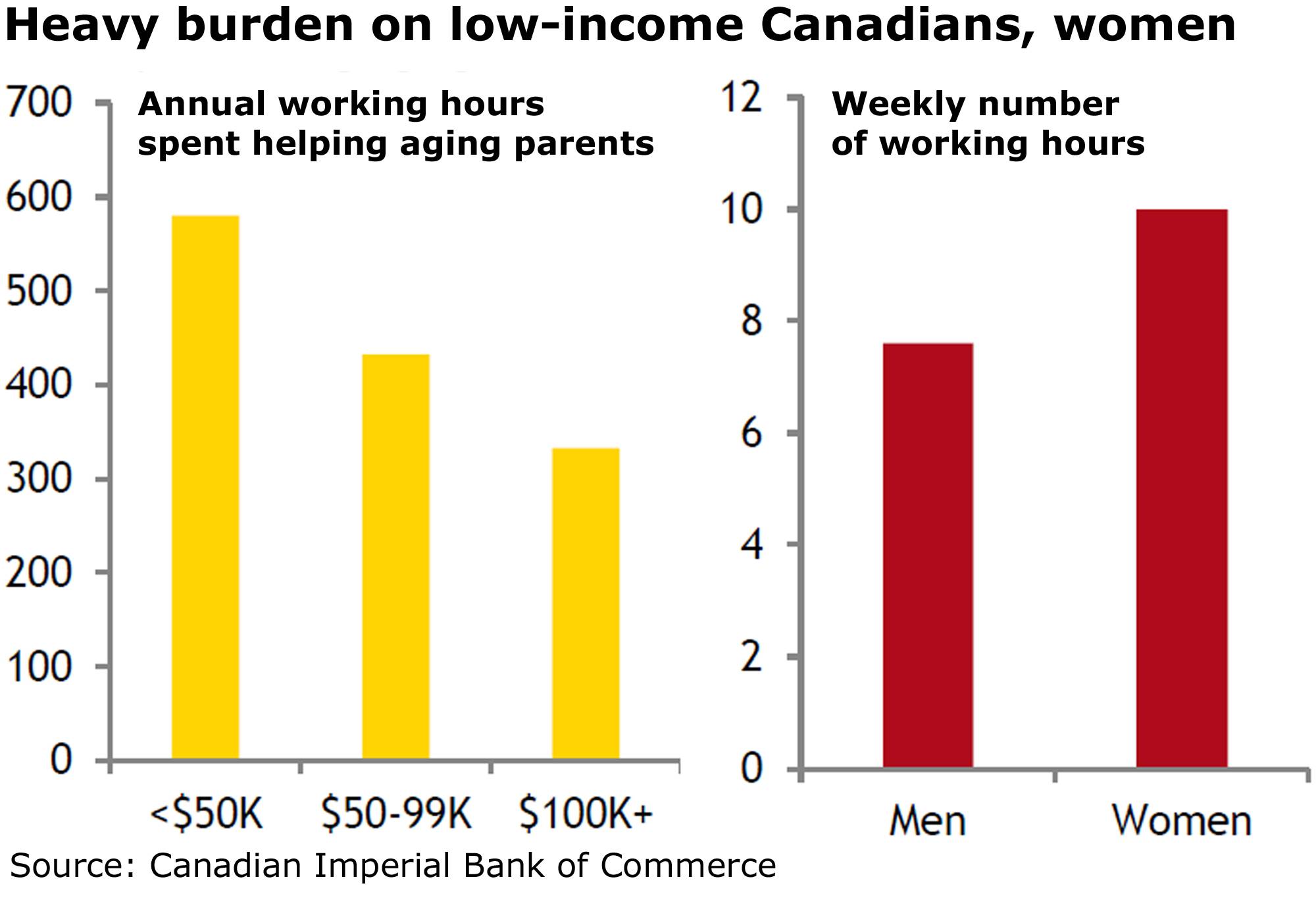
This falls disproportionately on people who earn less than $50,000 a year, and who spend an average 30 per cent more on such costs than those whose incomes top $100,000. There’s a regional element, too, with Ontario and Quebec below the national average.
Still, those expenses “pale in comparison” to the cost of taking time off work, said Mr. Tal and Mr. Mendes.
Almost 30 per cent of people with older parents have to take work time for caregiving, to the tune of about 450 hours annually.
“Given the average wage in Canada, that translates into roughly $27-billion of lost income or foregone vacation time,” the CIBC economists said.
(I don’t think Crosby, Stills, Nash & Young had basic math in mind when they sang about teaching children and parents well.)
“And, that doesn’t even take into account the reduced potential for job mobility or promotion that could be associated with taking that amount of time off from work,” said Mr. Tal and Mr. Mendes.
“Again, the likelihood of needing to take time off to care for a parent increases as you move down the income scale ... It’s worth noting that there is also a clear gender story here, with women taking 30 per cent more time off than men to care for aging parents.”
Coach to buy Kate Spade
Two big names in high-priced goods have struck a $2.4-billion (U.S.) deal to create what they say will be the first New York-based “house of modern luxury lifestyle brands.”
Coach Inc. announced plans to bid $18.50 a share cash for Kate Spade & Co., which it said marked a 27.5-per-cent pr