Briefing highlights
- Speculators line up against loonie
- Short positions climb, longs fall
- Canadian companies more upbeat
- What to watch for on trade numbers
- What to expect in jobs report
- SNC in tentative offer for WS Atkins
$2.1-billion
Net short position against the loonie: CFTC
Speculators are lining up against the Canadian dollar, betting big that the loonie’s going to fall.
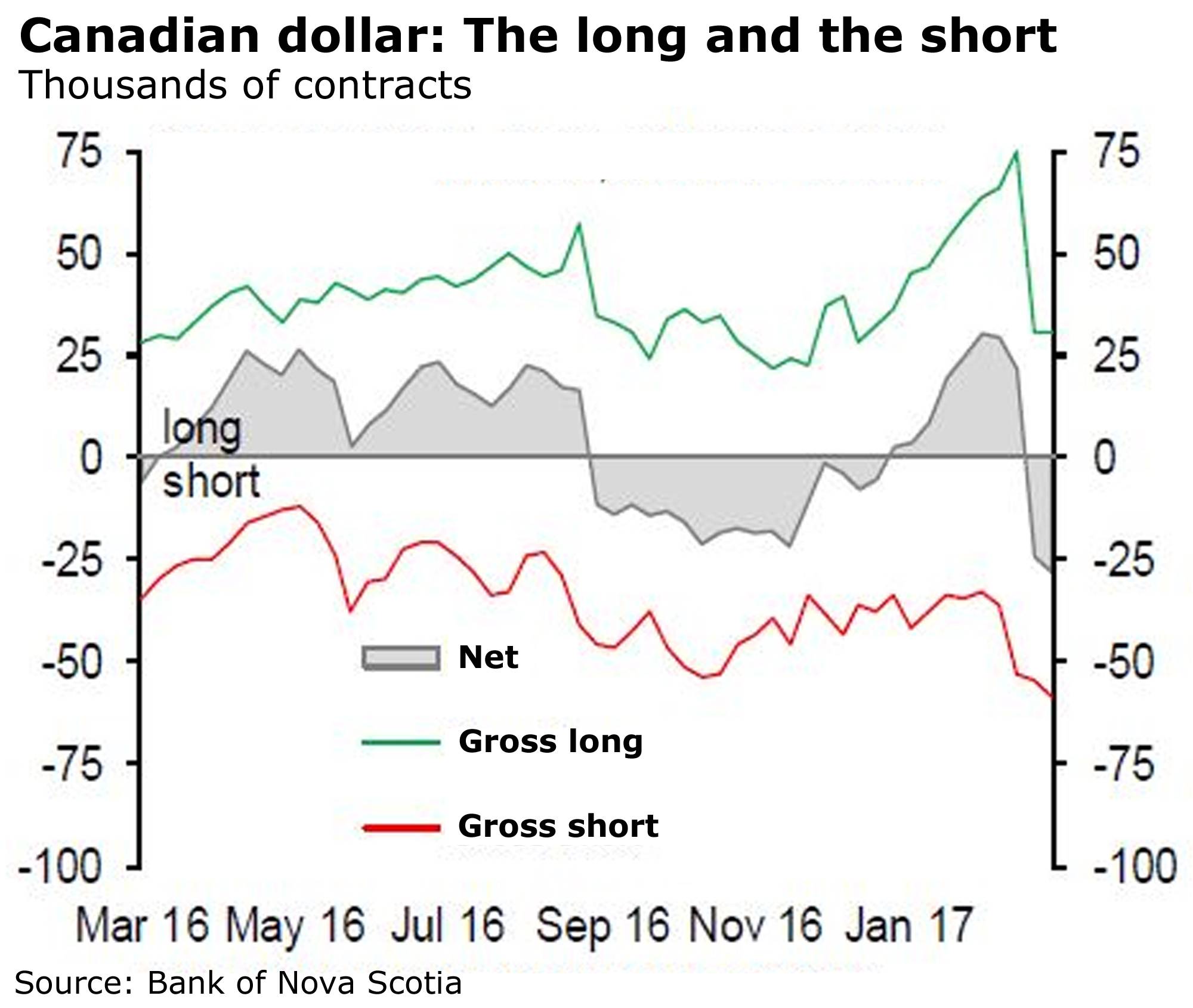
Short positions continue to rise as long positions decline, according to the latest report from the U.S. Commodity Futures Trading Commission, moves that could pressure the currency.
The weekly numbers, measured as of last Tuesday and released late Friday, show the net short position against the Canadian dollar at $2.1-billion (U.S.), fatter by almost $300-million.
In terms of the number of contracts, the net short now stands at 28,000, a rise of about 4,000.
Last week’s increase wasn’t particularly big. But it marked an ongoing bearish trend and, notably, followed the biggest one-week shift against the loonie on record, with bets moving markedly to a net short from a net long.
“CAD sentiment has deteriorated for a fourth consecutive week, pushing the net short position to $2.1-billion – its most bearish level since early March 2016,” Bank of Nova Scotia foreign exchange strategists Shaun Osborne and Eric Theoret said in a report, referring to the loonie by its symbol.
“The deterioration builds on the previous week’s record swing, and details hint to a broader turn with an impressive moderation in longs and a steady build in shorts.”
Speculative sentiment such as this can weigh on the loonie, which now sits at about the 75-cent mark.
Indeed, a previous study of four big shifts by Mr. Osborne and Mr. Theoret showed the currency eroding in each of the following two-week periods.
The loonie, which also tends to swing with oil prices, is already under pressure from the policy differences of the Canadian and U.S. central banks.
While the Bank of Canada isn’t expected to change its key rate until some point in 2018, the Federal Reserve is gradually raising its benchmark, all of which makes the loonie less attractive.
Mr. Theoret said later he believes this policy divergence to be the “core driver” of the shift.
Investors are weighing the Fed’s mid-March rate hike, and following “hawkish rhetoric,” against the “dovish/cautious” tone in the run-up to the Bank of Canada’s April 12 rate decision and an accompanying monetary policy report expected to include updated forecasts.
“The other piece, oil, is also likely another reason for renewed bearish sentiment/positioning in CAD as it had been one of the only pillars supporting it despite the widened yield spread,” Mr. Theoret said.
He added that he sees “fundamentally driven bears/shorts” in this chart, below, and that he’s “not sure what the bulls/longs were seeing but they’ve clearly bailed/capitulated.”
Having said all this, the Canadian dollar has held up well recently. And, for the record, April tends to be a strong month for the currency.
Several strategists expect the loonie to sink further this year. Though, given the uncertainties surrounding American trade policy and oil prices, there are varying forecasts.
The Bank of Canada, not to mention the country’s manufacturers, hopes a weak currency will help juice exports.
But it affects us in many other ways, too, and here’s just one recent example: We’re staying home, and others are joining us.
Recent numbers from Statistics Canada show that tourism spending, at $92-billion last year, now accounts for 4.5 per cent of gross domestic product, which National Bank noted is its strongest share of the economy since 2002.
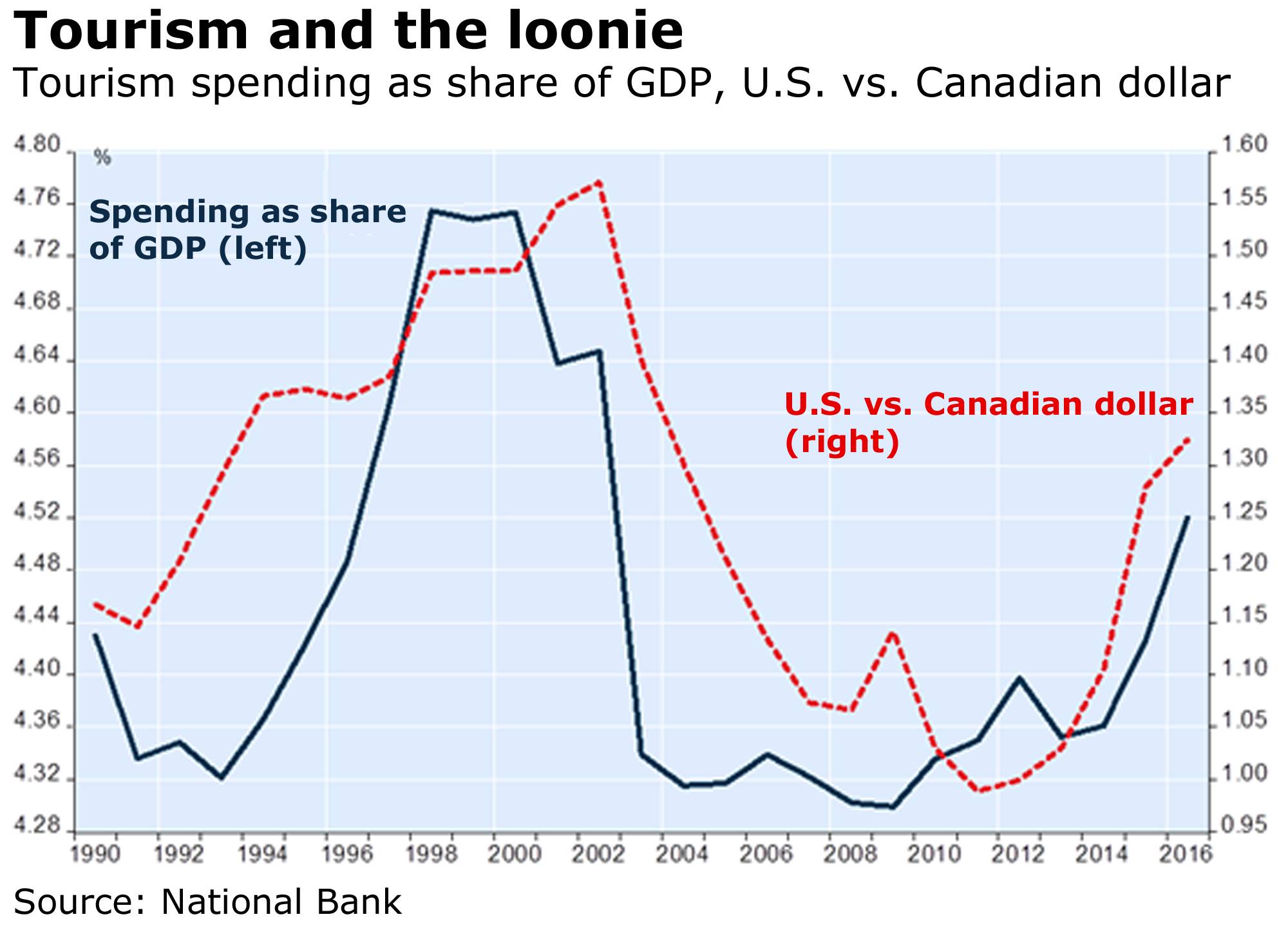
“Latest data from Statistics Canada show real tourism expenditures grew 4.2 per cent last year, the biggest annual increase since 2000,” said National Bank senior economist Krishen Rangasamy.
“Spending growth was driven by international visitors (+9.7 per cent was the biggest annual jump since 1998), although Canadians also contributed,” he added.
“The weaker Canadian dollar no doubt contributed to the increase in tourism spending by making it cheaper for foreigners to come to Canada while encouraging Canadians to spend their vacation dollars at home.”
Firms more upbeat
Canadian businesses are feeling more bullish about future sales and investing, but their mood is tempered by persistent worries about U.S. protectionism and tax reform, The Globe and Mail’s Barrie McKenna reports.
There are “signs of a further strengthening of demand” after two years of stagnation, according to the Bank of Canada’s quarterly business outlook survey.
Executives surveyed by the central bank say they are more optimistic about future sales, exports, investing and hiring.
It all points to what the bank characterized as a “modest recovery in business sentiment.”
What to watch for this week
There’s not much on the corporate side, in terms of earnings, but there is a fair bit to watch for over the next few days that will paint the backdrop for the Bank of Canada’s April 12 rate decision.
We've already got the central bank's quarterly business outlook survey. And Tuesday brings a reading right up Bank of Canada Governor Stephen Poloz’s alley, the monthly measure of trade.
Economists expect Statistics Canada to report that our trade surplus narrowed slightly to about $700-million (Canadian) in February. But note, it’s still expected to be a surplus.
“The Canadian dollar averaged its strongest level since June 2015 in the month, suggesting some softness in exports and a mixed picture for imports,” said Bank of Montreal senior economist Benjamin Reitzes.
“Our call would mark the fourth straight monthly surplus, which would be the best streak since oil prices collapsed in 2014.”
The U.S. trade report will also be released Tuesday, and Mr. Trump, for one, will be watching closely. Particularly because it comes two days before he meets at Mar-a-Lago with Chinese President Xi Jinping, whose government the U.S. believes needs a lesson in fair trade.
Tuesday also brings a decision from Australia’s central bank, which is always worth watching among Canadians because of the country’s resource base and its commodities-linked currency. The Reserve Bank of Australia is expected to hold the line.
On Wednesday afternoon, the Fed releases the minutes from its mid-March meeting, which, of course, will add to speculation over how many times the U.S. central bank is likely to raise rates this year.
“The minutes will be eyed for indications that the Fed is planning to increase the pace of tightening,” said BMO senior economist Sal Guatieri.
“While the median policy maker looks for two additional rate hikes this year, several members are pushing for more.”
Statistics Canada caps the week with its monthly look at the jobs market.
You never know what this monthly report is going to show. But economists expect to see that Canada gained more jobs last month, anywhere from about 3,000 to 11,000, and that unemployment either held at 6.6 per cent or inched up to 6.7.
“After last month’s surge in full-time employment, we could see the composition of jobs cut the other way in March – a negative for overall job quality,” said Nick Exarhos of CIBC.
“Still, on an annual basis, hours worked should start to converge with the healthier pace seen in overall employment,” he added.
“A healthier pace in hours will give greater confidence to the Bank of Canada that the economy is more firmly on its way in recovering from the oil shock.”
The U.S. jobs report will be released at the same time. Expect some tweets from Mr. Trump if it’s a good one.
Want to interact with other informed Canadians and Globe journalists? Join our exclusive Globe and Mail subscribers Facebook group