Loonie climbs
The Canadian dollar powered through the 78-cent mark today, buoyed by higher crude prices among new talk of a deal between two big oil producers.
The loonie traded in a range of 77.4 cents U.S. and 78.4 cents, the latter well up from yesterday’s close at 77.5 cents.
The currency had been gaining on a weaker U.S. dollar, but then shot up further as oil prices climbed on an Interfax report that Saudi Arabia and Russia reached an agreement on freezing output levels heading into a key weekend meeting among producers.
Analysts aren’t quite sure about the credibility of a deal, or what that meeting might bring. But for now, prices are up.
“This week was always likely to see market positioning in advance of the meeting, which has driven substantial gains across the energy sector,” said IG market analyst Joshua Mahony.
“However, given that many of the world producers are pumping less than they did in January, a freeze could even increase the amount of crude being produced.”
Things seem to be going right for the loonie these days, with more stable commodity prices, a stronger outlook for the Canadian economy and lower expectations for how fast U.S. interest rates will rise, said Shaun Osborne, Bank of Nova Scotia’s chief foreign exchange strategist.
Indeed, he said, the loonie could rise to somewhere in the 80- to 83-cent range in the next few months.
Also at play will be tomorrow’s rate decision and monetary policy report from the Bank of Canada.
The central bank isn’t expected to change its benchmark rate from the current 0.5 per cent, but observers believe it will signal the economy is performing better than it had forecast.
Royal Bank of Canada strategist Adam Cole said the loonie could near the 79-mark tomorrow, depending on the comments from Bank of Canada Governor Stephen Poloz and his colleagues.
“The Canadian dollar is surfing on the upswing,” said London Capital Group market analyst Ipek Ozkardeskaya, noting the move in oil prices.
“The Bank of Canada meeting this week could hint at a better economic recovery given that the latest growth figures were, although not sufficiently brilliant, enough to keep a balanced tone, whereas the [Federal Reserve] appears to be stuck with one, if feasible, rate hike in 2016,” she added.
Canada’s economy has certainly been on the upswing of late, from recent readings of gross domestic product to last Friday’s jobs report, and the central bank is expected to flag this with its rate decision and monetary policy report.
“Canada’s economy was battered and bruised in 2015, but already it seems to be exiting its slump briskly,” said Emanuella Enenajor, the North America economist at Bank of America Merrill Lynch.
“As a result, we believe the Bank of Canada will likely have to revise up its growth forecasts in the April monetary policy report (MPR), with Q1 GDP growth set to be raised from 1 per cent to roughly 3.5 per cent.”
New highs
Canada has hit fresh records in oil trade with the United States, now accounting for four of every 10 barrels imported into America.
While imported oil has generally been on the decline since peaking in the mid-2000s, imports from Canada hit a record 3.2 million barrels a day of gross exports to the U.S. last year, according to the U.S. Energy Information Administration.
That marked a 10-per-cent increase from a year earlier, the EIA said today.
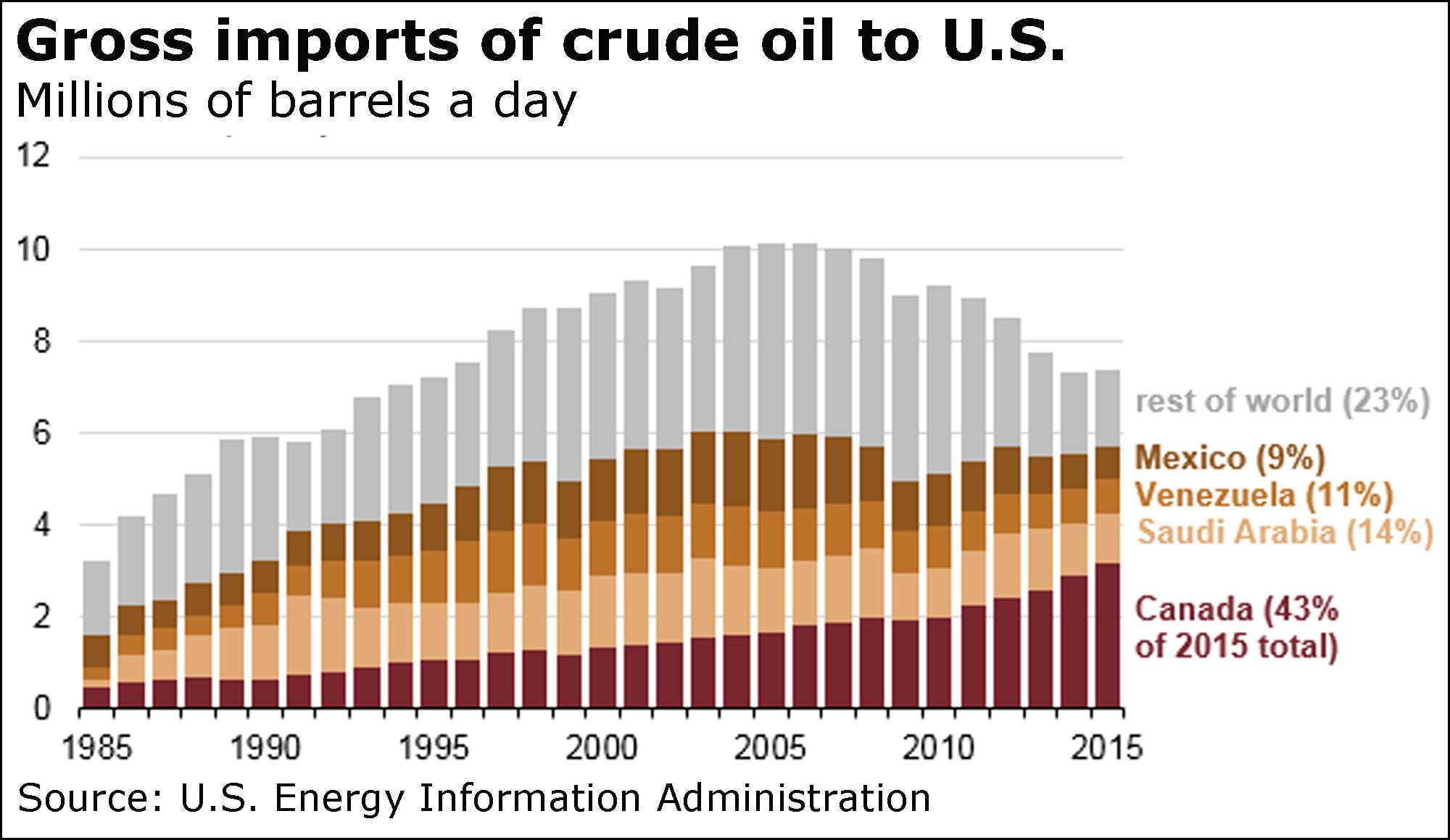
Not only that, Canada’s share of the total pie rose to 43 per cent.
Canada, meanwhile, took in 92 per cent of America’s 458,000 barrels a day of exported crude.
“Canada generally produces heavy, sour crude oil that is well matched to processing capacity in the United States, where many refineries have the equipment needed to process such oil,” the EIA said.
“Canada has few alternative outlets for the heavy crude produced in Alberta, where most of Canada’s proved oil reserves are located,” it added.
“Canada is expected to continue to provide a large share of U.S. oil imports for the foreseeable future, especially given the expansion of pipeline and rail shipping capacities to transport Canadian oil.”