Briefing highlights
- ‘Too much car’ as luxury sales soar
- Fed puts a bounce into markets
‘Too much car’
An increasing number of Canadians are buying “too much car,” based on the surge in sales of luxury autos.
BMO Nesbitt Burns senior economist Alex Koustas took a “deeper dive” into the strong Canadian autos sales data over the past few years, finding telling numbers for vehicles with a manufacturer’s suggested retail price, or MSRP, of at least $90,000.
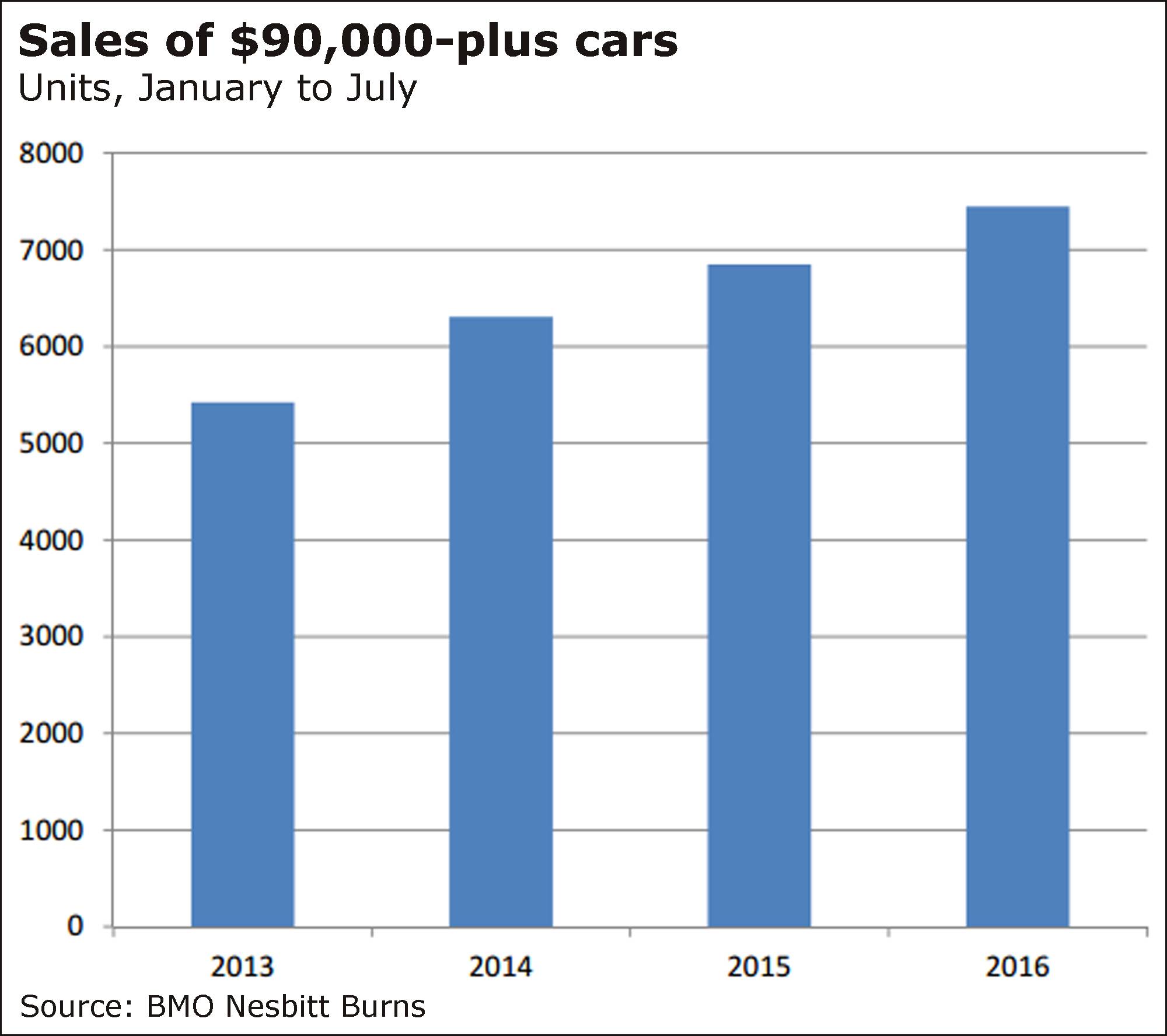
“Sales of vehicles with a base MRSP of $90,000 or more (not including taxes, fees, delivery charges) have increased an eye-watering 37 per cent since 2013,” Mr. Koustas found.
That may actually be underestimating the phenomenon because the numbers aren’t “granular enough” to gauge base models that are pushed above the $90,000 mark by upper trim levels, or special stuff.
“If we were able to do that, chances are the numbers would be even more inflated,” Mr. Koustas said.
“A good example is a BMW M5, which retails for $103,000, whereas the base model starts at $60,000,” he added.
Mr. Koustas found that the “upper-upper-crust” now accounts for 1 per cent of the market.
“Anecdotal evidence suggests that an inflow of foreign money is fuelling the sales growth, but we’ve long argued that a growing share of Canadians are buying ‘too much car,’” he said.
“Neither case is an ideal scenario.”
(I’d liken it to buying ‘too much house’ in Vancouver or Toronto.)
“Depending on the source, the responsible price-to-income ratio for a car can range from 20 per cent to 30 per cent,” Mr. Koustas said.
“That means that even a good set of the top 1 per cent of the Canadian income bracket would be stretching themselves to buy a car at $90,000-plus (you would have to make at least $300,000 if you used for the upper bound of the affordability ratio),” he added.
“Of course, this would only get you the base model.”