Briefing highlights
- Rosenberg slams Bay Street economists
- The U.S. dollar’s hurtin’ song
- RBC sees U.S. tax hit
- Markets at a glance
- Blackstone to buy Pure Industrial
- Canadian housing starts slow
- TD acquires AI startup
Economist David Rosenberg is criticizing his Bay Street counterparts and market players over what he considers "wild overreaction" to, and unabashed cheerleading for, Canadian economic numbers.
"Once again, the Bay Street economics community, the money market and the Canadian dollar are in wild overreaction mode," the chief economist at Gluskin Sheff + Associates said Monday.
"I rarely have seen such lopsided and hyperbolic responses to a piece of economic data before as much as the December employment report," he added in a report.
"I wouldn't even call what I've read analysis as much as one part reporting and one part cheerleading. Let's hope there's a bit more of a deep dive into the data going on at the Bank of Canada before any decisions are made on Jan. 17."
Mr. Rosenberg was referring to three things: Statistics Canada's exceptionally strong jobs report Friday, the spike in the loonie that followed it, and the central bank's rate decision next week.
The federal statistics agency said Canada's economy churned out 78,600 new jobs last month, a number that far surpassed the projections of economists, with unemployment falling to just 5.7 per cent, the lowest in decades.
That sent the Canadian dollar up to almost 81 cents (U.S.) as markets bet that Bank of Canada governor Stephen Poloz, senior deputy governor Carolyn Wilkins and their colleagues will raise their key overnight rate next week by one-quarter of a percentage point.
The report capped a year of strong job gains, and several observers suggested the Bank of Canada likely will raise its benchmark rate from 1 per cent, where it sits after two increases and then a pause in 2017.
Several analysts hailed the jobs report, though Avery Shenfeld, for one, the chief economist at CIBC World Markets, had this to say: If the November-December employment surge was real, it should mean that businesses were confident about what lies ahead."
Mr. Rosenberg also questioned the numbers the day they were released.
To put his comments in context, you've got to recall a few things:
Canada's economy chalked up a hefty expansion in the first half of 2017, then simmered down. Economists believe the final numbers will show economic growth of about 3 per cent, the best showing among Group of Seven countries.
Economists expect slower economic growth this year, of just above 2 per cent.
Home Capital Group Inc., an alternative mortgage lender, fell into deep trouble in 2017, raising concerns over Canada's hot housing market and bringing the loonie down with it.
The Bank of Canada had been on hold for some time in the wake of the oil shock, keeping a lid on the overnight rate when some economists were suggesting it should move higher.
Which it did. Twice. Then the pause amid some uncertainties, including the Trump administration's agenda, which calls for an overhaul of the North American free-trade agreement. And negotiations on that front are faltering.
Welcome to 2018, a year economists believe could see the Bank of Canada raise rates up to three times, though some observers think it will be less forceful.
Here's how Mr. Rosenberg viewed that timeline:
"So last spring, we had the Home Capital debacle with the downbeat mantra and the markets taking the loonie down for the count and [betting on a rate cut]. Just a tad prematurely as was the recession talk at the time. Next thing you know, a moribund Canadian economy suddenly does a transition to the fastest growth area in the industrialized world."
At that point, economists are "just gushing," and the central bank follows with two rate hikes as "so much of the economic rebound was merely the statistical rubber-band effect of the energy sector no longer imploding."
Then, in late summer, the central bank "inadvertently" signalled a potential third rate hike but "quickly backtracked" in citing uncertainties from NAFTA to household debt. The central bank is indeed monitoring the impact of the earlier rate increases in debt-strapped consumers.
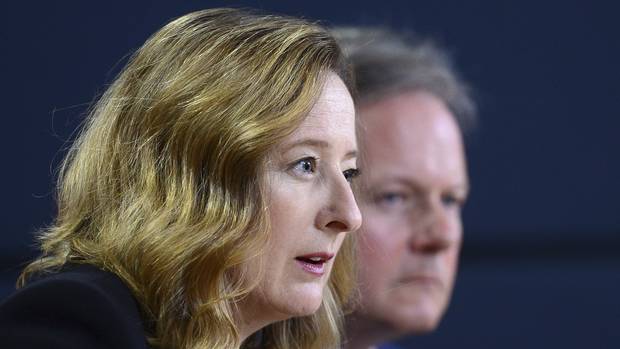
Bank of Canada senior deputy governor Carolyn Wilkins and governor Stephen Poloz
Globe and Mail Update
After that, Mr. Rosenberg chronicled, a speech by Mr. Poloz seemed "to reduce the tone of his concerns," there were stellar jobs reports, and now the market sees a rate hike next week.
"And not just that, but, crazily this notion that the bank will go three times this year," Mr. Rosenberg said.
"Seriously?" he added.
"Meanwhile, it looks like real GDP growth in Q4 is going to come in at nothing more than a 2-per-cent annual rate. So if you believe in those Statcan jobs data, productivity must be contracting at roughly a 1-per-cent annual rate. Go figure."
Statistics Canada's jobs numbers, from its monthly labour force survey, have been questioned by economists before. And the agency has defended them.
The latest batch of numbers raised the eyebrows of at least Mr. Rosenberg, who questioned how a "7,000 raw decline in employment translated into a seasonally adjusted 78,600 run-up."
He went further, questioning a huge jump in service sector jobs, and a big gain in financial services but just a slim rise in employment in Ontario, where that latter industry is based.
"And all I had to do on Friday to figure it was a good time to go to the bank and buy more U.S. dollars was watch the knee-jerk reaction take the loonie from C$1.250 to C$1.238 in minutes."
By that, he meant a Canadian dollar that spiked from 80 cents (U.S.) to 80.8 cents. In minutes.
Read more
- Rachelle Younglai: Canada’s jobless rate hit four-decade low in December as hiring surged
- David Parkinson: Canadian businesses face tight capacity as case for rate hike grows: BoC
- Prepare for higher interest rates as early as next week
Hurtin’ song
Then there's the U.S. currency, which has prompted Mark McCormick to sing the "ballad of a depressed dollar."
Okay, he didn't actually sing it. But the TD Securities North American head of foreign exchange strategy did release a report highlighting its troubles.
The once-mighty greenback is getting its butt kicked (which sort of does have the ring of a hurtin' song), though it has perked up over the past couple of days.
Just look at the U.S. dollar index, or DXY, a measure of the currency against those of other countries, which declined sharply last year.
"The dollar starts the New Year on the back foot," said Mr. McCormick.
"For the narrow DXY, this move comes on the heels of a 10-per-cent drop throughout 2017 that marks the biggest annual decline since 2003," he added in a report titled "Ballad of a depressed dollar," citing this chart.
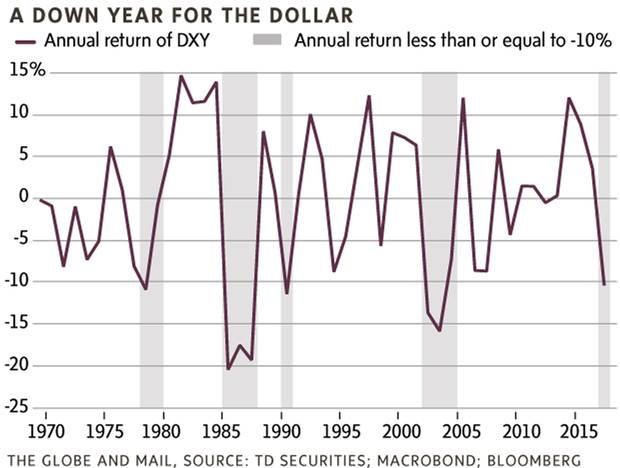
"Indeed, the performance of 2017 was one of seven years in the past 47 where it dropped at least 10 per cent. We believe this dynamic reflects the ongoing regime shift in the global foreign exchange market, spurred in part by global reflation and central bank normalization."
Where to from here?
TD is "firmly in the USD bear camp" at this point.
"This view continues to rest on the links between global reflation, the closure of output gaps outside the U.S. and the ongoing regime shift in global capital flows," Mr. McCormick said.
Read more
RBC sees tax hit
Royal Bank of Canada expects to take a $150-million (U.S.) writedown in the first quarter due to the effects of U.S. tax cuts, but plans to earn that sum back by the third quarter as a dramatically lower corporate tax rate lifts earnings.
Speaking at an industry conference, RBC chief executive officer Dave McKay said the writedown could vary 10 to 15 per cent higher or lower, as the bank is still working through the final details of the sprawling U.S. tax bill passed late in 2017, The Globe and Mail's James Bradshaw reports.
The charge is due largely to a reduction in the bank's deferred tax asset – an accounting measure tied to the timing between a bank booking a tax loss and realizing its benefit.
Read more
Markets at a glance
Read more
More news
- Blackstone buying Vancouver’s Pure Industrial
- TD acquires Toronto-based AI startup Layer 6
- Canadian housing starts slow in December: CMHC