Briefing highlights
- The ‘dead CAD bounce’
- Canadian dollar near 78.5 cents
- Morneau’s ‘placeholder’ budget
- Markets at a glance
- Scotiabank raises dividend
- BMO profit slips in first quarter
- Comcast in rival bid for Sky
- Fed’s Powell sees gradual hikes
The 'dead CAD bounce'
The Canadian dollar is struggling today, down to about 78.5 US cents, and TD Securities thinks there's more to lose.
Indeed, said Mark McCormick, TD's North American head of foreign exchange strategy, the loonie "remains our favourite short in the G10 at the moment," and it has more room to fall.
Mr. McCormick referred in his note to clients to the "dead CAD bounce," a take on the "dead cat bounce" phrase using the loonie's currency symbol.
"This reflects a few different drivers like rates pricing and growth momentum," Mr. McCormick said, the rates price being what markets expect from the Bank of Canada going forward.
"Still, in short, it boils down to the fact that much of the good news is now priced, leaving room for negative rather than positive shocks to impact the currency," he added.
"On the local side, we note that data momentum has deteriorated from the perky levels a few months ago and turned decisively negative over the past few weeks."
This comes ahead of Statistics Canada's Friday report on economic growth for December and the fourth quarter.
Economists expect that report to show slim growth in December, and an annual pace of 1.7 to 2.1 per cent for the final three months of the year.
Which will mean a marked slowdown from earlier in 2017.
"The Canadian economy maintained its slower second half pace after a torrid four-quarter run (2016 Q3 – 2017 Q2) where growth averaged 3.6 per cent, the strongest since 2010," said Benjamin Reitzes, Bank of Montreal's Canadian rates and macro strategist, and his colleague, senior economist Robert Kavcic.
The strength of the Canadian dollar last year came amid better signals for the economy, which plays into what TD's Mr. McCormick sees for the loonie.
"For instance, Canada watchers upgraded their growth view nearly 200 basis points over the past year," Mr. McCormick said.
"This reflects some extreme pessimism following the oil shock, though we see little room for growth revisions to maintain upside momentum," he added.
"By the same token, we also see this process working in reverse, which could weigh on CAD if the market starts to downgrade its views on growth. Equally important, this backdrop is set against forward pricing that puts the [Federal Reserve] and BoC on a similar trajectory."
- Follow our Inside the Market
- Crazy as a loon: The chasm in forecasts for the Canadian dollar
- Loonie pops 1¢ in a day as markets kiss ‘immensely unloved’ greenback goodbye
- Stock market angst: You want the good or bad news first? (Then let’s talk about the Canadian dollar)
What to expect in today's budget
Expect a "placeholder" budget from Finance Minister Bill Morneau today, as CIBC World Markets puts it.
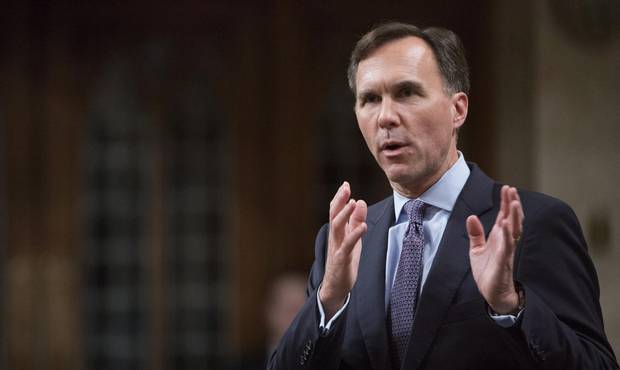
Finance Minister Bill Morneau responds to a question during Question Period in the House of Commons, in Ottawa, on Oct. 19, 2017.
Adrian Wyld/THE CANADIAN PRESS
"The Liberals will want to be much closer to 2019 before unveiling new budget measures that will form the backbone of their platform for the election that year," CIBC chief economist Avery Shenfeld said in a lookahead.
"If you're worried about higher taxes on capital gains, hoping for Ottawa to match the U.S. on immediate expensing of capital equipment, or advocating something big on the spending side, wait until next year."
There's no huge pressure from the fiscal and economic side, either, Mr. Shenfeld said, particularly given that the Liberals have already brought in much of what they'd proposed and unemployment is below 6 per cent.
And, for that matter, the only things left are "some overdue details" on small business taxes.
"Having reached full employment, this isn't the time in the cycle for a stimulative boost to government spending," Mr. Shenfeld also noted.
"Unlike the U.S. Congress, the Liberal government seems reasonably well versed with Keynes," he added.
"We still have plenty of infrastructure dollars coming, and potential stimulus from election year budgets in Ontario and Quebec. Better to save some federal spending power for the next recession."
As for the deficit, Capital Economics expects Mr. Morneau to unveil a slimmer-than-expected gap of about $18-billion for fiscal 2017-18.
Gender issues are expected to be much of the focus of the budget.
"From a policy perspective, the recent chatter has surrounded measures to promote gender equality and, from an economic perspective, that could cover issues such as equal pay and labour market participation," said Benjamin Reitzes, Bank of Montreal's Canadian rates and macro strategist, and his colleague, senior economist Robert Kavcic.
Then there's the issue of competitiveness, particularly in the wake of recent U.S. tax reform.
"We did did indeed witness significant erosion in Canadian competitiveness - not just from the U.S. tax changes but also made-in-Canada measures like minimum wage hikes and carbon taxes," said Royal Bank of Canada assistant chief economist Paul Ferley.
"The scope for significant new measures to reverse that erosion is limited with the federal government already running large deficits," he added.
"There are indications the budget will focus on gender and skills, both areas that deserve some policy attention. We think there is also some scope for improving competitiveness without spending too much money, for example via smarter regulation."
This is Mr. Morneau's third budget.
And, noted Laurentian Bank Securities chief economist Sébastien Lavoie, "the economic momentum is stronger now than it was for the previous two: Robust real GDP global growth supports commodity prices and the unemployment rate sits near a four-decade low."
Having said that, Ottawa still needs to tackle some issues, among them the "erosion of competitiveness" and the uncertainty hanging over the economy amid negotiations to redraw the North American free-trade agreement," Mr. Lavoie said.
"One thing to look for in the 2018 federal budget is if it will include a response to Washington's policies," he suggested.
"While a massive and generalized cut to the corporate income tax rate is very unlikely, the odds of a targeted measure such as the immediate expensing on capital investments are relatively higher. In addition, small business owners will find out the federal government's final decision regarding the utilization of passive investment income above the $50,000 tax-free annual threshold announced last October."
- Matt Lundy, Tom Cardoso: Six things to watch in the federal budget
- Campbell Clark: With this budget, Morneau’s political education to be put to the test
- Barrie McKenna: Seven things Bill Morneau should do in this week’s budget (but probably won’t)
Markets at a glance
Read more
Scotiabank raises dividend
Bank of Nova Scotia is raising its dividend by three pennies amid a gain in first-quarter profit.
Scotiabank posted a jump in profit to $2.3-billion, or $1.86 a share, diluted, from $2-billion or $1.57 a year earlier.
Return on equity rose to 16.2 per cent from 14.3 per cent, and the dividend to 82 cents.
Bank of Montreal, meanwhile, posted a 35-per-cent drop in profit because of U.S. tax reforms and a gain a year earlier.
First-quarter profit slipped to $973-million, or $1.43 a share, with adjusted profit down 7 per cent to $1.4-billion.
Read more
- James Bradshaw: Scotiabank tops profit forecasts, hikes dividend
- James Bradshaw: BMO continues banks’ winning streak as profit beats estimates
Comcast joins Sky drama
The battle for Sky PLC is becoming quite the drama, with Comcast Corp. jumping in today with a US$31-billion bid.
Comcast, owner of NBC and Universal Pictures, is bidding £12.50 a share for Sky, which has already struck a troubled deal with 21st Century Fox.
Walt Disney Co. is involved, too, with an agreement to buy Fox businesses that include Sky.
“[Comcast] has been savvy in its offer by promising to maintain Sky News, something that was less certain under ownship by Disney,” said Jasper Lawler, head of research at London Capital Group.
“Comcast can use the general mistrust of Rupert Murdoch in the British Isles to sweep in and get a bargain,” he added.
“We suspect this offer, which is preferential for shareholders because of the higher price tag, has a much better chance of passing regulatory scrutiny than the Fox deal. A bidding war would make the outcome uncertain, but we think Comcast now looks like the most likely future owner of Sky.”
Read more