Briefing highlights
- Fitch warns Canada on Trump threats
- Trudeau vs. Trump: ‘Cruel reality’?
- What to expect from housing data
- What to expect from Fed's Yellen
- Corporate earnings season solid
- OPEC reports big Saudi oil cut
The Trump threat
One of the big three credit rating agencies is warning Canada of a double threat from the Trump administration.
The warning on trade and investment comes as Prime Minister Justin Trudeau, whose government is among a shrunken group of countries that still boast a coveted triple-A rating, meets President Donald Trump in Washington.
Fitch named several countries under threat in a recent statement, citing a risk to ratings as “policy predictability” dims under the new U.S. administration.
“The primary risks to sovereign credits include the possibility of disruptive changes to trade relations, diminished international capital flows, limits on migration that affect remittances and confrontational exchanges between policy makers that contribute to heightened or prolonged currency and other financial market volatility,” Fitch said.
“The materialization of these risks would provide an unfavourable backdrop for economic growth, putting pressure on public finances that may have rating implications for some sovereigns.”
Fitch noted how Mr. Trump has already pulled out of the Trans-Pacific Partnership, called for an overhaul of the North American free-trade agreement, threatened American companies for foreign investment and slammed several countries for what he alleges is currency manipulation.
Much won’t be known for awhile, the agency added, but it appeared to hold out little hope given the “aggressive tone” of the rhetoric.
“Sovereigns most at risk from adverse changes to their credit fundamentals are those with close economic and financial ties with the U.S. that come under scrutiny due to either existing financial imbalances or perceptions of unfair frameworks or practices that govern their bilateral relations,” Fitch said.
“Canada, China, Germany, Japan and Mexico have been identified explicitly by the administration as having trade arrangements or exchange rate policies that warrant attention, but the list is unlikely to end there.”
Then there’s the investment side of the equation, which again threatens Canada.
“Countries hosting U.S. direct investment, at least part of which has financed export industries focused back on the U.S., are at risk of being singled out for punitive trade measures,” Fitch said.
“Countries with the highest stock of U.S. investment in manufacturing are Canada, the U.K., Netherlands, Mexico, Germany, China and Brazil,” it added.
Observers have noted the seemingly friendlier attitude of the Trump administration toward Canada, but they have also warned America’s northern neighbour can’t help but get caught up in any trade moves, notably the renegotiation of NAFTA.
Fitch had already fired a shot across Canada’s bow, flagging an economic risk to Canada in a separate recent report.
The Trudeau government is seen by many observers to have a sound fiscal policy, with manageable budget deficits. But, as this table from Fitch shows, Canada’s economy is something of a question mark.
| Public finances | External finances | Structural issues | ||||||
|---|---|---|---|---|---|---|---|---|
| S | T | S | T | S | T | S | T | |
| Australia | ||||||||
| Canada | ||||||||
| Denmark | ||||||||
| Germany | ||||||||
| Luxembourg | ||||||||
| Netherlands | ||||||||
| Norway | ||||||||
| Singapore | ||||||||
| Sweden | ||||||||
| Switzerland | ||||||||
| U.S. | ||||||||
“Canada’s medium-term macroeconomic outlook has been assigned a negative trend, meaning its status could change to a weakness,” Fitch said.
For the record, only 11 countries now boast a Fitch triple-A rating, with several having been downgraded since the depths of the financial crisis. That’s the smallest group since 2003.
Trudeau vs. Trump
Many observers suggest Mr. Trudeau has a strong hand to play as he meets Mr. Trump, though it’s far from simple.
Canada-U.S. trade is relatively balanced, and many American states rely on trade with their northern neighbour.
And, presumably, shipments of 3 million barrels of oil a day from Canada have got to count for something.
It’s interesting to note, though, that Mr. Trudeau meets Mr. Trump just as Canada’s trade with the U.S. shows a bit more pep.
“Normally a return to a trade surplus would be warmly greeted by Ottawa’s policy makers, but this is an awkward time to be running surpluses, with the U.S. administration’s laser-like focus on trade imbalances,” said BMO Nesbitt Burns chief economist Douglas Porter.
Having said that, U.S. government figures just last week pegged Canada’s 2016 goods trade surplus at a “moderate” $11-billion (U.S.). And, as Mr. Porter and others have noted, that would be countered by a Canadian deficit on the services side.
“That rough balance in trade between the two nations will likely figure quite prominently in Prime Minister Trudeau’s speaking points in his much-anticipated meeting with President Trump on Monday,” Mr. Porter said.
“While it won’t come up, he could also point out that Canada is not exactly ’stealing’ many manufacturing jobs these days, as factory payrolls are bumping along at record lows and down 20 per cent from just a decade ago in Canada.”
Of course, then you get into that whole sleeping-with-an-elephant scenario, as the prime minister’s father, the late Pierre Trudeau, so famously put it in his day.
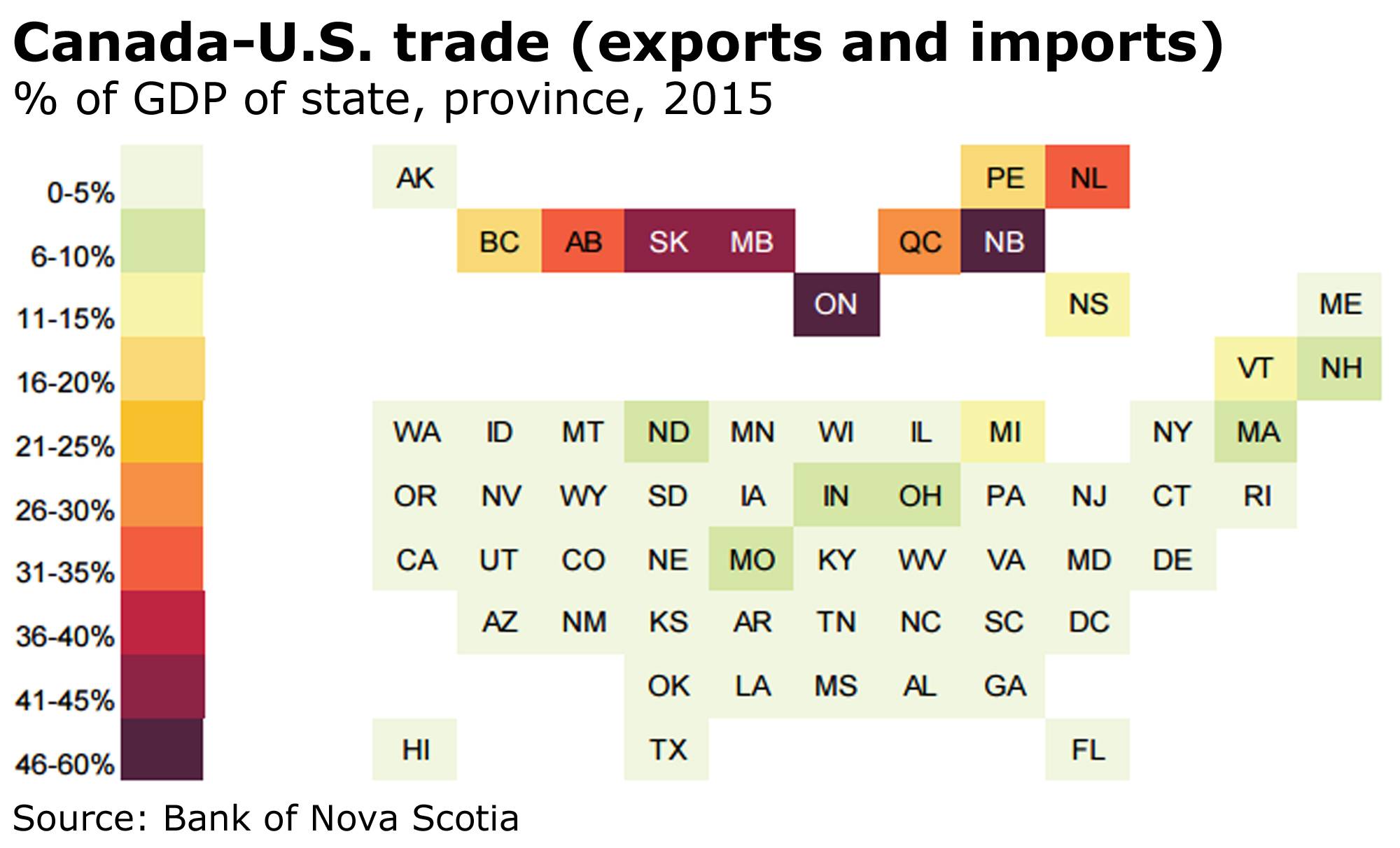
“The cruel reality is that while total trade with Canada accounts for roughly 3 per cent of U.S. GDP, trade with the U.S. accounts for a honking 37 per cent of Canadian GDP; and that’s just goods,” Mr. Porter said.
“The bilateral trade relationship is very important for the U.S., but it’s beyond critical for Canada.”
This heat map from Bank of Nova Scotia tells that story, though don’t underplay the reliance of many states on their relationship with Canada.
Indeed, many observers say NAFTA has been a boon to all three partners, boosting trade dramatically since its 1994 inception.
“NAFTA has expanded continental trade and investment, it has generated economic growth that has created jobs and boosted living standards, and it has improved the global competitiveness of North America’s three largest economies,” Scotiabank chief economist Jean-François Perrault and deputy chief economist Brett House said in a report Friday.
“NAFTA has not been responsible for a net decline in manufacturing jobs in the United States (U.S.) and Canada, nor has it led to a hollowing-out of labour, environmental, or intellectual property standards.”
Some impressive statistics from the Scotiabank economists: Canada and Mexico represent the top export-destination countries for 49 states. They represent one of the top two such countries for all states, but for seven. And they rank as one of the top two exporters for 39 states.
“Wider U.S. trade deficits within NAFTA could make a reopening of the agreement more challenging, but they should not prevent renewal of the pact in ways that could benefit all three countries.”
What to watch for this week
We’ll get two data sets on the ever-popular housing market front, the first being the release of the Teranet-National Bank home price index Tuesday, and then the monthly sales and price report from the Canadian Real Estate Association Wednesday.
We’ve already seen several local reports, notably from Vancouver and Toronto, but the national CREA measure is expected to show sales up 2 per cent in January from a year earlier, and average prices up 7 per cent, according to BMO.
The MLS home price index, seen as a better measure, is forecast to show a gain of 14 per cent.
“Vancouver prices are now correcting modestly, along with Calgary and Edmonton, with more meaningful declines for the high end of the market,” said BMO senior economist Robert Kavcic.
“Toronto price growth, however, continues to accelerate, with the benchmark price up 21.8 per cent year over year, the fastest clip since the late 1980s,” he added.
“Strength has also started to emerge in Ottawa and Montreal, with those markets tightening up alongside ramped up federal government spending (Ottawa) and a strengthening labour market (Montreal).”
Wednesday also brings a look at recent retail sales and inflation numbers in the United States.
And, most importantly for markets, Federal Reserve chair Janet Yellen speaks Tuesday and Wednesday in what as known as her Humphrey Hawkins testimony.
“Fed chair Yellen’s Humphrey Hawkins testimony should garner an elevated level of attention given the economic/political backdrop,” said observers at Royal Bank of Canada.
“Ultimately, we expect Yellen to echo what has been a pretty consistent narrative from Fed officials from both sides of the dove/hawk spectrum since the turn of the year,” they added.
“Even some of the most ardent doves ... are leaning toward what is effectively the Fed ‘consensus’ of three rate hikes in 2017. Expect the chair to be aligned with this general outlook.”
Also on Wednesday, Statistics Canada releases its monthly look at manufacturing sales, which are believed to have slumped by 0.5 per cent in December, according to CIBC World Markets.
“Manufacturers are caught between a rock and a hard place,” said CIBC’s Nick Exarhos.
“Capacity closures and a slowdown in global trade means that they haven’t been able to fully exploit the benefits of the cheaper Canadian dollar. And with protectionist rhetoric south of the border threatening their access to the U.S. market, they’ll have to take a cautious approach to investment.”
Investors will also get a look at the latest quarterly results from a number of companies this week, including Restaurant Brands International Inc., TMX Group Ltd., CAE Inc., Devon Energy Corp., Molson Coors Brewing Co., T-Mobile US Inc., Yellow Pages Ltd., Agnico Eagle Mines, Barrick Gold Corp., Cineplex Inc., Cisco Systems Inc., Goldcorp Inc., Kinross Gold Corp., Kraft Heinz Co., Marathon Oil Corp., PepsiCo Inc., Shopify Inc., Cenovus Energy Inc., Duke Energy Corp., Encana Corp., Fairfax Financial Holdings Ltd., Sherritt International Corp., Time Inc., TransCanada Corp., West Fraser Timber Co., Air Canada, Campbell Soup Co., Deere & Co., Enbridge Inc. and Moody’s Corp.
“The earnings season is in full swing, and so far the results have been solid,” said BMO’s Mr. Kavcic.
“With about 70 per cent of the S&P 500 reporting, 75 per cent have topped consensus earnings expectations according to Bloomberg’s tally, while just over 50 per cent have beaten the revenue mark – both results are consistent with longer-run norms,” he added.
“Strength has been clear in financials (more than nine out of 10 have beaten the mark) and health care, while telecom and utilities have seen the most widespread disappointment.”