Briefing highlights
- Pros and cons of cryptocurrencies
- Canada’s economy loses steam
- Markets at a glance
- All eyes on Fed
- Europe’s economy recovering
- What to watch for today
- WestJet profit beats estimates
- Samsung shakes up leadership
- Bank of Japan holds steady
'Too big to ignore'
The evolution of how we pay for stuff is a fascinating thing, from playing cards in Canada so long ago to coins and bills, plastic, use of cyberspace and, now, cryptocurrencies.
And there's a lot to worry about with the latter amid the many benefits, Royal Bank of Canada warns.
"Cryptocurrencies have the potential to fundamentally change the global economic system and threaten global economic stability," Sue Trinh, RBC's head of Asia foreign exchange strategy in Hong Kong, warned in a new report.
"These threats becomes increasingly real as more and more individuals use them and more and more companies launch their own cryptocurrencies – there are currently 1,194 cryptocurrencies in circulation," she added.
"Needless to say there are some significant economic, political and legal policy issues that require further assessment. Perhaps one of the biggest issues yet to be properly addressed: Is it a currency? Is it software? Is it an equity?"
Ms. Trinh looked at how cryptocurrencies work, how you use them, and the many central banks, including Canada's, that are studying them.
She also looked at the different versions out there now, from bitcoin to ethereum, noting the prices. Bitcoin, for example, is trading around $6,000 (U.S.), and, Ms. Trinh said, these things are "becoming too big to ignore."
(Compare that to a 78-cent loonie.)
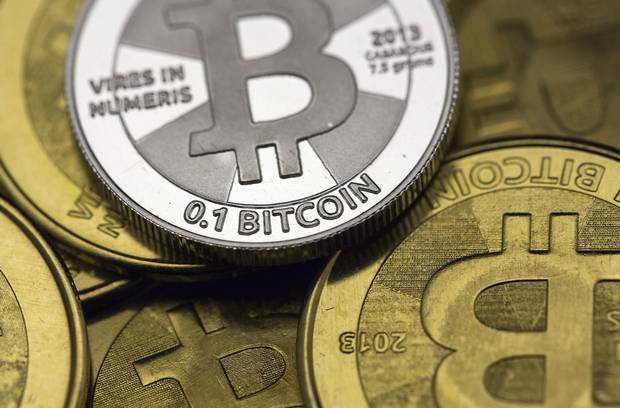
Bitcoin and other cryptocurrencies have surged in value in recent months
Jim Urquhart/Reuters
Ms. Trinh also ran through the pros and cons, noting that some of the former also rank among the latter.
The benefits:
1: No barriers to access: "Developing countries with broken financial sectors are an obvious example and rich with potential. Venezuela and Zimbabwe are recent examples where economic crises have driven rampant adoption of cryptocurrencies by its citizens."
2: No central authority: "The owner has total control of their funds and (theoretically) no one is able to take it away from you or freeze your assets held in the account without consulting you."
3: Peer to peer: "Cuts out the middle-man (bank, lawyer, notary) and transaction fees are much smaller as a result."
4: Fast transactions: "Cuts out third parties (lawyers, banks) and therefore delays compared to traditional asset transfers."
5: Protection: "Cannot be counterfeited or reversed arbitrarily by the sender, as with credit card charge-backs. Likewise, whereas credit cards give the merchant access to a buyer's credit line, cryptocurrency allows the buyer to send to the merchant."
There's more, Ms. Trinh said, including the anonymity factor, and the fact that such currencies can skirt any capital controls. Blockchain technology, she added, "can have wider applications beyond moving money between individuals."
The drawbacks:
1: Many of us have experienced that "damn, I lost my wallet" moment. Don't rule out "damn, I lost the password to my wallet" if it's kept on, or lost by, an exchange.
2: Hackers can wreak havoc, for example through a denial of service attack or temporarily bringing down a site to "create panic selling" from which they can make a digital buck. There's also "robbing mining pools," Ms. Trinh said.
3: Because they are "borderless and largely unregulated," central banks can't control cryptocurrencies or manage exchange rates. (And President Donald Trump would have nothing to complain about.)
4: Crime is oft linked to them because of the anonymity that's also seen as a benefit.
5: They could bring instability as "their explosive growth attracts financial speculation." (Sort of like using Dutch tulips. Or detached homes in Vancouver or Toronto.)
6: They gobble up power: "Processing a bitcoin transaction is said to consume between 3,000-5,000 times as much energy as a Visa card transaction." (As opposed to the energy we spend trying to pay off our Visa card transactions.)
"As cryptocurrency usage continues to grow, so too must policy makers' ability to assess the effect on the stability of [foreign exchange] markets and their ability to control those effects," said Ms. Trinh, noting the issues for banks, payment systems and the broader financial world.
"While some countries have explicitly allowed their use and trade, others have banned or restricted it," she added.
"We think such moves are a case of regulators looking to buy time to better understand the phenomenon and to create rules to protect investors."
Read more
- Alexandra Posadzki: Bank of Canada has ‘head in the sand’ on bitcoin: OSC
- Ian McGugan: Gold vs. bitcoin: A look at which holds more promise for your investment dollars
- How does bitcoin work?
Economy loses steam
Canada's economy is rapidly losing steam, contracting slightly in August after flatlining in July.
Today's reading from Statistics Canada sets up a third quarter that will be far different from the first two, when economic growth surged.
"That justifies the Bank of Canada's current wait-and-see approach after two quick hikes, with our forecast for their next move still being in the spring of 2018," said Nick Exarhos of CIBC World Markets.
Gross domestic product inched down 0.1 per cent in August, as losses in manufacturing, mining and oil and gas extraction offset the gains in several other sectors, the statistics agency said.
Manufacturing took it on the chin, declining by 1 per cent after a slight drop in July.
The energy industry also suffered, with oil and gas extraction contracting 1.4 per cent.. Conventional oil and gas extraction suffered more, falling 5.2 per cent.
"Maintenance shutdowns in Newfoundland and Labrador in August affected conventional oil production," Statistics Canada said.
"Non-conventional oil extraction grew 3.3 per cent, more than offsetting a 3-per-cent decline in July."
Read more
Markets at a glance, eyes on Fed
The Federal Reserve begins a two-day meeting that will climax with a Wednesday rate decision, though no change is expected.
Actually, the climax for the U.S. central bank will be President Donald Trump's choice of a new Fed chair. That's expected this week, and the betting is on current Fed governor Jerome Powell.
"Powell is in favour of low interest rates, hence well in line with President Trump's low rate inclination," said Ipek Ozkardeskaya, senior market analyst at London Capital Group.
"His appointment could temporarily weigh on the U.S. dollar," she added.
"But it is important to note that [current chair] Janet Yellen is also a dove, therefore Powell's appointment will certainly not change the Fed's current strategy drastically."
Read more
Europe recovering
Europe's economy continues to recover.
Gross domestic product expanded by 0.6 per cent in both the euro zone and the wider European Union in the third quarter, the Eurostat statistics agency said today.
Compared to a year earlier, economic growth was 2.5 per cent.
Unemployment also dipped in the euro zone, to 8.9 per cent in September from 9 per cent a month earlier and 9.9 per cent a year earlier, the agency said. The latest is the lowest since early 2009.
Across the EU, unemployment is now 7.5 per cent, the same as in August and the lowest since November, 2008.
Annual inflation in the euro zone, in turn, is believed to be 1.4 per cent this month, down from 1.5 per cent, according to the agency's flash estimate.
Read more
More news
- WestJet profit beats estimates on record traffic
- Samsung shakes up leadership ranks as profit soars
- BOJ keeps policy steady; board newcomer signals desire for easing