Gas pains
Canadians should be enjoying lower prices at the gas pump given the wreckage in the oil market, BMO Nesbitt Burns says.
Many things factor into the cost of gas, including taxes, and it varies across the country, but prices should still be lower than they are, according to calculations made by BMO senior economist Benjamin Reitzes.
“With last week’s plunge in oil fresh in my mind as I headed into the weekend, I couldn’t help but notice how gasoline prices had ticked higher from the previous week,” Mr. Reitzes said in a research note late yesterday, citing the fact that Brent crude has slipped below $55 (Canadian) a barrel, the lowest since 2008.
Thus, he added, about $1 a litre at the pump “seemed odd.” And this chart “suggests that gas prices should be well below $1,” he said.
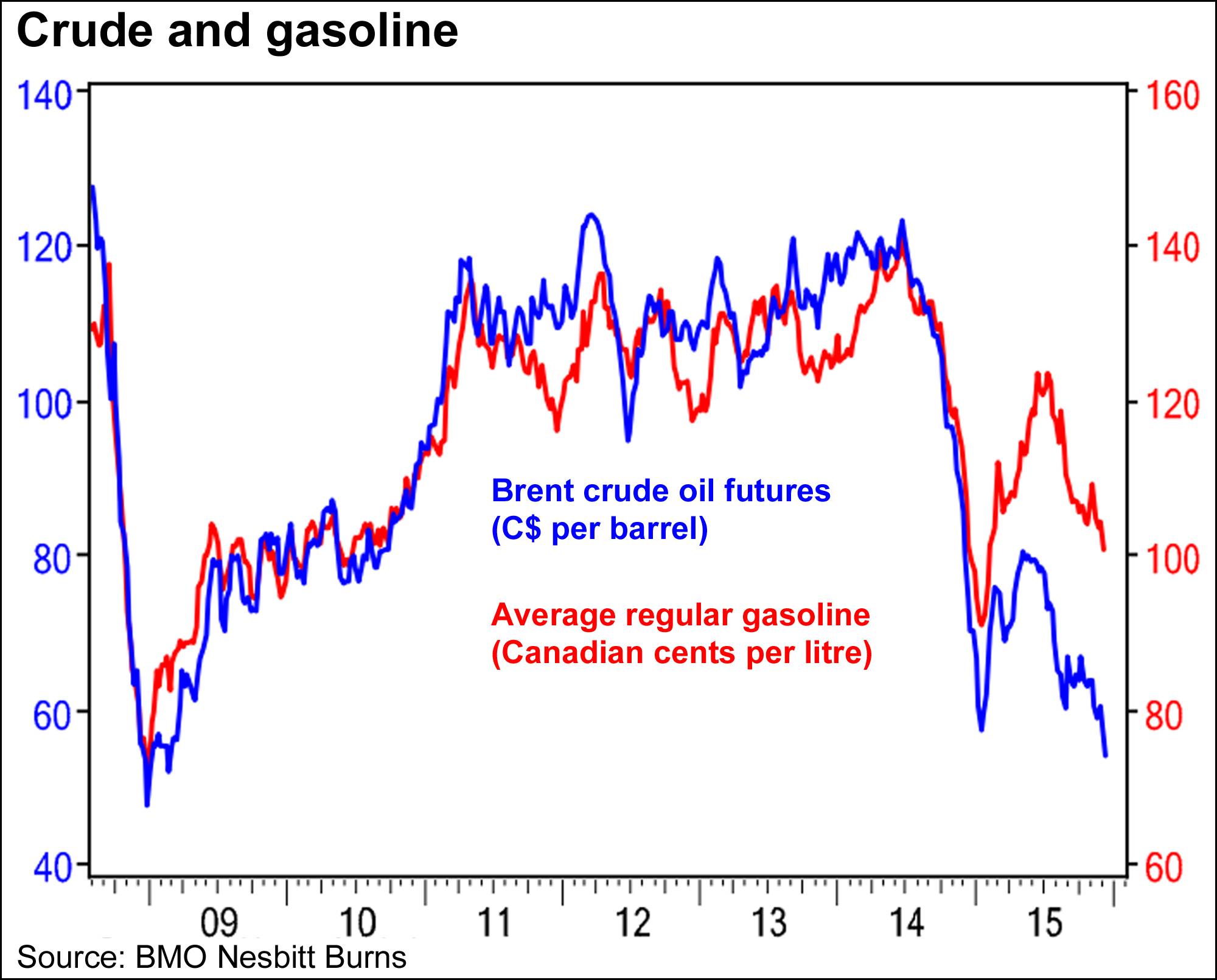
“Simply, consumers don’t appear to be reaping the full benefit of lower oil prices.”
Refining margins have likely expanded, Mr. Reitzes said in an interview, adding he believes the pump price should be somewhere around the 90-cent mark, or lower.
Keep in mind, too, that costs are far below $1 in some parts of the country, and much more in other parts.
Analysts believe consumers will spend more as they shift their dollars from the pump to the mall, but this takes time. And if Canadians aren’t getting all the benefits, that’s an issue, particularly in such uncertain times.
“The direct effect of a $10-per-barrel fall in the oil price is transfer income worth approximately 0.4 per cent of world GDP from net oil producers to net oil consumers,” said Capital Economics senior global economist Andrew Kenningham.
“Given that net oil consumers (such as the U.S.) generally spend more of their income than net producers (such as Saudi Arabia), this should, eventually, boost spending,” he added.
“Admittedly, the past year has shown that producers tend to cut spending more rapidly than consumers increase theirs.”
Oil prices are more stable today, having bounced around, but are still well down.
“Oil prices have steadied a little, having plunged to some multiyear lows yesterday, but some of this can be put down to some pullbacks in the [U.S.] dollar ahead of the [Federal Reserve] meeting this week and the fact that the demise of oil seems to be prevalent in the mainstream media,” said London Capital Group chief analyst Brenda Kelly.
Ms. Kelly was referring to tomorrow’s decision by the U.S. central bank, which is expected to raise its benchmark lending rate for the first time in almost a decade.
“We hear all lots of guff from central bankers about how declines in energy prices are transitory, yet the declines being seen right now have been going on for 18 months now,” said CMC Markets chief analyst Michael Hewson.
“Since the last Fed meeting alone Brent oil prices have declined over 22 per cent, while U.S. prices have dropped over 24 per cent.”
BoC frets about housing
The Bank of Canada’s angst about the housing market is now focused mainly on two high-priced cities – Toronto and Vancouver – plus the swelling bulge of younger homeowners with large mortgage debts relative to their incomes, The Globe and Mail’s Barrie McKenna reports.
The overall risk to Canada’s financial system remains unchanged from six months ago, the central bank said today, but it warned in its twice-yearly financial system review that cracks are becoming more apparent.
“Certain vulnerabilities are still edging higher, but recent changes by Canadian authorities will help to mitigate the risks as we move into 2016,” Bank of Canada Governor Stephen Poloz said in a statement, accompanying the financial system review.
Manufacturing sales fall
Canada’s manufacturing sector suffered another setback in October, the third in a row, as sales fell 1.1 per cent, according to fresh numbers released today.
Oil and coal, aerospace and machinery led the way, Statistics Canada said today.
Inventories rose 0.5 per cent, and the inventory-to-sales ratio moved to 1.46 from 1.44 in September.
Unfilled orders slipped 1.3 per cent, and new orders 1.4 per cent, also the third drop in a row.