1
Pull out of the TPP
2
Revive Keystone XL pipeline
3
Set plans for The Wall in motion
4
Threaten 20% import tax to pay for it
Donald Trump’s first week as president has been a tumultuous one that has left the United States on the cusp of a trade war.
And that’s before even taking on China.
Observers caution that these are early days, and that we have to see if Mr. Trump makes good on his various threats.
“President Trump is holding to the view expressed during the campaign, which reinforces that trade remains a front-and-centre policy platform for this new administration in the first 100 days,” said Toronto-Dominion Bank chief economist Beata Caranci.
“Beyond that, we’ll need to wait and see how both sides respond via action or negotiation.”
But the temperature is certainly rising.
As The Globe and Mail’s Joanna Slater reports, the U.S. and Mexico are in a tense standoff over building the controversial wall and forcing the Mexicans to pay for it.
On Thursday, Mr. Trump’s spokesman indicated the wall across Mexico could be paid for via a 20-per-cent tax on countries running a trade surplus with the U.S.
Later, though, his chief of a staff said that’s just one of the measures being looked at.
Regardless, the U.S. is now on the brink of an all-out trade battle with its southern neighbour, one with ramifications for economies around the world.
“The tax will certainly escalate tensions between the U.S. and Mexico, but let’s see what the final plan is from the Trump administration,” said Bipan Rai, executive director of macro strategy at CIBC World Markets.
“Oddly enough, escalating trade tensions between the two countries will actually bode well for the Canadian economy given the potential for increased market share of goods in the U.S.”

Canada runs almost balanced trade with the U.S., and initial fears of being caught up in a trade fight have eased.
That doesn’t mean the new administration doesn’t want to change some of the Canada-related provisions under the North American free-trade agreement, but observers say NAFTA negotiations won’t be nearly as bitter as those with Mexico.
“Mexico runs a significant trade surplus with the U.S. and the manufacturing sector is heavily dependent on the U.S. for demand,” said Dev Ashish of Société Générale.
“Given the trade outlook-led pressure on the peso and its implications for inflation and rates, Mexico is already heading for possible stagflation,” he said in a report.
“In the event the trade relationship with the U.S. worsens further, Mexico could be heading for an outright recession despite a continued expansion in the U.S.”
Economists have warned that Mr. Trump’s threats could backfire if put into action, sparking a widespread trade war and a surge in the U.S. dollar
“The pickup in world trade in the last quarter of 2016 adds to the evidence that the global economy gained momentum late last year,” said Michael Pearce, the global economist at Capital Economist.
“But the key question is whether the new U.S. administration will bring this recovery to an end,” he added.
“Donald Trump’s first few days in the White House suggest that he fully intends to tear up the rule book governing U.S. trade. For now, we suspect that he will not do enough damage to completely undermine global growth prospects, but the risks are rising.”
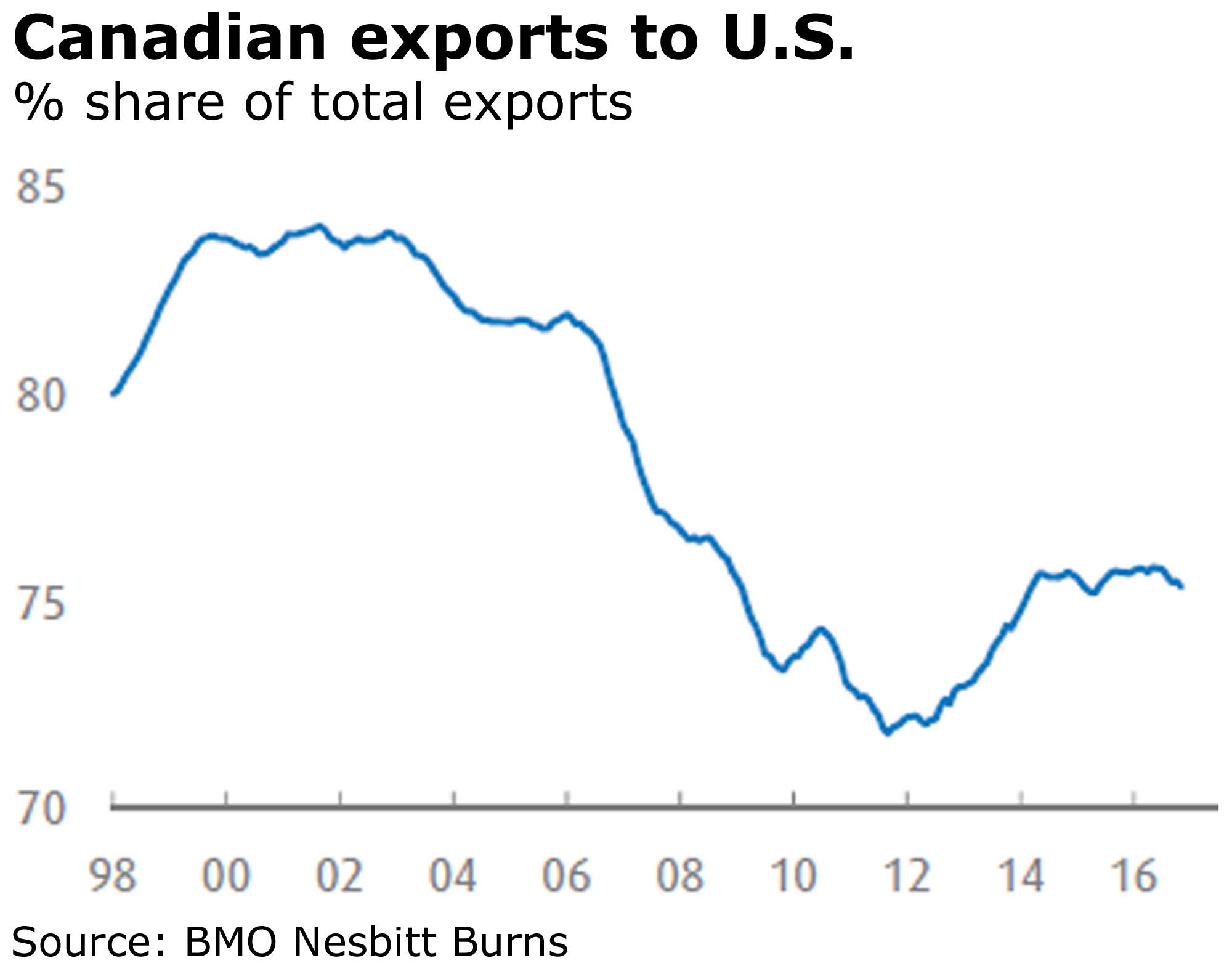
For Canada, much depends on how broad-based any tariffs might be, and the potential for exemptions, said TD senior economist Brian DePratto.
“That said, Canada’s high reliance on the U.S. as an export destination leaves the economy highly exposed to potential impacts,” he said in a report.
“The total trade relationship with the U.S. (exports plus imports) is equivalent in size to half of annual Canadian economic output (GDP).”
Of course, there’s much at play here.
“Just as a potentially stronger U.S. dollar will blunt the effectiveness of trade measures, a weaker loonie would have a similar effect for Canada, improving export competitiveness,” Mr. DePratto said.
“Moreover, in the case of broad U.S. tariffs, within certain industries, substitutes for Canadian inputs may not be immediately available, delaying/offsetting the impact of protectionist measures.”
Yet to come from Mr. Trump is whether the administration chooses to label China a currency manipulator.
“They’ve gone back and forth on labelling China as a currency manipulator,” said CIBC’s Mr. Rai.
“If they do, the decision will be more political than actually based on sound economic reasoning. The [yuan] is weakening because of large outflows, not because the government is managing the exchange rate.”
U.S. growth slows
The U.S. economy was slowing down in the dying days of the Obama administration.
Gross domestic product expanded at an annual pace of 1.9 per cent in the final quarter of 2016, a marked change from the third quarter’s 3.5 per cent, according to the U.S. Commerce Department.
In what could be further ammunition for Mr. Trump, exports weighed down the reading, falling 4.3 per cent.
Of course, much of that was because of the stronger U.S. dollar, said Royce Mendes of CIBC World Markets.
“As expected, household consumption and private investment supported growth, with net exports providing a drag,” he said.
Take heart, Mexico
Well, at the very least, Mexicans will soon have Canada’s iconic coffee.
Restaurant Brands International, which owns Tim Hortons, says it has partnered with a Mexican investor group to franchise the brand in Mexico.
It’s the first venture into Latin America for Tims.
“Mexico has a thriving coffee market so we are very optimistic about the opportunity to grow the brand across the country,” said Restaurant Brands chief executive Daniel Schwartz.
Energy East review to reboot
The new regulatory panel assessing TransCanada Corp.’s proposed Energy East pipeline will restart the review process, adding further delays to the troubled project, The Globe and Mail’s Shawn McCarthy reports.
The National Energy Board assigned three new panelists two weeks ago, after the original members were forced to resign in September as a result of revelations they participated in private meetings in Quebec, including with former premier Jean Charest who was acting as a consultant for TransCanada.
Opponents to the $15.7-billion pipeline project argued all decision made by the original panel were tainted, and threatened further court challenges if they did not start back at square one.