Briefing highlights
- RBC warns on housing in Toronto, Vancouver
- Toronto a 'city of opportunity'
- Video: Use of social media in the office
Warning signs
Royal Bank of Canada’s latest housing market monitor is flashing red in a couple of key areas in Vancouver and Toronto.
The report from chief economist Craig Wright and senior economist Robert Hogue signals a “low probability” of nation-wide meltdown in the next few years, but there are some notable points regarding the country’s two hottest housing markets.
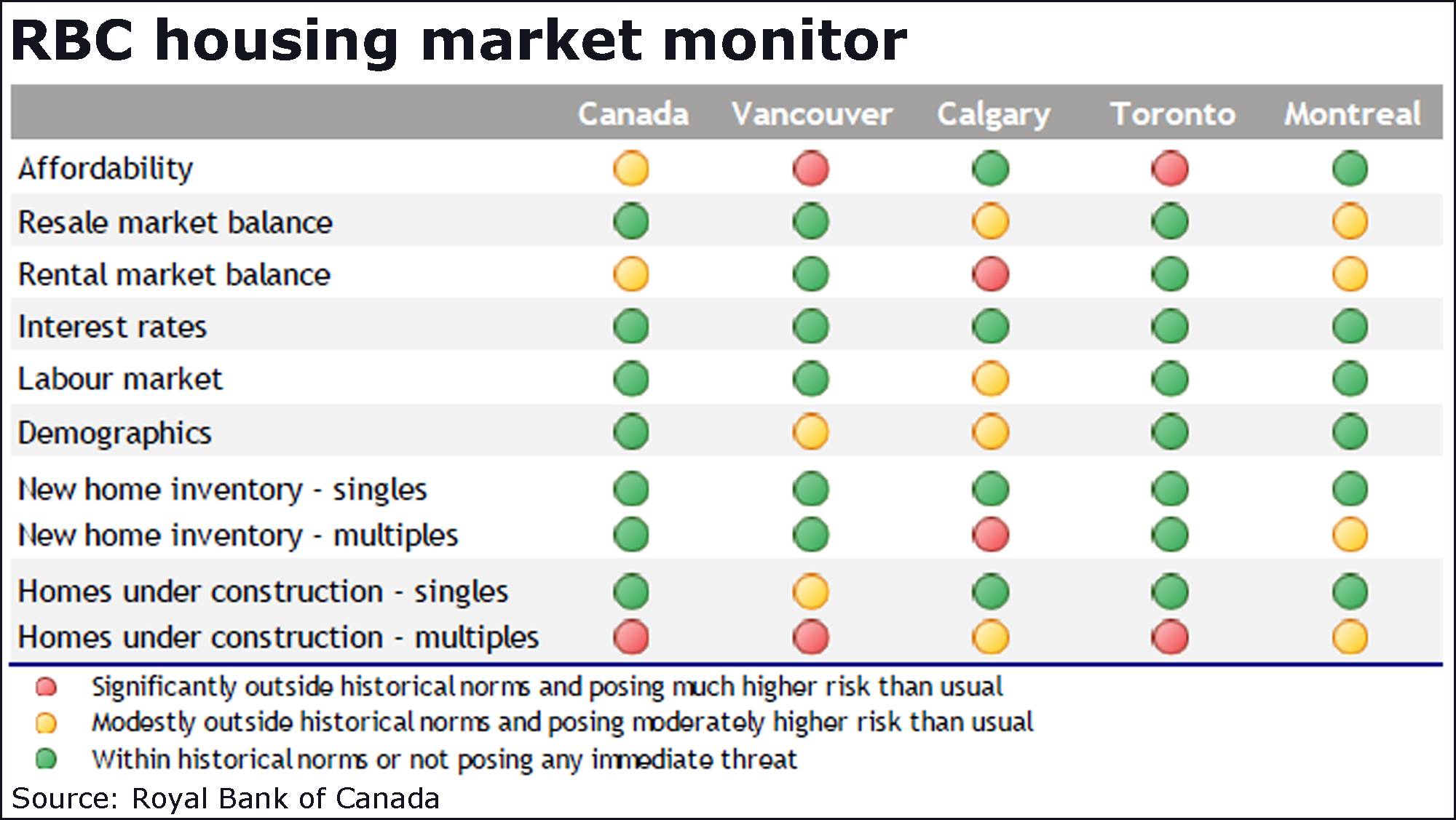
Here are some key points:
Cities: “Indicators paint distinct risk profiles with overheating concerns topping the list in Vancouver and Toronto, and weak economy posing the main threat in Calgary.”
Prices: “Affordability-related risks continued to increase significantly in Vancouver and Toronto this year, as prices accelerated further, especially for single detached homes. Vancouver, in particular, showed strong signs of overheating, although recent declines in sales brought some cooling.”
B.C.’s tax on foreign buyers of Vancouver area properties: “The surprise introduction by the B.C. government of a new 15-per-cent tax on homes purchased by foreign nationals in Metro Vancouver added a new layer of risk for the Vancouver market. The tax is without precedents in Canada and raises uncertainty in the short term.”
Condominiums: “The risk of overbuilding has diminished considerably this year. While condo units under construction remain historically elevated, completed but unsold inventories have come down in most markets. High levels of construction are part of the solution to ease resale market tightness in Vancouver and Toronto.
Government policy: “Ongoing concerns about housing affordability, government exposure to housing and stability of hot housing markets and the financial system keep the odds of policy intervention elevated.”
The oil shock: “Oil-producing provincial economies continue to face difficult challenges, which maintains material risks for housing demand and prices in Alberta and other oil industry sensitive markets in the near term.”
City of ‘opportunity’
A new study ranks Toronto as one of the three best cities in the world in which to live.
And it is a wonderful city. But it sure is expensive. And the subway’s hot, to boot.
The “Cities of Opportunity” report, released this week by PricewaterhouseCoopers, is justifiably flattering as it ranks Toronto No. 3 behind second-place Singapore and first-place London.
“The city may be calm, cold a good bit of the year, and overshadowed by the ‘buzz’ in U.S. cities to the south, but its performance clearly shows that a strong economy and high quality of life can exist very happily a bit farther from the madding crowd,” it said.
“We need only add that Toronto ranks in the top 10 in seven of 10 indicators but does particularly well in those categories that speak to the daily needs and concerns of urban residents,” it added.
The study ranks 30 cities on those 10 indicators, from livability, transportation and the ease of doing business, to tech preparedness and security.
Toronto scored well on health, safety and security, the environment and cost.
On the latter, inflation may in fact be tame, but salaries aren’t exactly surging either, as The Globe and Mail’s Janet McFarland reports.
According to a study this week by Aon Hewitt, top executives in the Toronto area are getting raises of 2.8 per cent this year. For junior managers and professionals, it’s 2.7 per cent this year, for admin and tech staff, it’s 2.3 per cent, and for the “manual work force” 2.5 per cent.
That’s above Toronto’s annual inflation rate, which is now running at 1.7 per cent, but really nothing to write home about.
If you can afford a home.
It’s true that Toronto scored well in costs in the PwC report, but that category takes in a raft of indicators, including rent, cost of living, and corporate and personal taxes.
Home ownership is obviously a biggie, and Toronto is known particularly for its unrelenting price surge, as The Globe and Mail’s Brent Jang reports. A single detached home in the city core now goes for an average $1.2-million.
Indeed, BMO Nesbitt Burns senior economist Douglas Porter warned that where Toronto housing is concerned, “without some kind of intervention, this market risks becoming a runaway train.”
The latest Royal Bank of Canada look at housing found Toronto at its most “stressed” in 25 years.
One last kvetch: While the PwC reports Toronto can be cold at times, it’s particularly hot now, notably on the subway, as Mayor John Tory learned Wednesday.
As The Globe and Mail’s Oliver Moore writes, Mr. Tory found the discomfort on his ride “considerable.”