Rogers and me
You can imagine how I salivated when I got an e-mail from Rogers Communications with this subject line: “Mike, see how we’ve improved your bill.”
For the record, my family is satisfied with our Rogers service, which spans everything from several wireless phone contracts to Internet and TV.
But here I’d thought we’d hit the telecom jackpot.
Alas, they were talking about the look of the bill, not how much they were charging me.
“The new design will make things easier for you and will not impact your services or pricing,” Rogers told me.
Well, yeah, I would hope they wouldn’t charge me more for a bill.
“We’re taking the guesswork out of billing with a new bill that shows you exactly what you need to know,” it explained.
Not in my case. God, let alone Rogers, knows what my kids are ringing up on their phones. Or how much we’re all streaming from Netflix. Or what several different family members are spending on pay-per-view. So there’s still a lot of guesswork where my house is concerned.
But it’s true that the new bill is really pretty, and that it goes out of its way to explain most everything.
It actually may seem like a small thing, but it’s a big deal for Rogers, which has allocated $100-million this year to improve customer service, a program that includes the redesign of the bill, which was a year in the making.
As my colleague Christine Dobby reports, chief executive officer Guy Laurence has noted how, in some cases, a customer care agent had not been able to see the bill in the same format that a customer could see it.
And, thus, “you’d be amazed at how much people talk past each other because of that,” Mr. Laurence said at the Rogers annual meeting in April.
“One of the exciting features is the staff can see it in exactly the same format as the customer,” he said.
“Which means when they say ‘that figure in the bottom right hand side above the blue line,’ we can see exactly what figure they’re talking about.”
My latest e-mail from Rogers, by the way, came about a week after an earlier one telling me I’d been pre-approved for a Rogers First Rewards MasterCard, whereby I earn points through Rogers Bank when I use the card.
This isn’t unique to Rogers, of course. Canadian Tire also has a bank, for example.
But if the folks who sent the Rogers Bank e-mail spoke to the folks who sent the message about the bill, they’d realize that the last thing I need is another credit card.
A scene I'd love to see: IMF rolls the dice on Greece

Fear and loathing
Greek says it still aims to strike a deal with its creditors, but that it won’t back down on certain anti-austerity plans that have plagued the country.
“We will not adopt measures which will cut pensions, raise the value-added tax on basic goods or measures which exacerbate the vicious circle of austerity,” a spokesman for the new government reportedly told a news conference today.
Talks between the parties have broken down as Greece faces crucial payments at the end of the month.
Here’s how Jennifer Lee, senior economist at BMO Nesbitt Burns, breaks down the sticking points:
Pensions: Creditors are seeking reforms that would save an equivalent of 1 per cent of gross domestic product, while Greece is proposing 0.04 per cent. A higher retirement age goes along with that.
Fiscal: Lenders now want to see a primary surplus of 1 per cent of GDP, down from their earlier demands for 3 per cent.
VAT: Creditors want to “improve” the current system.
As always, the failure to strike a deal is weighing on the markets.
“There would be no prizes for guessing that stock markets would open lower this morning, given that traders headed to their desks with news that the Greek negotiators and their counterparts had barely spent enough time in the same room to exchange pleasantries last night,” said senior market analyst Chris Beauchamp of IG.
“Contact between the two sides appears to be getting more and more infrequent - a certain fatalism appears to have gripped the Greeks, as their exit from the euro zone appears more and more likely. Stock markets, however, would still rather see a deal, even if it were only to postpone the inevitable.”
Word of the day
Greece
A country described on Wikipedia as being “at the crossroads of Europe, Asia and Africa.”
Follow-up word of the day
Default
See above.
HBC strikes deal
Canada’s iconic Hudson’s Bay Co. says it’s taking a “significant step forward” in plans to become a leading global retailer.
As The Globe and Mail’s Marina Strauss reports, HBC today struck a $3.9-billion deal, including assumption of pension liabilities, to bring Germany’s Galeria Kaufhof under the HBC umbrella, which already owns the equally iconic Saks.
HBC is buying the 135-store operation from Metro AG.
HBC also announced an agreement in principle with Simon Property Group, its U.S. real estate partner, to purchase at least 40 of Kaufhof’s owned or partially-owned properties for at least $3.3-billion.
Quote of the day
“This transaction is a significant step forward in our plans to become a premier global retailer.”
Jerry Storch, CEO, HBC
Home sales up
A jump in mortgage default insurance premiums is believed to have helped boost home sales across Canada as more buyers rushed to beat the deadline, the country’s real estate association said today.
Home sales rose 3.1 per cent in May from April, and 2.7 per cent from a year earlier, the Canadian Real Estate Association said in releasing the latest numbers, which also showed the average price up 8.1 per cent on the year.
But if you strip out Vancouver and Toronto, prices were up just 2.4 per cent.
Of note, too, was a jump in sales in the oil-hit Alberta cities of Calgary and Edmonton.
“CMHC announced in April that effective June 1 it was hiking mortgage default insurance premiums for homebuyers with less than a 10-per-cent down payment, so some buyers may have jumped off the fend and purchased in May to beat the increase,” said CREA president Pauline Aunger, referring to Canada Mortgage and Housing Corp.
Manufacturers hurt
Canada’s factories have suffered their third setback in four months, with a 2.1-per-cent drop in April sales.
And note this from Statistics Canada today: “Sales were 7.3 per cent lower than their post-recession peak of $53.7-billion in July 2014.”
The drop from March was largely on lower shipments of food, aerospace-related products and oil and coal products.
Only part of the drop was attributable to prices, with volumes down 1 per cent.
“Real manufacturing has been on a clear downtrend since the middle of last year, highlighting that the factory sector will need more time to benefit from a cheaper Canadian dollar and firmer U.S. demand,” said Nick Exarhos of CIBC World Markets.
A performance I'd love to see

Russia cuts
Russia’s central bank cut its key rate by a full percentage point today as its economy suffers.
“Major macroeconomic indicators demonstrate further economic cooling,” the Central Bank of the Russian Federation said as it took the rate to 11.5 per cent from 12.5 per cent.
The central bank cited the hit to manufacturing and a rise in unemployment, among other things.
Tweet of the week
“Why did Georgio Armani discontinue my favorite foundation??? I’m on my last bottle & everyone I know uses this!!! Please make it again!”
@KimKardashian
What to watch for this week
The Federal Reserve takes centre stage with its Wednesday pronouncement, new forecasts and a news conference with chair Janet Yellen.
What everyone wants to know, of course, is when to expect “liftoff,” the market lingo for the U.S. central bank’s first rate hike, which many believe will come in September.
“Guidance will be front and centre at this month’s Fed meeting,” observers at Royal Bank of Canada said in a lookahead.
“While we still anticipate the Fed will hike in September - based on a continued rebound in Q2 data, decline in the unemployment rate, and firming inflation prospects - we don’t expect the statement or Yellen’s remarks will reference September explicitly,” they added.
“Instead, we think comments will be more ambiguous, emphasizing data dependence and possibly a nod to a hike happening this year, but not a particular meeting.”
There are a few economic readings to watch for, as well, including May inflation reports in Canada and the United States, and how Canadian retailers fared in April.
We've already seen the manufacturing and housing numbers. On Thursday, markets get a report on U.S. inflation in May, to be followed on Friday by a similar report from Statistics Canada, along with retail sales in April.
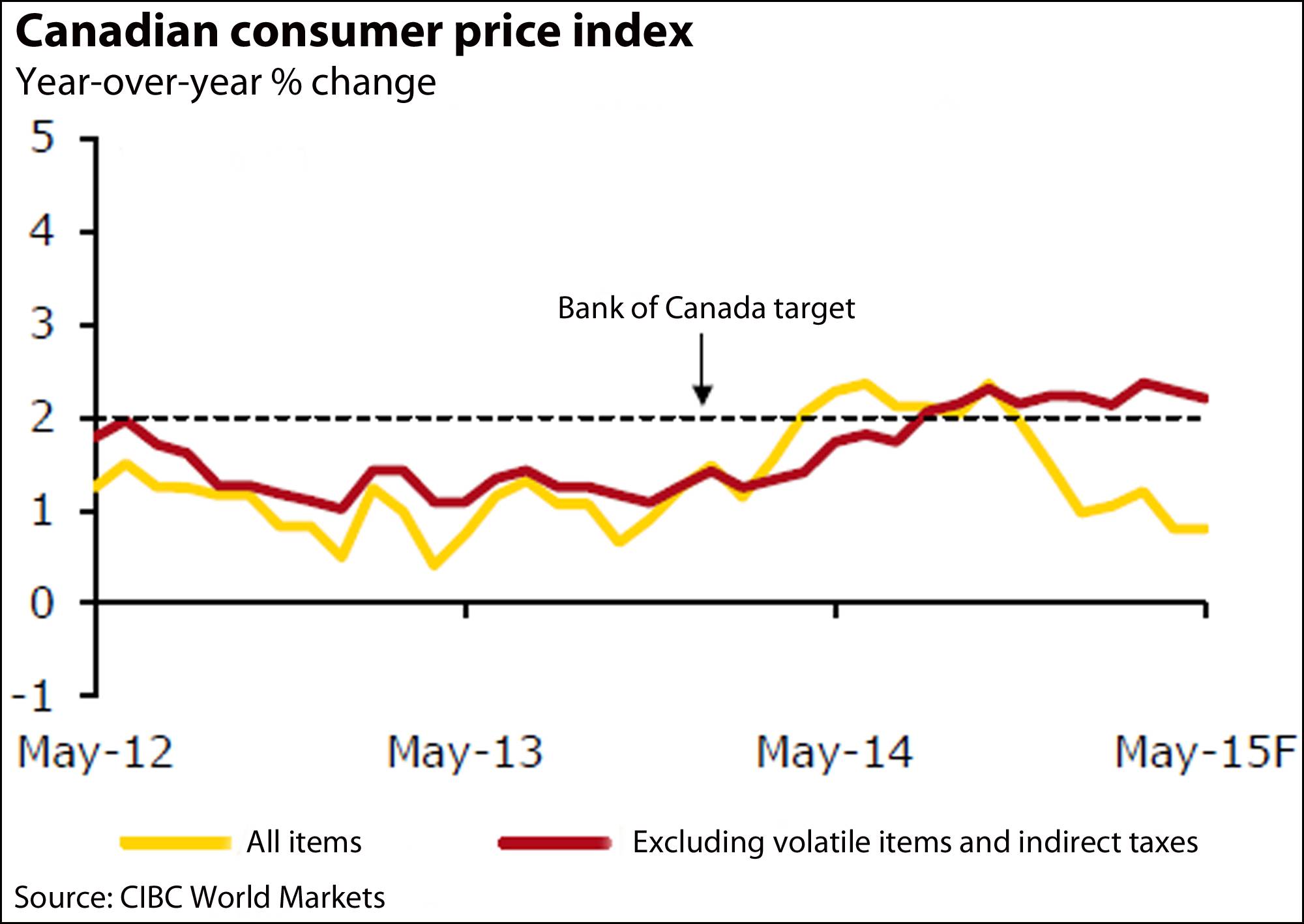
The Canadian reports are expected to show consumer prices rising 0.5 per cent from April and 0.8 per cent from a year earlier, and retail sales up somewhere in the 0.5-per-cent range.
“Headline prices slid a bit more than the street was expecting in April, but May should see overall inflation hold steady, albeit at the relatively muted 0.8-per-cent level,” said Nick Exarhos of CIBC World Markets.
“That stability will be driven by a firming in gas prices, along with food inflation holding near its almost 4-per-cent year-over-year pace.”