Briefing highlights
- A word of advice to helicopter parents
- Loonie's relationship with oil 'breaking down'
- Canadian factories score sales gain
- BHP posts whopping loss
- Video: Use of social media in the office
Stay out of it
A word of advice to helicopter parents: Employers don’t want your input.
A new U.S. survey by OfficeTeam, part of the Robert Half group, found 35 per cent of senior managers find it “annoying” when the parents of potential employees intervene in the hiring process.
Thirty-four per cent said they wouldn’t advise it, but, on the other hand, they’d “let it slide.” And, surprisingly, most of the rest saw it as a non-issue.
“It’s a positive for mom and dad to help behind the scenes by reviewing resumes, conducting mock interviews and offering networking contacts,” Brandi Britton, a district president at the staffing service company, said in releasing the survey results.
“However, ultimately, companies seek employees who display self-sufficiency and maturity.”
While that may seem obvious, one is struck by the lengths to which some parents went, according to the managers surveyed:
“The candidate opened his laptop and his his mother Skype in for the interview.”
“A woman brought a cake to try to convince us to hire her daughter.”
“One parent asked if she could do the interview for her child because he had somewhere else to be.”
“A father asked us to pay his son a higher salary.”
“A job seeker was texting his parent the questions I was asking during the interview and waiting for a response.”
“Once a father called us pretending he was from the candidate’s previous company and offered praise for his son.”
“Moms and dads have called to ask why their child didn’t get hired.”
And then there’s this: “When we called one candidate, his mom answered and asked us not to hire him.”
‘Glitch in the matrix’
Oil and the Canadian dollar are parting ways, in a move that may support the loonie, CIBC World Markets says.
“The strong inverse correlation between oil and [the Canadian dollar] cannot be expected to last forever, and we’re finally starting to see signals that the relationship is breaking down,” said Bipan Rai, CIBC’s director of foreign exchange.
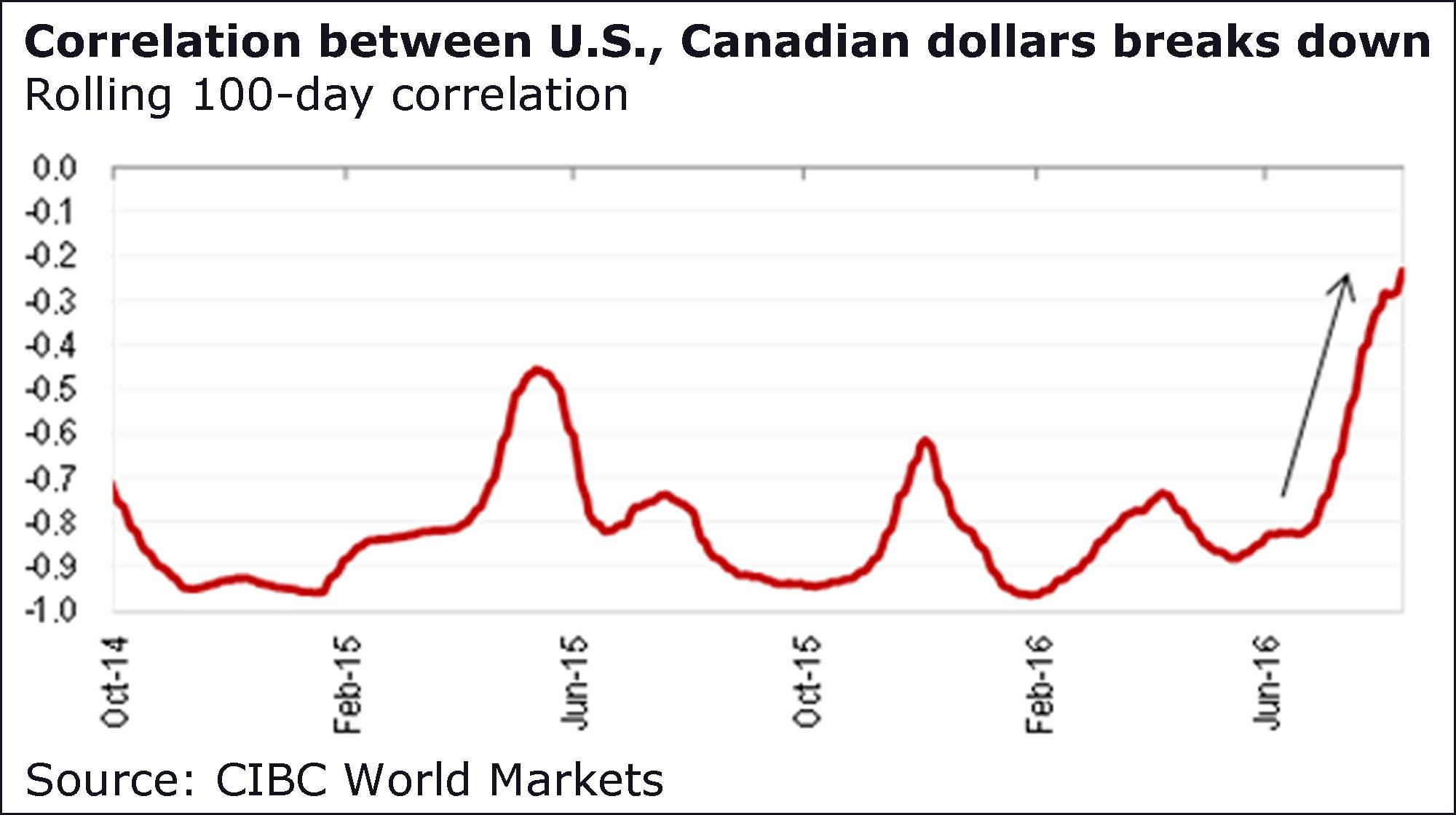
“Generally, one would expect this to be the case since oil isn’t making fresh lows and instead appears to be settling into a long-term range,” he added in a recent report.
The loonie has been on a downward spiral since the oil shock began a couple of years ago, and has been moving up or down from there depending on factors of the day, but particularly the price of crude.
“From a fundamental perspective, the co-movement makes sense,” Mr. Rai said in his report titled “A glitch in the matrix?”
“Oil is Canada’s most important natural resource export and its collapse was the primary reason that the Bank of Canada eased rates twice last year.”
Société Générale looks at it somewhat differently: Oil-linked currencies like the loonie are “now overvalued” when you look at crude prices and the U.S. dollar.
The Canadian dollar, Brazil’s real, Norway’s krone and the ruble are now “slightly expensive,” the bank’s currency analysts said, adding that the relationship between oil and those currencies is “significant” still.
“In effect, despite the slide in oil price in July, oil-linked currencies have failed to reflect the recent oil price weakness,” they said in a report Monday, though crude has rallied in the past few days.
“Despite this, we retain our positive stance on the overall oil-linked currencies space, as we have a constructive view on the outlook for oil prices over the medium term.”
Mr. Rai believes that as oil’s influence on the currency wanes, foreign money pouring into Canada will now be the indicator to watch.
“For all of its economic woes and struggles, Canada is still a triple-A credit in a shrinking pool of them and a beacon for stability in a world of unconventional monetary policy and fiscal restraint,” he added.
“For Canada, the inflow of foreign portfolio flows helps to finance a still-wide current account deficit as the recovery in non-energy exports still lacks vitality.”
These foreign inflows, Mr. Rai said later, are supporting the Canadian dollar, which now could perform better than what’s expected by CIBC, which is for the loonie to sink to about 73 cents U.S. in the next three to four months, from close to 78 cents now.
Factory sales rise
Canada’s manufacturing industry scored a win in June, with sales rising 0.8 per cent after a 1-per-cent drop a month earlier.
The bulk of the gain was driven by shipments of machinery and transportation equipment such as cars and parts, according to the latest reading from Statistics Canada.
“The volume gains point to a sharp rebound of GDP in June after the prior month’s slump,” said National Bank senior economist Krishen Rangasamy.
“The picture is less rosy for the quarter as a whole,” he added.
“Real factory shipments fell 4.6 per cent, annualized, in [the second quarter] while real inventories slumped 4.8 per cent in the quarter. That’s the worst combination of sales and inventories since the 2009 recession.”
BHP posts big loss
BHP Billiton posted a whopping annual loss as it warned that commodity prices are expected to stay “low and volatile.”
The giant mining company lost $6.4-billion (U.S.), slumping from a profit of $1.9-billion a year earlier, though chief executive officer Andrew Mackenzie cited several gains.
“The last 12 months have been challenging for both BHP Billiton and the resources industry,” Mr. Mackenzie said.
“Over the past five years we have actively reshaped our portfolio, and we are confident we have the right mix of commodities, assets and opportunities to create substantial value over time,” he added in a statement releasing the numbers.
“While commodity prices are expected to remain low and volatile in the short to medium term, we are confident in the long-term outlook for our commodities, particularly oil and copper.”