Briefing highlights
- Central bank not expected to change rate
- But it is expected to revise outlook
- Markets at a glance
- Air Canada profit more than doubles
- Visa profit rises 11 per cent
- TransCanada to sell Ontario solar assets
Much uncertainty for BoC
Canada's economy has been unseasonably hot, but this could well be the winter of Stephen Poloz's discontent.
There's got to be a lot on the Bank of Canada Governor's mind as we head into colder days, both literally and economically.
From trade to housing to the Canadian dollar, we should learn more this morning as Mr. Poloz and his central bank colleagues release their rate decision and accompanying monetary policy report.
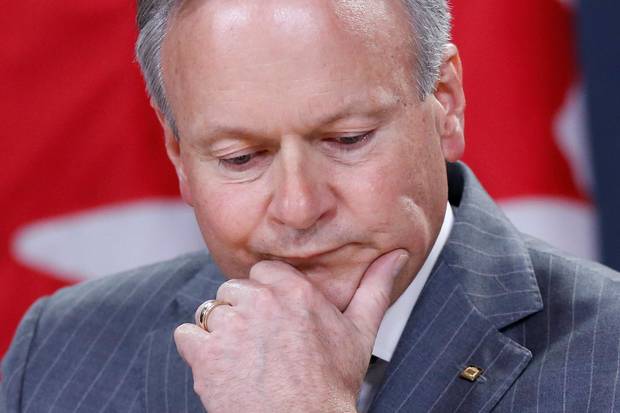
Bank of Canada Governor Stephen Poloz takes part in a news conference in Ottawa, July 12, 2017.
CHRIS WATTIE/REUTERS
Having raised its benchmark overnight rate twice this year, to 1 per cent, the Bank of Canada isn't expected to move again today. But markets will be looking for clues on the possibility of another hike in December in a world fraught with uncertainty.
"While nobody is pricing in much chance of an October rate hike, the market could further take down odds for a December move if, as we expect, the bank highlights uncertainties in the outlook that it needs to resolve before moving again," said CIBC World Markets chief economist Avery Shenfeld.
While Canada's economy has certainly performed much better than expected – and that will be reflected in today's report – growth is expected to slow.
On top of that is trouble on the trade front as negotiations over the North American free-trade agreement have soured, with the next round scheduled for November, possibly giving Mr. Poloz more clarity heading into the winter.
Then there's housing. The Bank of Canada said as it raised interest rates that it will monitor the impact on consumers, whose debts are dramatically high.
Added to that are new policy measures, the latest from the commercial bank regulator on mortgage financing.
"We estimate that housing demand could fall by 5-10 per cent, while prices could slide by 2-4 per cent in 2018 relative to baseline, as a result of the change," said Toronto-Dominion Bank economist Dina Ignjatovic.
"Given these mortgage rule changes, combined with other regulatory changes in some regional markets such as Ontario, the Bank of Canada will have to be cautious in its tightening approach, so as to ensure a soft landing in the housing market."
As for the loonie, "look for the section on inflation to note the pick-up in core measures, while noting that the recent sharp appreciation of the Canadian dollar could act as a dampener over the next year," said Benjamin Reitzes, Bank of Montreal's Canadian rates and macro strategist.
And, CIBC economists added in a new currency outlook this week, "even if NAFTA talks turn out constructive, the recent widening in Canada's trade deficit and general malaise in non-energy exports … suggest that the economy needs a weak exchange rate to get that sector going again."
Thus, the uncertainty. Indeed, there are many uncertainties that "can't be assessed by pushing a few buttons on the Bank of Canada's forecast model," said CIBC's Mr. Shenfeld.
"There's no variable in the model for 'NAFTA ends.' There's no button on the computer for 'new mortgage rules,' There's no historical precedents that can be used to confidently measure the growth and inflation impacts of a minimum wage hike as large as the one Ontario is about to institute."
Read more
- David Parkinson: Rate hike prospects dwindle as growth cools
- David Parkinson: Falling exports signal a slowing Canadian economy
- IMF warns Canada over perilous, longer-than-average credit boom
Markets at a glance
Read more
More news
- Air Canada profit more than doubles on tax gain
- Visa quarterly profit rises 11 per cent
- TransCanada to sell Ontario solar assets for $540-million