It’s not even 6:30 a.m. and Georges St-Pierre is only two sips into his first cappuccino, but as he climbs into a luxury SUV at the Westin Harbour Castle in downtown Toronto to head out for a marathon day of interviews, he wants to know whether his PR person has watched the video of last week’s U.S. congressional hearing on UFOs. “Insane, huh?” he says, approvingly.
The publicist admits she caught only a bit of the hearing – it’s been a busy time, lining up all of the elements of this one-day whistle-stop tour through Toronto media outlets to promote a unique speaking engagement that St-Pierre will do at the end of the month – but she says she did click through to some of the links he sent her about the phenomenon.
“Yeah, the Mahabharata,” he says, referring to one of the links. He’s talking about the ancient Indian epic poem, which contains descriptions of flying chariots that some people believe may have been either UFOs or man-made vehicles using technology developed by extraterrestrials. “I don’t know what it means,” he adds with a quizzical tone. “It’s all about how they interpret it.”

Georges St-Pierre, punching up at Jake Shields in 2011's UFC welterweight title bout, retired from UFC eight years later.Fred Lum/The Globe and Mail
From his first UFC title win in 2006 as the welterweight mixed martial arts champion, St-Pierre was one of the most feared men on the planet. But after winning the middleweight belt in 2017, he chose to go out on top, officially retiring in Feburary, 2019. So, while he has become an entrepreneur, he has also had a lot of time to indulge his interests.
They are evidently manifold. Over the course of a long day, dawn to dusk spent shadowed by a reporter and photographer, he will talk at length about UFOs – or, rather, UAPs (Unidentified Anomalous Phenomena) as they have been rebranded in order to lose the weirdo taint of the original acronym – about the Mesozoic era and dinosaurs (he has a small collection of fossils and bones), about health and fitness, self-hypnosis, ancient civilizations, philosophies of pleasure and pain. He will be curious, and he will be unashamed if he doesn’t know something – at one point, he apologizes for what he calls “my ignorance,” and asks about the difference between Canada’s parliamentary democracy and the systems of government in the Republics of France, Germany, and the United States.
And there is something else. When St-Pierre, 44, sits down for an interview late in the afternoon, he will reveal, for the first time ever, that he is a husband and a father, sharing details about life at home on the south shore of Montreal that make him sound like any middle-aged dad with a house full of love and chaos and obligations.

As the sky begins to lighten, the driver noses the car into traffic and the publicist, an arts world veteran named Victoria Lord, outlines a few last-minute instructions for the day ahead. Over the ensuing 13 hours, St-Pierre will do 24 interviews at nine locations, including two stops each at the Bell Media and Rogers Communications headquarters. (If the car had a tracking app, the group’s movements across the downtown core would draw something approximating one of those murder walls in a police procedural.)
Lord explains to St-Pierre that one of his first interviews will be with Maurie Sherman, part of the local radio station KISS92.5’s frisky morning crew. “He does a lot of social media. He’s a jokester, so we want you to have a lot of fun,” she says. “It’s not going to be straight-up questions.” St-Pierre replies: “Ah, so if he makes a bad joke about me, I should be like” – he adopts a fake screaming voice, like a manic wrestling promoter – “Are you making fun of me?!”
She nods and reminds him that some interviewers may forget to include details about the evening he is promoting, such as where to buy tickets.
“I’ll slide it in,” he replies, then practises the line he’ll use through the day. “‘I’m in Toronto to promote the show, GSP: Instinct of a Champion, Sept. 29 at Meridian Hall. Tickets are at Ticketmaster.ca.’” (The actual title of the event is An Evening with Georges St-Pierre: The Instinct of a Champion.)

Lord, St-Pierre and writer Justin Kingsley, at rear, have nine locations to get to today for 24 interviews in all.
GSP, as he is known to his fans, flew into Toronto last night from Montreal with Justin Kingsley, a friend and collaborator who is co-writing the script for the event and accompanying him on some of today’s interviews. By the time they arrived, it was too late to hit any one of his favourite restaurants: the Italian spots Sofia or Sotto Sotto in Yorkville, or the downtown steakhouses Jacobs & Co. or Harbour 60.
“I have a routine, everywhere I go, I always go to the same spot,” St-Pierre admits. “If someone hired a hitman to get me, I would be the easiest target.”
Kingsley chuckles and elaborates. “Let me demystify it. There’s either a gym involved, or food. There’s no hangouts where you say, ‘What’s your favourite place to go shopping?’ There are no favourite places to go shopping. He hates it. But we have to eat and he has to train every day.”
The two first met about 15 years ago when Kingsley, who was then a partner with the ad agency Sid Lee, developed the strategy that would be used to transform GSP into a consumer brand.
They went on to co-write St-Pierre’s 2013 autobiography, GSP: The Way of the Fight, which included some tough stories about the fighter’s upbringing – his rough family life, the relentless bullying that characterized his childhood in St-Isadore, Quebec – that would form one of the pillars of Instinct of a Champion and springboard into other details St-Pierre has never discussed.
The car arrives at the head offices of Rogers Communications on Bloor Street East a few minutes before 7 a.m., where St-Pierre is whisked through security and then to a studio upstairs for a pair of 5-to-6-minute radio interviews at CHFI and KISS92.5. By 7:30, he is back downstairs, in the green room for CityTV’s Breakfast Television. A producer outlines for him and Kingsley how their segment is going to proceed and what questions the host, Tim Bolen, may ask. A makeup artist does a quick touch-up on St-Pierre: just some powder to dull the shine of his face.

St-Pierre is not really fighting Tim Bolen of CityTV Breakfast Television; the headlock is just for show.
As it unfolds, the segment sets a template for many interviews that follow through the day. In his intro, Bolen describes the event on the 29th as “untold stories, raw reflections, and a deeper look at the mindset behind the champion.” St-Pierre tells Bolen that, when his autobiography was published, he was still an active fighter, “and there’s a lot of fight insight that I couldn’t talk about, and also a lot of personal stuff. My personal life has always been the most precious thing I have. It’s not the belt, the trophies. It’s my personal life. As a fighter, you want to hide those, because your adversary can use that against you. So that’s why at the time I couldn’t talk about it.”
He adds: “I never liked to fight. I used that to propel me where I wanted to be in life.”
Kingsley teases that the event will delve into “personal things about family, about self-growth, things that happened when he was a kid, when he was a teenager.” St-Pierre hears this, points at his friend and cracks: “He’s going to try to make me cry!” and all three men laugh. Later, St-Pierre and Kingsley say the moment wasn’t planned, but it works so well they perform a version of it in almost all of the other interviews through the rest of the day.

The group meets the car out on Bloor Street and heads down to the Bell Media building at 299 Queen Street West for a pair of live TV hits: both men on CP24 Breakfast, with Jee-Yun Lee at 8:20 a.m., followed by St-Pierre sitting down alone at 8:48 a.m. with Anne-Marie Mediwake on CTV Your Morning.
St-Pierre begins the first interview by telling Lee that he wanted to do Instinct of a Champion because, “we live in a world dominated by social media, and I’m a good old-fashioned guy, I like to have contact with my fanbase in person.” The line seems to land: He keeps that, too, in the rest of his interviews.
At one point during the interview, Kingsley praises St-Pierre as a “great Canadian,” and the fighter’s face seems to go blank, almost as if he is uncomfortable listening to the adoring words in such close proximity. That isn’t the only time he seems withdrawn. When the cameras aren’t on, he’ll stand with his hands in the pockets of his Boggi khakis, like a kid in junior high school trying not to draw notice during a school dance. As a fighter, St-Pierre was often a restrained presence, leaving it to his opponents to waste movement and tire themselves out. Without warning, he would strike and then quickly draw back in defence. He seems to have a similar approach to interviews: lying in wait for the right moment, extending himself, and then pulling back.


Ryan Parker, Shawna Whalen and Ben Mulroney were among the broadcasters to greet St-Pierre and Kingsley at Corus headquarters.
The car heads down to the headquarters of Corus Entertainment on Dockside Drive, nestled on the shore of Lake Ontario, for interviews on Q107, 102.1TheEdge, Global TV and Corus Radio. Lord tells St-Pierre that, at the conclusion of his TV interview on The Morning Show, the host Jeff McArthur may ask him to demonstrate an MMA move.
“Choke him out!” says Kingsley. “It’s good social content.”
St-Pierre, of course, does nothing of the sort. Indeed, when the show’s producers ask him whether he might like to meet a few folks from an insurance company who are in studio to watch a new segment they were sponsoring, he obliges with a big smile and doesn’t leave until everyone gets the selfies they wanted.
At 10:15 a.m., St-Pierre and Kingsley are on Corus’s The Ben Mulroney Show for a 10-minute segment. When it wraps, Mulroney calls a friend on FaceTime who’s a huge MMA fan, and passes the phone to St-Pierre. The friend answers and, seeing his hero in the frame, squeals like a kid at a birthday party. St-Pierre reacts like a welcoming maître d’, telling the friend what a pleasure it is to meet him.
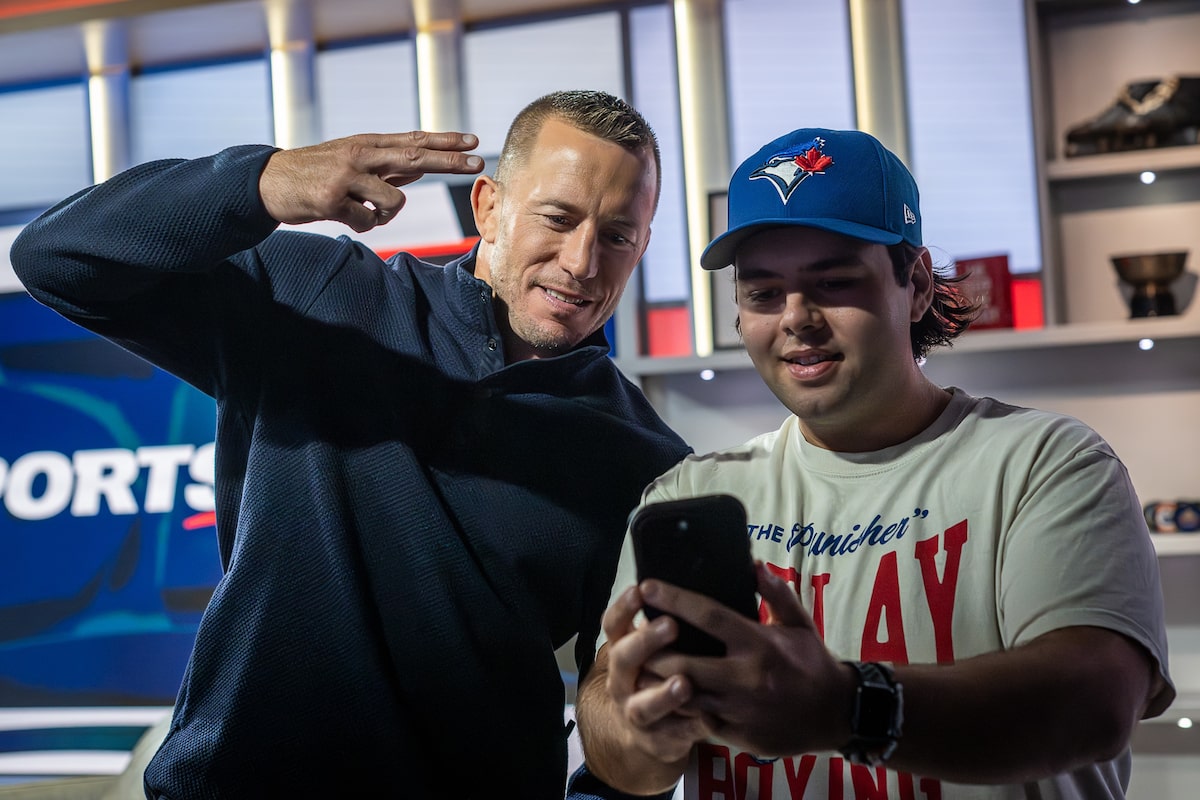
This happens too many times to count over the ensuing hours: a talent coordinator at CTV’s eTalk, vibrating with excitement, gets a portrait with St-Pierre on the couch; a lighting operator at Sportsnet snags a happy birthday message for his brother; the executive producer of UFC on Sportsnet scores a portrait; an ESL student from Mexico passing time in the Rogers lobby reacts as if he’s having a (happy) nervous breakdown when he sees St-Pierre on the way to the car, and he stops him for a selfie.
“There’s nothing more disappointing to me than when you see an athlete that, when you have people coming, they refuse to do that,” St-Pierre explains later. “They’re the reason athletes are able to [succeed].”

By 4:30 p.m., 10 hours in, the day’s mad dashes are beginning to recede. He and Kingsley have just finished a half-hour spot on Sirius XM, and St-Pierre is now seated in the executive boardroom of The Globe and Mail for an interview. It may be that all of the performing he has done through the day is beginning to wear on him. He closes his eyes, as if to consider a question; he seems in a contemplative frame of mind.
All day long, his hands have been in a gentle fidget during interviews: fingers pressing together and then coming apart, or thumbs flicking each other. They’re at rest right now, on the boardroom table, and when you see them up close, these former weapons of war, now all manicured and buffed and muscular, they look like something that has come out of Michelangelo’s workshop.
From the beginning this morning, interviewers have been asking St-Pierre which would make him more nervous: the long walk to the octagon or laying himself bare onstage, as he will do later this month. You could tell he wanted to play along, to reveal for them that the one-time world’s most coldblooded warrior actually might be felled by common stage-fright, but he just couldn’t: His autobiography is filled with accounts of the sickening fear he experienced as a fighter. He is ecstatic, he says now, to be out of that life.
“When I retired, I retired with a smile,” he says. “I was free. I felt like I was a little bit in a prison, so to speak, you know? Because as soon as I finished a fight – I was happy, but immediately after, there’s another guy lined up, and you’re like, ‘Oh, God, man, give me a break.’ But it was like that my entire career.”
St-Pierre trains in 2013 to best Johnny Hendricks, and then fights him in Las Vegas a month later. Today, St-Pierre remembers obsessing about strategy in those days.The Canadian Press; The Associated Press
He is, he notes, obsessive-compulsive, though he says he has not actually been diagnosed. (Still, he had cited the condition as one of the reasons he vacated his title in 2013.) It was severely debilitating, because he wouldn’t be able to stop thinking about how to solve an opponent. “It makes you completely insane,” he says.
He offers an example. One day – this was some years ago – he was driving along the Decarie Highway when he glanced at the odometer and decided that he would hold his breath for the next two kilometres. He demonstrates, sucking in a deep breath. “And I’m driving – and then I’m at 1.9 kilometres, and there is 100 metres left, but I’m stuck in traffic and I’m NOT GOING TO MAKE IT! I go on the side – vroom! – I do my 100 metres, and I’m like” – he lets out a sudden rush of breath.
“I know it is dumb as hell, but these are the things that make me who I am,” he says. “I’m completely crazy, but this is the thing that you need to be if you want to be the best in the world, especially in combat sport. We all have our thing, you know? For me, it was that.”
How does he evolve that characteristic to fit into his post-fight life?
“I was forced to change, because I couldn’t keep up the same mentality. I needed to let go,” he says. “I have five kids,” he adds. He checks to see if this revelation has registered. (It has.) “Nobody knows. I have five beautiful kids.” He pulls out his phone and produces a family portrait of himself, his wife, and five adorable children – two boys and three girls – who are now between the ages of 11 and four.
His wife, Divine Kirezy, is from Rwanda. Her family fled to Europe during the genocide in 1994 and eventually settled in Canada. “I had a crazy life as an athlete, coming from a crazy background, crazy sport, but I really feel like I met an angel, and it was the perfect person for me, you know?”
These are the sorts of things that he will talk about in the show. “I never talked about it before, because I was protecting it. I never put it on social media, because my social media is business, and I want to protect the identity of my kids.”
He loves them dearly, but it can be hard to handle when things get out of order (as every parent knows is inevitable). Last week, he came back from a trip to Austin, Texas, and his things – which are normally, he says, “like military, organized” – were in disarray. “I step on a toy, I’m like – God! I often have to” – he imitates himself taking a deep breath. “‘Okay, it’s normal. Let go.’ And I have to pause, because it drives me crazy.”
“It’s very challenging, the chaos,” he acknowledges. “But it’s okay. It helps me to grow as an individual and become better. You know?”
He and Kingsley head over to the University Club, an august century building of oak panels, crystal chandeliers and vaulted ceilings, for a tight 25-minute fireside-chat-with-cocktail event hosted by the publisher of Toronto Life. There, St-Pierre delivers the hard-won nuggets of wisdom he’s been offering up all day. As the clock strikes 7 p.m., he thanks the audience for their time, bids them adieu and slips out a side door, through the kitchen, and down to the car, which is waiting to speed him to Toronto’s Island airport: Just another middle-aged father on a business trip flying home to the unruly jumble of real life.
