Canadians will have to play big roles if Gonzaga, a little university in Washington state, is to live up to expectations and make some big March Madness noise.
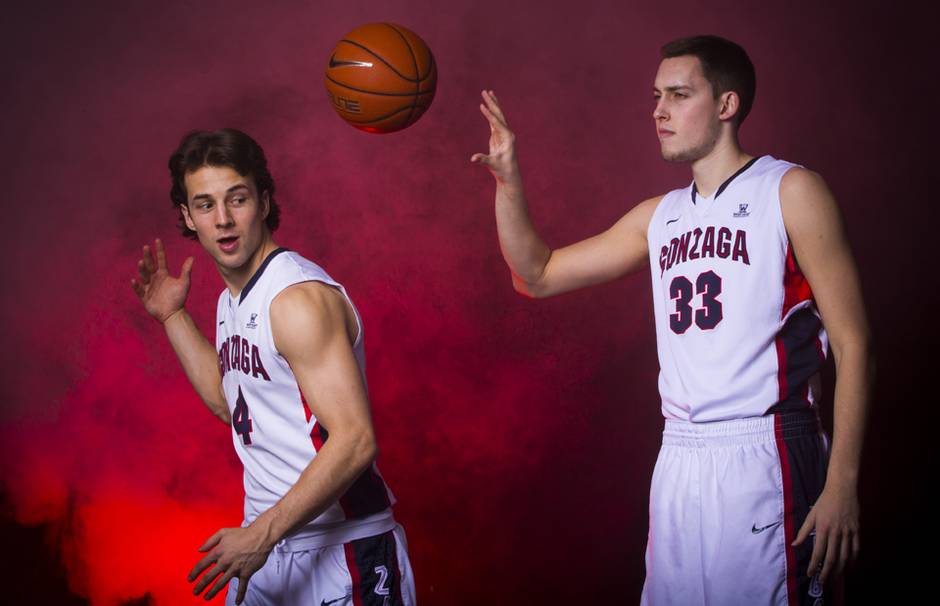
The arena at Gonzaga University is quiet at midday, a couple hours before practice. Mark Few walks up to his star point guard, Kevin Pangos, who grew up north of Toronto and sits courtside.
Few has long recruited basketball talent from Canada. Kelly Olynyk of the Boston Celtics and Robert Sacre of the Los Angeles Lakers are two Canadians who recently were pillars at Gonzaga.
“Kevin doesn’t say aboot,” says Few, making observations on the nuances between the United States and its northern neighbour. “I used to,” says Pangos, “but it changed.” More differences that separate Americans and Canadians are discussed – Canadian content on the radio, the spelling of ‘o-u-r’ words – and then the big one: Z.
“Zed? What?” Few says, learning the letter is pronounced zed. “Zee is, really? It’s called zed? Why there’s some stuff I need to keep digging in to.”
The distinction between zed and zee may be new to him, but Few knows Canada well.
When he took over as head coach of Gonzaga in 1999, the small university was struggling financially and had no standing in college basketball, save for the unlikely run to the final eight teams in the NCAA’s March Madness it had made several months earlier. Few led the team back to the Sweet Sixteen his first two seasons and has never missed the tournament since, a remarkable run.
In recent years, it has been powered by Canada – doubly so this season. First, there is Pangos, a 22-year-old senior from the village of Holland Landing, Ont. No one has hit more three-pointers and won more games in a Gonzaga Bulldogs uniform than Pangos.
An essential new arrival is (half) Canadian, Kyle Wiltjer. He grew up in Portland, Ore., but his father Greg is Canadian, a former national team player. Kyle, a 6-foot-10 forward, played his first two years at the powerhouse University of Kentucky. He then made the unusual decision to transfer to Gonzaga – akin to abandoning Manhattan for the rural west. Wiltjer sought transformation. The lure was Travis Knight, Gonzaga’s guru trainer, who had overhauled the body of Olynyk and helped propel him to the NBA.
This winter Gonzaga put together its best-ever record, 32-2, one win better than two years ago when Olynyk and Pangos helped score Gonzaga’s first No. 1 seed in March Madness. But the team couldn’t make it past the first weekend, winning one before losing. Gonzaga hasn’t reached the Sweet Sixteen since 2009. A reputation ferments: Gonzaga’s good but not when it really counts.
The tournament begins anew next week, with Gonzaga a likely No. 2 seed. Few, the son of a Presbyterian pastor, together with the Canadians who lead his team, seeks redemption.
Wiltjer won a national championship at Kentucky in 2012 but was a small part of the victory. He learned how hot the spotlight felt. “You’re in the heart of it there, every night,” Wiltjer says. “Playing on that stage, and not letting it get to your head.”
This time, it is on Wiltjer and Pangos, both named this winter to a list of the top-20 players in U.S. college hoops. Gonzaga has one of the most potent offences, underpinned by a deep roster, and is the most accurate shooting team in the country. “We want,” Wiltjer says, “to prove everybody wrong.”
‘An off-the-charts shooter’
Pangos remains after practice ends. It’s late February and he puts up a series from behind the three-point arc, then toes the free-throw line. He sinks shots with metronome-like efficiency. This is meditation for the shaggy haired 6-foot-2 point guard – the mechanics, the movement, the repetition.
In his first game as a freshman, he was a substitute off the bench. Pangos made the starting five the next game and he banged down nine three-pointers, tying a school record. He started every game thereafter.
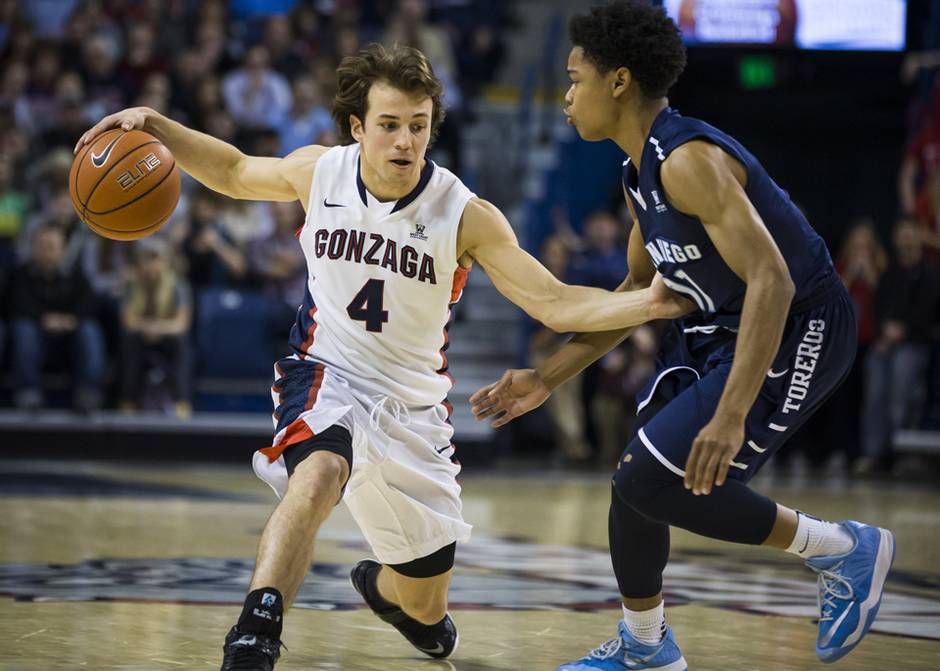
Pangos, like Wiltjer, was born in a basketball family. His mother Patty played at McMaster University in Hamilton, where she’s in the athletics hall of fame. His father, Bill, played at the University of Toronto and has, for almost 30 years, coached the women’s team at York University.
From boyhood, Pangos had a singular goal: “I wanted to play professional basketball,” he says.
He played many sports but basketball was central. The Pangos family lived on a quiet crescent and they had a portable hoop. Inspired by a story Kevin had heard about Steve Nash putting up 500 shots a day, he was always shooting. “Hours on end,” remembers Bill, who coached numerous teams Kevin played on growing up. “It didn’t matter what the weather was.”
Indoors, after an extension was built on the family home, Pangos put in dribbling sessions in a basement room with a tiled floor, an old mattress leaned against the wall to hit for passes, a clothes hanger to serve as a scarecrow defender, and the radio turned loud.
The intersections of a golden generation of Canadian basketball players began to emerge in Kevin’s youth. During several summers at the Olympia Sports Camp near Algonquin Provincial Park, Kevin devoted every spare minute outside official basketball practices to go at it one-on-one with another camper, Nik Stauskas from Mississauga, 21, who is now an NBA rookie on the Sacramento Kings. “All week, non-stop,” Pangos says with a smile at the memory of their contests.
Later, when Pangos was 17, in the summer of 2010, he helped lead Canada to bronze medal at the under-17 world championship in Hamburg. It was Canada’s best-ever result for the age group.
On a roster with a 15-year-old Andrew Wiggins – Pangos’s roommate at the tournament – and another future No. 1 NBA pick, Anthony Bennett, Pangos was the team’s top scorer and named the championship’s top point guard. Later that summer, Pangos was together again for Canada with Wiggins and Bennett at a North American tournament organized by Nike. There he met Kyle Wiltjer, who had made the decision to play for Canada internationally.
March Madness is the immediate focus for Pangos and Gonzaga, but as his compatriots have reached the NBA, Pangos keeps one eye on his boyhood goal. Pangos – who has hit 42 per cent of his three-pointers in college – may not be picked in the two rounds of the NBA draft, but he is expected to get a shot with a team at NBA Summer League. Then there is the challenge to crack a NBA roster, or work through the development league, or choose to play in Europe.
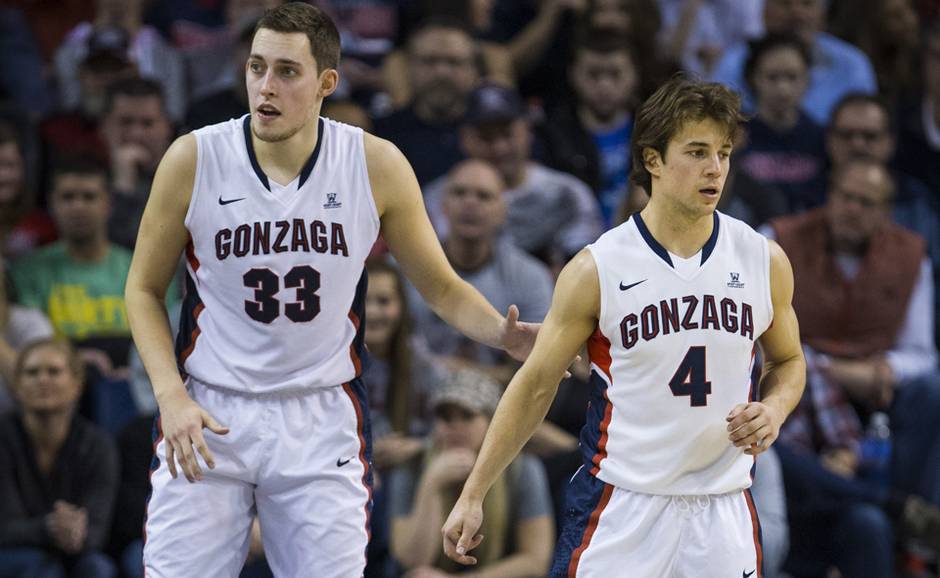
“He’s done more than enough at the collegiate level and internationally that he’s going to have people looking at him,” says Leo Rautins, Canada’s former national team coach.
Point guard is a position where there is considerable depth of talent – but Few believes Pangos’s shot sets him apart. “He’s an off-the-charts shooter,” the Gonzaga coach says. For those with great shots, the line between making it and not is a fine one. Stauskas was picked No. 8 by the Kings in last June’s draft. Brady Heslip, another ace shooter from the Toronto area, went undrafted last June, played in summer league, then lit up the development league. He now stars in a league in Bosnia, working toward his NBA shot.
“Whatever Kevin needs to master,” says Few, “he figures it out. ‘Okay, this is what I’ve got to do’ – and then, bang bang, he goes out and solves it.”
‘Be unusual’
Travis Knight grew up in the Seattle area, played baseball as an undergraduate at Gonzaga and studied physical education. After he finished a master’s degree in exercise science at Wichita State in Kansas, he returned to Gonzaga. His official title is ordinary: strength and conditioning coach. But sitting in his small office in the corner of a weight room at Gonzaga, eating a lunch of steel cut oats, agave and cranberries, he sounds more like a mystic of muscles.
He calls some of his training work “maybe even philosophical in nature.” The core idea: “Our limitations are temporary.” It’s a matter of practical necessity. Gonzaga, even with its run of March Madness appearances that ranks with perennial powers such as Kansas, Duke and Michigan State, is still a small school. “We have to be unusual.”
Four years ago, Knight unfurled his ideas when he worked with Olynyk, a 7-footer who had two mediocre years at Gonzaga before he took an entire season off to work on his body.
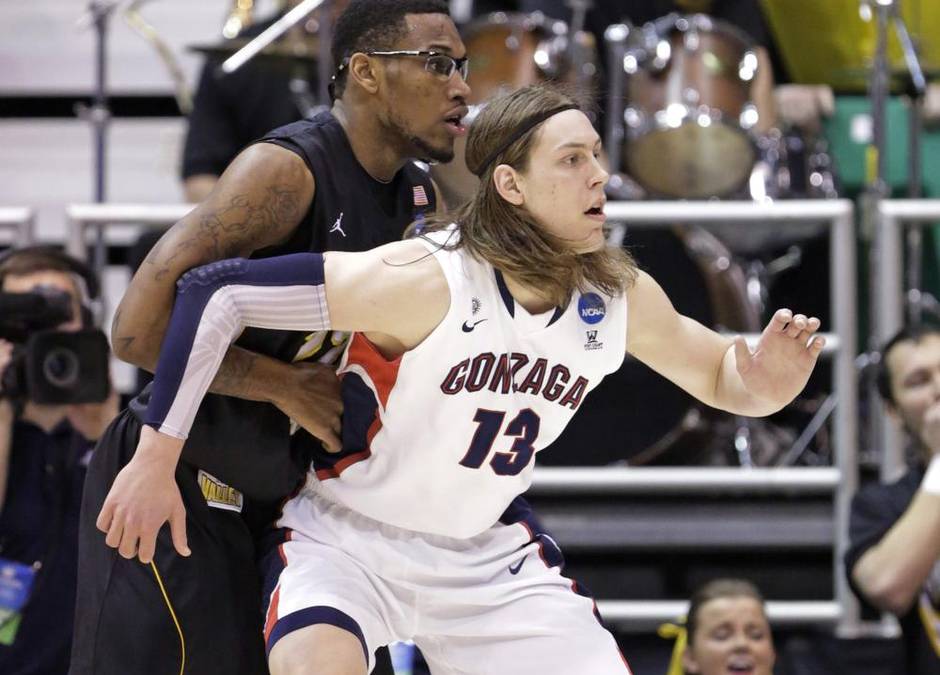
One of Olynyk’s problems was that he would trip over himself when he quickly shifted to forwards from backwards. Knight developed drills to get at the “neurological workings” of the brain to improve “physiological capacity.” One task involved a series of numbered tennis balls, which Knight would toss and, depending on the number, Olynyk would react in a certain direction. Then they’d incorporate the difference between numbers of successive balls. Agility combined with mathematics. It demanded all the attention of the brain’s motor cortex.
“The level of processing – you’re not aware of your feet at all,” Knight says. “Like when you drop your cellphone and catch it with your foot. It’s instinctive. That can’t travel to the motor cortex, where you’re trying to remember: it is the right foot or left foot?”
Olynyk emerged a remade player and made the NBA. Wiltjer, finishing his second season at Kentucky, had met Olynyk at Canadian national team camps and saw the change. He made the leap.
‘Play with wild abandon’
As a boy, Wiltjer learned the game from his father, Greg, who came to basketball late, in the Victoria area in Grade 11, when a growth spurt shot him toward 6-foot-11. Greg struggled at first but quickly flourished. After university in the U.S. and Canada, he was drafted in 1984 in the second round by the Chicago Bulls and played for Canada at the Summer Olympics in Los Angeles, where Canada finished fourth and Greg was the tournament’s top rebounder. He didn’t crack the NBA and instead had a successful career in Europe.
Greg was a classic big man, strong in the post near the hoop, and schooled Kyle on fundamentals. “Be comfortable close to the rim,” Greg says. “You have to play with both hands.” Before every practice, there was the Mikan drill, named after legendary centre George Mikan and standard practice for big men. Kyle would put up 100 shots, all from right under the hoop, rolling the ball up and in with hooks, left and right, again and again.
“As a little kid,” says Kyle, “that drill sucks. Your arms get tired. Your shoulders get tired. You don’t really realize why you’re doing it. ‘Dad, these shots are easy.’ Now, I have a really good touch. It’s just instinct.”
Wiltjer soon developed a strong touch from a distance. Greg remembers Kyle hitting 10 three-pointers in the second half of a game in his early teens. Around the same time, when the U.S. national program began to make inquiries, the family sat down to talk. Greg spoke about his time at the Olympics. It resonated. Kyle, born and bred American, chose to play for Canada internationally.
Greg had told his son about how the Canadian team was like family. And, indeed, the ties extend through generations. Greg was teammates in 1984 with Jay Triano, Canada’s leading scorer. Triano, now national team coach, was at the helm of Canada’s 2013 World University Games team that Wiltjer and Pangos played on. Triano’s son Dustin is a freshman teammate of Pangos and Wiltjer at Gonzaga.
Like Pangos, Wiltjer shone for Canada as a teenager. In 2010, playing for Canada’s under-18 team at the FIBA Americas championship in San Antonio, Wiltjer hit a ridiculous 16-for-23 from three-point range during the tournament. His last one was the winning three-pointer in overtime, with 1.7 seconds on the clock, against Argentina for the bronze medal. Wiltjer sank it near Manu Ginobili in the stands, the Argentine pro for the San Antonio Spurs. “It feels like yesterday,” he says.
Wiltjer could shoot as well as a guard from distance, but his inside game was weak. His body was the culprit. At Kentucky, where he arrived as a leading high school recruit, he was easily pushed around. His knees and hips always ached. In his sophomore year, he did win the Southeastern Conference’s sixth man of the year award but Wiltjer realized he needed to recalibrate. He looked to Gonzaga.
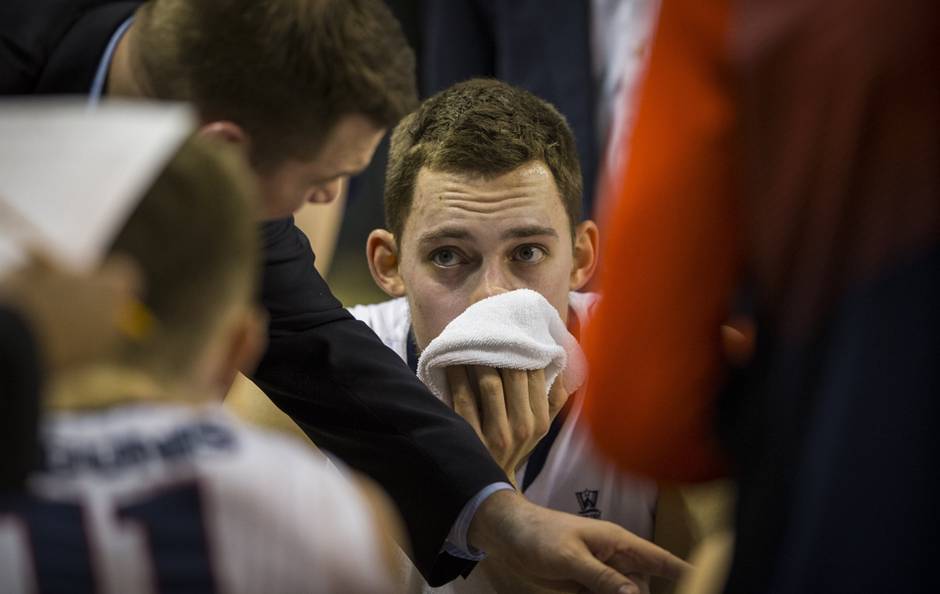
“Kyle is going to be a professional player as soon as his body begins to change,” wrote Kentucky coach John Calipari on his blog in 2013, at the time of the transfer.
What Knight saw in Wiltjer was a body out of whack. Wiltjer ran awkwardly, like a man twice his age. He lacked strength. His knees were so sore he couldn’t really jump off his left foot.
Wiltjer took a red shirt, as Olynyk did – a year away from games to focus only on physical work and practices. With Wiltjer, however, Knight had to rebuild basics – flexibility, stretching and yoga. After several months, they got to the heart of the program.
There were squats with weights under water in the deep end of the pool. On a sand volleyball court, Wiltjer lunged and jumped to catch tennis balls Knight tossed over the net and sent them back. In the gym, Knight heaved nine-kilogram medicine balls at Wiltjer’s body. Wiltjer absorbed the game-like blow – and then had to snatch it after it caromed off an exercise ball in front of him.
And there was dancing; not quite the formal dance lessons that Steve Nash had suggested, but close. Wiltjer would align himself on the half-court line and begin hopping. Once on his left foot, twice on his right. Then moving left, or right. Then hopping in front of or behind the half-court line. All the while alternating which foot hopped once or twice. The swirl of instructions dominated the motor context.
“Trusting his body,” Knight says. “To play with wild abandon.”
The grind was similar to the Mikan drills he’d done as a boy; the payoff seemed unclear.
And it was hard to be away from games. “Some of the stuff, I was like, ‘Why am I doing this?’” Wiltjer says. “You’re getting no recognition. Every day, you’re doing all the dirty work and no one really sees it. You’ve just got to trust in it.”
Wiltjer did not make as much progress in his year off as Olynyk – Wiltjer has one year of college eligibility remaining – but, like Olynyk, he has emerged as a new player, at the top of the college ranks. “Everything flows,” Knight says. “There’s a rhythm. He’s enjoying basketball.”
After 10 points a game in Wiltjer’s last year at Kentucky, he has climbed to 17 points at Gonzaga, nailing nearly half of his threes and playing strong inside. He has twice won a national player of the week award, the second time in February for a 45-point outburst.
A couple weeks later, Wiltjer landed on the cover of the Western edition of Sports Illustrated under the headline: Gonzaga Rising.
‘More sure of each other’
Gonzaga has fallen short enough times that it is easy to be skeptical. Coach Few, an outdoors man who fly fishes and mountain bikes, knows this. He maintains a zen. He’s been here a long time, like his father, the Presbyterian pastor who oversaw a congregation in a small Oregon city for more than half a century. Few has no interest in bigger jobs elsewhere. “I often wonder if that was ingrained in me,” says Few, in his office overlooking the basketball court, a space piled with trophies.
Few leads Gonzaga into March Madness, as head coach, for the 16th straight time. It’s one better than a 15-year run produced by the combustible Bobby Knight at Indiana. Tom Izzo at Michigan State has overseen a streak of 18 seasons. Mike Krzyzewski of Duke hits 20 this year. North Carolina’s Dean Smith, who died last month, holds the record of 23.
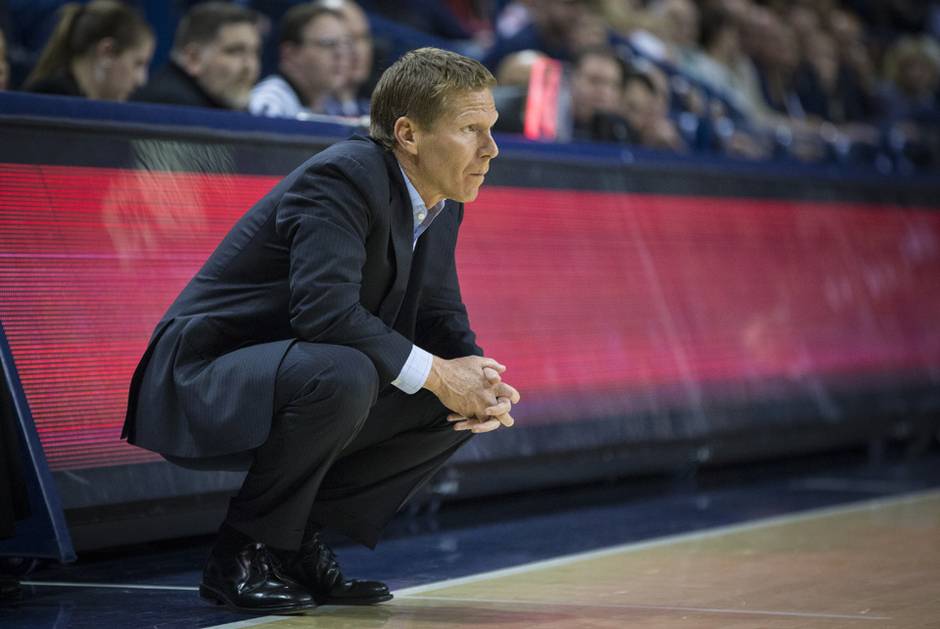
“Being able to make this thing 16 times,” says Few, casually dressed in jeans and a beige sports visor, “it’s crazy.”
Pangos has been a March also-ran three times, one win and one loss in each of his three years at Gonzaga. The team wobbled in late February – a streak of 41 wins at home, the best in the country, was snapped – but Gonzaga then decisively won its conference tournament. Some national commentators see something bigger. Jeff Goodman of ESPN has expressed confidence that Gonzaga can make a deep push. “They can score,” he said on SportsCenter. “They’re tough. They’re physical.”
Olynyk, watching from Boston, knows how easily it can end: “It’s going to be a tough last stretch.”
Back on campus, an old hand observes practice from the empty stands. Jerry Krause senses this team has something more than past Gonzaga squads. Krause has been around here longer than anyone. The former college coach is Gonzaga’s director of basketball operations. He’s seen a lot of teams. Way back in the 1980s, he was part of the NCAA rules committee that prompted implementation of the three-point shot in the college game.
“This is a pretty special group,” Krause says. A deeper roster, and closer bonds of friendship, than the 2013 team. “They’re more sure of each other.”