
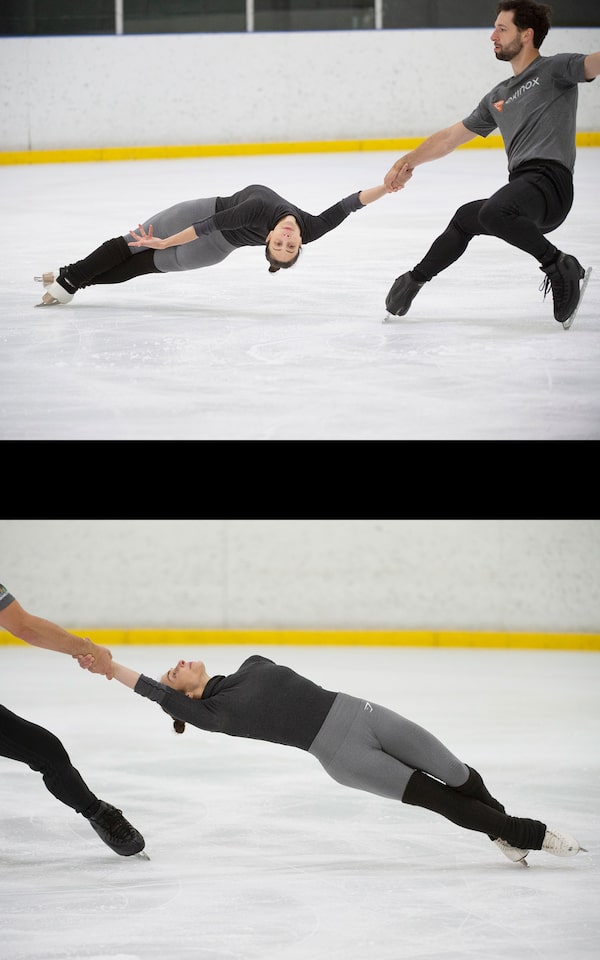
It’s the comeback story that has seemed to taunt the laws of biology and time, but now a last-minute injury has threatened the fairytale ending.
On Friday, 42-year-old Canadian pairs figure skater Deanna Stellato-Dudek was to become the oldest woman to compete in Olympic figure skating in nearly 100 years.
Even more extraordinary was the fact that Ms. Stellato-Dudek and her partner, Maxime Deschamps, had a real shot at a podium finish.
But on Monday, Skate Canada announced that Ms. Stellato-Dudek suffered an injury while training in Quebec. She and Mr. Deschamps will be pulling out of the team competition, an event in which skaters from different countries compete in their respective disciplines – singles, pairs and ice dance – and are awarded points based on their placings. The country with the most combined points wins.
It is unknown if she will be able to compete in the individual pairs event, which begins on Feb. 15.
“Stellato-Dudek’s condition and readiness for the individual pairs event is being assessed on a day-by-day basis," Skate Canada said in its news release.
It’s a heartbreaking turn of events for Ms. Stellato-Dudek, who returned to competitive skating in her thirties after a 16-year hiatus. Her incredible story was recently the subject of an Olympic Channel documentary called Deanna’s Dream.
Ms. Stellato-Dudek is among a small but notable group of superstar athletes in recent years who have been able to compete well beyond what was once believed to be a reasonable best-before date.
Venus Williams recently played in the Australian Open at age 45. Cristiano Ronaldo, who turns 41 on Feb. 5, will be taking the field in the 2026 World Cup. Basketball legend LeBron James is 41 and still an NBA All-Star.
But the difference between them and Ms. Stellato-Dudek is that they are millionaires many times over, with access to private chefs and the most advanced (read: expensive) medical therapies and doctors. Mr. James reportedly spends upwards of US$1-million a year preserving his health. Mr. Ronaldo is said to have installed a hyperbaric oxygen chamber in his home. For Ms. Stellato-Dudek, it’s mostly just her, supplemented with guidance and some resources from the Skate Canada team.


Goldie the maltipoo is a source of encouragement for Stellato-Dudek.Fred Lum/The Globe and Mail
Speaking from the rink where she trains just outside of Montreal last fall – months before her recent injury – Ms. Stellato-Dudek said her vintage is her superpower.
“My age is a massive asset,” Ms. Stellato-Dudek said.
She says she is mentally strong in ways that she wasn’t as a teenage competitive skater. She has had four decades to learn about her body and what it needs.
And her maturity drives her to follow the rigorous health regime that’s required to keep her in elite form – a gruelling daily regimen that includes a strict diet, hours of recovery, stretching, and do-it-herself at-home treatments, including red-light therapy, compression pants and a cupping machine.
“I have the rest of my life to have a glass of wine on a Friday,” she said.
That doesn’t mean it can’t be annoying. “Sometimes I’m at events and I see what [other competitors] are eating. Cupcakes! Desserts! Obviously I wish I could have a cupcake the day before a free program. This is the price I pay for my age.”

Coach Josée Picard, with Goldie tucked in her coat, says she had to tailor training methods for Stellato-Dudek and Deschamps that took their age into account.
Although she is now a Canadian citizen, Ms. Stellato-Dudek was born in Park Ridge, Ill., and spent the first phase of her career as a high-ranking American skater representing the United States. She won silver at the ISU World Junior Championships, but a hip injury forced her into an early retirement. Her last competition was the Skate Canada International on the Grand Prix circuit in 2000.
Ms. Stellato-Dudek was just 17 years old when she left the sport. At the time, her biggest rival was Michelle Kwan, the Twin Towers were still standing and many of the world’s current top-ranked skaters were not yet born.
She moved on with her life. She became the director of aesthetics at a plastic surgeon’s office in Chicago. And then one day, at a work retreat, she took part in a team building exercise that changed her life. The staff had to answer questions written on notecards. Ms. Stellato-Dudek’s asked: “What would you do if you knew you couldn’t fail?”
“I immediately blurted out: I would win an Olympic gold medal,” Ms. Stellato-Dudek said. “At this point I had not skated in 16 and a half years. I couldn’t believe what I had said.”
For two weeks, she interrogated herself about why skating had come to mind after all these years. She started to feel like she had unfinished business. She phoned her mom to see if her skates were still in the basement. Ms. Stellato-Dudek began popping into sessions before work. She told no one. Within a few months, she’d gotten back all of her triple jumps.
Ms. Stellato-Dudek travelled to meet her old coach, Cindy Watson-Caprel, in Florida. She wanted someone to watch her skate to see if she was crazy. “She said, ‘You look like you’re coming back from an injury after being off the ice for six months. Not that you haven’t skated for 16 and a half years.’ And I was like, ‘So do you think I could do this?’ She said, ‘I know you. I know how you work. Yes, I think that you can do it,’” Ms. Stellato-Dudek recalls.

Nathan Bartholomay was Stellato-Dudek’s partner when she returned to competition in the 2010s as a pairs skater.Gregory Shamus/Getty Images
In June, 2016, she quit her job and moved to Florida to start training. Early on it was decided that Ms. Stellato-Dudek should switch to pairs skating, meaning she would need to learn a new arsenal of skills: lifts, twists, throw jumps, partner spins and death spirals.
“I was a competitive gymnast so the lifts came really naturally to me. The lifts felt like the uneven bars,” she said.
At her first nationals back, Ms. Stellato-Dudek placed fourth with her then-partner, Nathan Bartholomay. It was a promising start, but the partnership didn’t work out. So in 2019, she was on the hunt for another partner, reaching out to anyone she could in the skating world for leads.
“There were people who didn’t even consider having a tryout with me in 2019, because they thought I would never last until 2022″ – the Beijing Winter Olympic Games – “let alone 2026.”
Those skaters have since retired, she noted.
But one skater who wasn’t worried about her age was Mr. Deschamps, who had recently split from his partner. Ms. Stellato-Dudek travelled to Montreal for a tryout.
“Right from the beginning I felt that magic … it was her fire,” Mr. Deschamps said. “Age is not something that I was concerned about, but at the same time I wasn’t putting my head in the sand. If tomorrow the body decides it’s over – it’s over. And it’s the same for me too.”
Mr. Deschamps, who is now 34, said he had been considering retirement anyways: “Since I’ve skated with Deanna, this is all bonus.”

Stellato-Dudek took the citizenship oath in 2024 alongside Deschamps, who was born in the Montreal suburb of Vaudreuil-Dorion.Christinne Muschi/The Canadian Press
The pair elected to compete for Canada as it appeared easier for Ms. Stellato-Dudek to obtain Canadian citizenship than the other way around – she took the oath a little more than a year ago – in time for the 2026 Olympics. (It is common in both pairs and ice dance for skaters from different countries to team up, because of the limited pool of high-level talent.)
By 2022, Ms. Stellato-Dudek and Mr. Deschamps reached the Canadian podium. They went on to win three national titles. Their ascent culminated in a victory at the world championship in 2024 when Ms. Stellato-Dudek was 40 years old – she is the oldest woman in history to achieve the feat.
However, they have had rocky moments since, including at the national championships last month, when they fell to silver. Still, the team – when healthy – is capable of achieving scores that would land them on the podium in Milan.
The muscular Mr. Deschamps and petite Ms. Stellato-Dudek are known for their striking positions and explosive elements. Their power is reminiscent of legendary Canadian pairs skaters Isabelle Brasseur and Lloyd Eisler, and in fact, the teams share a coach: Josée Picard.
In an interview last fall, Ms. Picard said Ms. Stellato-Dudek and Mr. Deschamps are captivating to watch not only because of their athleticism, but also their innovations. (In this season’s short program, Ms. Stellato-Dudek performs an assisted backflip, a move which only recently became legal and which no pairs team has ever performed at the Olympics.)
“They can do all the tricks that everybody in the world can do. They’re competitive. They were world champions,” she said. “But we have to take into account their age … We have to train in a different way. We practice smart. Concentrate more on quality rather than quantity.”
This means not drilling run-throughs of both programs multiple times a practice, which a younger team might do. Instead, they’ll focus on sections and isolated elements, Ms. Picard said. It’s a model that can make consistency harder, but it’s necessary to keep the duo healthy – and as Monday’s announcement about Ms. Stellato-Dudek’s injury shows, there are never guarantees.
Still, it’s an example of how Ms. Stellato-Dudek, Mr. Deschamps and their coaching team are applying new research in athletic medicine to their training.

Anna Erat, a world-renowned sports physician who specializes in preventive and longevity medicine, said quantum leaps in science have enabled many elite athletes to extend their careers.
Fifty years ago, she says, “the medical community, the sports community, thought: ‘The more the better. Push yourself to the limit and you’ll succeed.’ Today, we know we have to be as professional and systematic about the recovery as the training,” said Dr. Erat, who is based in Switzerland and consults for national-level athletes.
This includes feeding the body with the building blocks necessary to create a stage of healing called supercompensation, she said. When training hard, athletes will suffer micro-lesions – tiny tears – in their muscles. The goal is ensuring that when they heal, they come back stronger. Proper hydration, sleep and the right combination of amino acids from protein can speed this along.
It’s why Ms. Stellato-Dudek spends so much time tracking her diet.
“The hardest part of the comeback – it’s not skating. It’s not this backflip. It’s the off-ice stuff. Nobody wants to eat a boiled chicken breast," she said.
“But I do it. I do it out respect for myself, for Maxime, and really out of respect for the dream.”
2026 Olympics: More from The Globe and Mail
The Decibel podcast
Heated Rivalry, whose stars were torchbearers at the Games, has brought a new frisson of enthusiasm to winter sports this season. TV critic J. Kelly Nestruck spoke with The Decibel about the gay hockey love story and how the made-in-Canada show has caught on globally. Subscribe for more episodes.
The view from Italy
A visitor survival guide to the Milan-Cortina Olympics