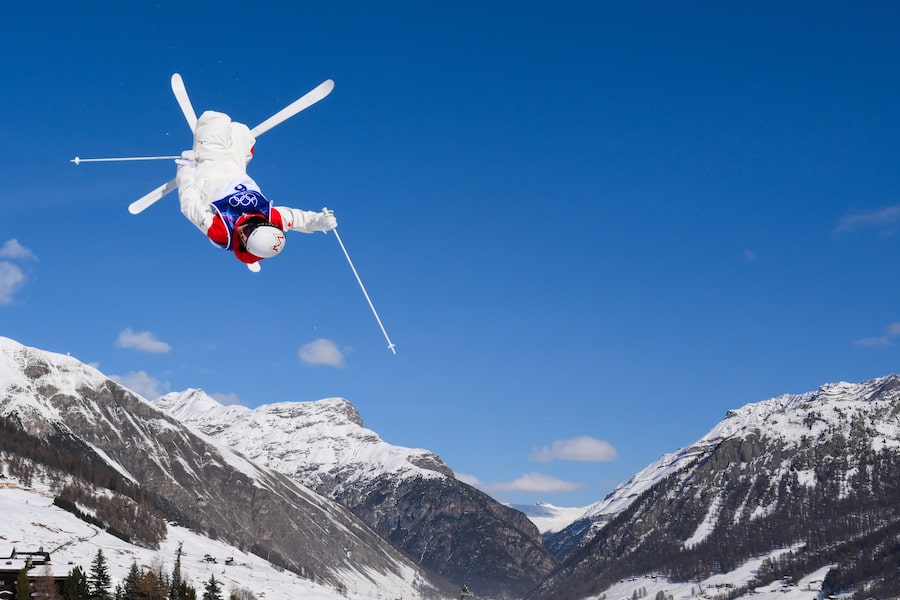

Mikaël Kingsbury has nothing left to prove.
At the Milan Cortina Winter Games, the world’s most decorated moguls skier is not even planning to perform his signature “1440” – four aerial rotations, or 1440 degrees of spin – though is not ruling out the spectacular manoeuvre if the conditions on the slope, and in his mind, are right for it.
“Really, I just want to ski and have fun,” he said in an interview two weeks before the men’s moguls’ final on Feb. 12, in Livigno, one of the Olympic towns in the Italian Alps.

Kingsbury celebrates his silver medal-winning run in men's moguls finals at the 2022 Beijing Winter Olympics.Sean Kilpatrick/AFP/Getty Images
Well, yes, okay. The Quebec-born skier certainly doesn’t need another podium to prove he is freestyle skiing’s GOAT. He knocked off his 100th career World Cup victory on Jan. 10 in Val Saint-Côme, Que. And he has three Olympic medals, each for moguls: silver in 2014 in Sochi, gold in 2018 in Pyeongchang; and silver in 2022 in Beijing. But the 33-year-old athlete has said Milan Cortina will be his last Olympics. So why not go out with a bang instead of a whimper?
That means more than just having fun; it means a medal around his neck, all the more so since 15 family members and five or so his closest friends will be at the bottom of the slope in Livigno to watch him soar through the air.
How moguls skier Mikaël Kingsbury mastered his signature trick
Of course, he would like to give them a show to remember. And winding down his career in no way means he is losing his ferociously competitive spirit. In Livigno, Kingsbury is looking forward to going up against Japan’s Ikuma Horishima – one of the few freestyle skiers to have consistently challenged the Canadian.
Horishima has ended Kingsbury’s winning streaks more than a few times in recent years. He is 28, won Olympic bronze in moguls in Beijing, and has 24 World Cup wins. He has become consistently faster and more technically proficient since those games.

Kingsbury will take on long-time competitor Ikuma Horishima of Japan in his final Olympic games.Cameron Spencer/Getty Images
“I know he can go crazy and he’s capable of doing the 1440,” Kingsbury said. “If we do our best stuff, it could go either way. I respect him a lot and I know he respects me a lot, too. We have been pushing this sport to another level for a couple of years. He makes me go out of my comfort zone.”
Kingsbury says he is feeling healthy and strong going into the Olympics. All bets were off in the late summer, when he suffered a groin injury that made him miss the season-opener World Cup in Ruka, Finland, in early December. A combination of rest and physiotherapy to treat the injury got him back in his boots.
“Today, I can ski without pain,” he said. “I am exactly at the point I want to be.”

In Livigno, he will compete in the moguls and the dual moguls. The latter is making its Olympic debut this year. The race sees two competitors going head-to-head on parallel mogul lanes. Two aerial tricks are required, as in the single moguls.
Kingsbury loves the dual moguls, which play into his killer competitive instinct. “The duals are so exciting. I feel I become a different human being when I am in the starting gate of the duals. I love that you are racing against someone,” he said.
The end of the Olympics will mark a new phase in Kingsbury’s career even if he will probably see through the current World Cup season. I asked him what retirement looks like, and whether the transition from on-the-slopes to off will be difficult. How could it not be, given his stellar performances and the glittering international lifestyle that came with it?

He has been competing pretty much non-stop in moguls since 2008, when he made his debut at 15 in the Nor-Am Cup in Quebec. His first World Cup race came two years later. His career has taken him around the world, made him a household name in Canada, put Canada on the global freestyle map and humbled big-name competitors who tried vanquish the upstart Quebec kid.
Along the way, he surpassed the legendary Swedish skier Jan Ingemar Stenmark for the most World Cup victories by a male athlete in any ski sport. Stenmark, whose best performances came in the 1970s, retired with 86 World Cup wins, primarily in slalom and giant slalom. His record lasted until Kingsbury knocked off his 87th World Cup win in 2024.

Kingsbury shares the podium with his son after his 100th World Cup victory in Val Saint-Côme, Que., in January.Sean Kilpatrick/The Canadian Press
But Kingsbury said he is actually looking forward to the new phase in his career. “I am ready for the next step, I have a lot of projects,” he said. “I don’t feel sad that these are my last Olympics.”
His main project will be the expansion of his moguls’ ski camps for kids and adults, which take place at a ski resort in Saint-Sauveur, Que., and which he has helped to run for four years. The kids’ camp attracts 100 wannabe mogul skiers for the two-day sessions.
“It’s a way to share my skiing knowledge and inspire them,” he said. “When I was 9 or 10, it would have been a dream for me to ski with my idols. My dream is to have the camp set up on different mountains in the U.S., then Europe and Japan, with ex-competitors as coaches.”
For the two weeks ahead of the Olympic competitions, Kingsbury and the rest of the Canadian freestyle team trained, but not too hard, rested and studied the moguls’ course once they reached Livigno. He will have one more task before race day – wash and pack his lucky T-shirt.
In 2010, Kingsbury bought a black T-shirt with big white letters on the front that read: “It’s Good To Be The King.” He has worn it over his base layer on almost every race since then and feels it has brought him good luck. The times he hasn’t worn it was when he didn’t have time to hunt down a washing machine before race day.
“It became like my lucky charm,” he said. “No one sees it except me. I think I will frame it when I retire.”

Kingsbury will make his final Olympics appearance at the Milan Cortina Winter Games.David Ramos/Getty Images
More Olympics coverage from The Globe and Mail
Austria’s Benjamin Karl ends career with gold in parallel giant slalom
How the Ice Academy of Montreal became a global hub for Olympic figure skaters
Five reasons why the size of the Olympic hockey rink in Milan probably doesn’t matter