

The Milan Cortina Winter Paralympic Games will take place in a format unlike previous editions. Competition will be spread across northern Italy’s cities and alpine regions, shaping a Games defined as much by geography as by sport.
For Canada, the Paralympics arrive with familiar medal expectations, a new approach to athlete leadership and a growing audience following from home.
Here is what to know and what to watch as the competition runs from March 6 to March 15.
Canadian captains
Unique to previous editions, Canada’s athlete leadership team at the Milan Cortina Winter Paralympics is represented by six designated captains. Retired para alpine skier Mac Marcoux was named as the honorary captain, a role intended to position him as an ambassador and mentor for competing athletes.
The five competing athlete co-captains are Ina Forrest (wheelchair curling), Alexis Guimond (para alpine skiing), Brittany Hudak (para nordic skiing), Tyler McGregor (para ice hockey) and Tyler Turner (para snowboard).
Marcoux is considered one of the most accomplished Paralympians to date. Having competed in three different Games, the Sault Ste. Marie native has compiled six medals, (two gold, a silver and three bronze). Since his retirement after the Beijing 2022 Paralympic Winter Games, Marcoux began working full-time with the Canadian Para Committee in 2024 as a co-ordinator for athlete engagement.
The six-person leadership group is meant to represent a broad cross-section of sports, experiences and voices within Team Canada. The 2026 structure reflects a shift toward emphasizing visibility across the delegation, rather than concentrating symbolic roles in a single figure, as previous editions have. This expanded leadership model aims to showcase how the Canadian Paralympic program is evolving. However, not all participating nations have taken on this multiathlete leadership approach.

Team Canada’s Paralympians said their farewells at Toronto’s airport last week. In Italy, the competitions are widely dispersed among Milan, Cortina and other towns.Eduardo Lima/The Canadian Press

Where is it happening?
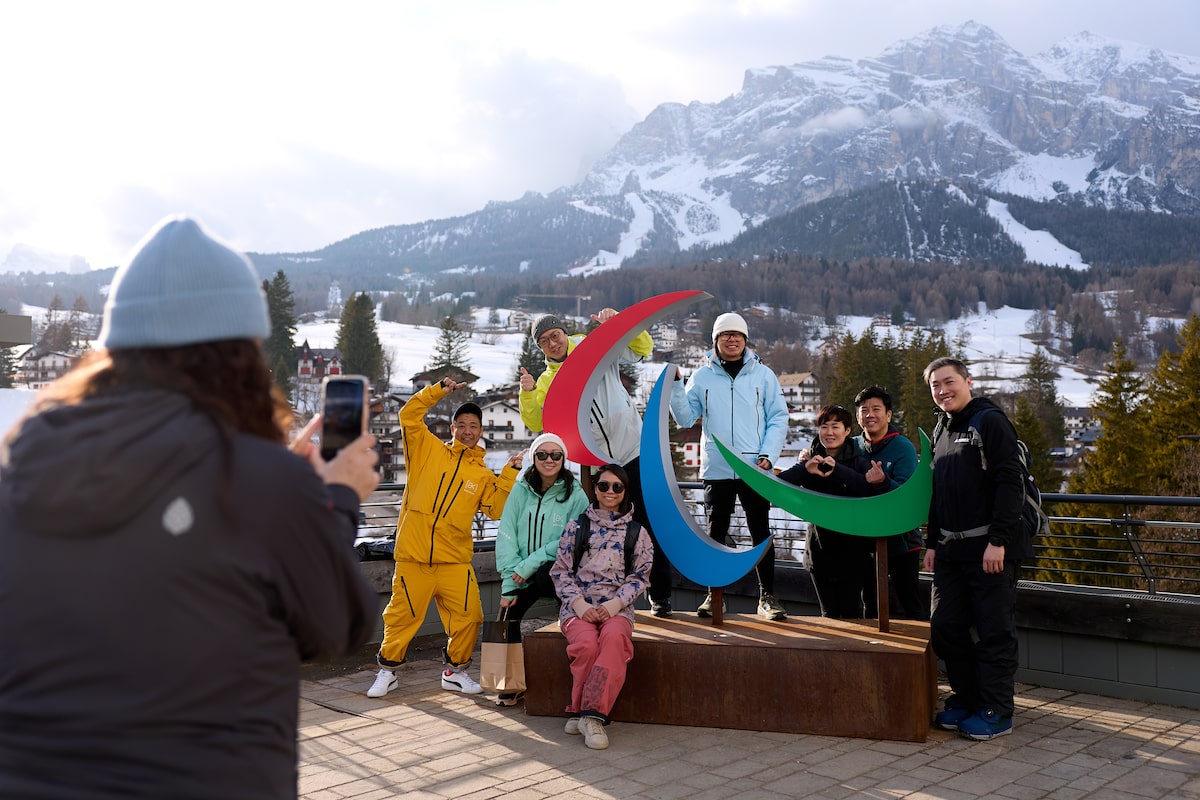
Like the 2026 Winter Olympic Games, the Paralympics are being held in different cities and mountain regions across northern Italy, rather than the typical single host city. In fact, this is the first Winter Games to officially bear two city names (Milan and Cortina), underscoring the geographic spread, which goes up to almost 320 kilometres between the two host cities.
Making history as the most widespread Games ever, it can take fans up to five hours of driving to go from one event to another through the mountains. To combat this, organizers have delegated certain sites for specific sports, decreasing the amount of travel needed for all parties involved. Despite this, the organizers have capped the number of tickets because of concerns over transport congestion.
Additionally, there will be multiple Olympic village sites – three for the Paralympics, specifically – which contrasts with the usual one-hub site often known for its huge size and comfortable living conditions. In Cortina, the village is about 15 minutes away from the city’s downtown and consists of 377 mobile homes. Each unit is approximately 200 square feet with its own heater and double room. The rooms for Paralympians have handicap-accessible showers, toilets and beds.
Sports to watch for

Canada’s skiers in Italy include Brian Rowland, training for the men’s downhill.Maja Hitij/Getty Images
More than 600 athletes will compete for 79 medals across six sports at the Paralympic Games, which includes para alpine skiing, para biathlon, para cross-country skiing, para ice hockey, para snowboard and finally, wheelchair curling, which has a new medal event debuting, with mixed doubles.
For Canadian viewers, para alpine skiing is typically the centre of the medal conversation, with Canada having a consistent podium presence in alpine events. The races are relatively short and easy to follow, making them a strong entry point for casual viewers.
Guimond, one of Canada’s designated captains, is coming off strong World Cup results, as well as two previous Paralympic bronze medals (in 2018 and 2022), making him Canada’s biggest hope on the slopes.
On the other hand, para Nordic skiing, including cross-country and biathlon, has also been a reliable source of Canadian medals in past Games.
Biathlon in particular stands out once viewers understand how missed shots translate into time penalties, turning endurance races into strategic battles that can swing late. Mark Arendz and Natalie Wilkie are the big stars on the Canadian para Nordic team, with 19 medals between the talented pair.
Of course, para ice hockey remains one of Canada’s most-watched Paralympic sports. The Canadian team ended a seven-year gold medal drought at the 2024 world championships in Calgary, defeating its archrival U.S. in the final 2-1, and will certainly be looking to do the same at the 2026 Games.
Where to watch

Fans that followed the Olympics from Canada can count on similar broadcast times, late mornings and afternoons in Eastern time, to enjoy the Paralympics.Melissa Tait/The Globe and Mail
CBC/Radio-Canada will be Canada’s official broadcaster for the 2026 Winter Paralympic Games, continuing its long-standing role as the country’s primary Paralympic media partner. Coverage will be available across television, digital platforms and streaming, with a mix of live events, highlights and on-demand replays.
For viewers, the most reliable entry point will be CBC Gem, which will carry live streams of multiple Paralympic events, particularly during medal sessions. Linear television coverage will focus on key Canadian moments, medal events and daily highlights, rather than wall-to-wall broadcasting of every sport.
As Canadians learned during the Olympics this past month, time zones will work largely in viewers’ favour as Italy is six hours ahead of Eastern Time. That makes many events accessible during late mornings and afternoons, with replays and packaged coverage filling prime time in the evenings.
Paralympic mascots


Waldi the dog was the first Olympic mascot in 1972; this year, that role goes to Tina and Milo the stoats.Top: Picture alliance/Getty Images; Above: Daniele Mascolo/REUTERS
The 1972 Summer Olympics in Munich, Germany, were the first edition to feature an official mascot. Waldi the dachshund, a dog, was designed intentionally for merchandise branding and public engagement to represent the Games symbolically. From then on, mascots have become a permanent Olympic feature. However, the Paralympics did not have a design of their own until the 1980 Summer Games in Netherlands.
The 2026 edition features a sibling duo of stoats – small mammals that are native to Europe and look like ferrets – Tina and Milo. Their names are derived from host cities, Cortina and Milan, and are portrayed as joyful and curious creatures in the snowy mountains.
Milo, special for Paralympics, was born without a paw, but learned to walk on his tail and uses this to his advantage. In the build-up to choosing a mascot for the Winter Games, Italian schoolchildren participated in submitting over 1,600 designs, which were voted on by the public and shaped the final duo.
More on the Paralympics from the Globe and Mail
The Winter Paralympics celebrate their 50th anniversary in Milan Cortina
Suddenly a flag-bearing Paralympic veteran, Wilkie embraces her third trip to Games
Rowland heads to his second Paralympic Games with his eyes on the podium