When a pope dies and the process to elect his replacement is announced, Gammarelli, the traditional garment-maker to the pontiffs, becomes a tourist attraction. That’s because its tailors display the robes that the new pope will wear in their storefront window, for all to see.
The conclave – the cardinals’ vote to pick a pope to replace Francis, who died on April 21 – is to start on Wednesday. Normally, the Gammarelli-made robes would already be on display in three sizes – small, medium and large – since the tailors don’t know the dimensions of the new pope. But this time, the window is empty.
When I visited Gammarelli a week ahead of the conclave, I assumed the new papal robes were still under the knife and needle and not ready for display. Not so. “We have not received the order from the Holy See, so we are not preparing any cassocks for the conclave,” Massimiliano Gammarelli, a sixth-generation member of the Gammarelli family, told me.


No wonder the mood was sombre inside the shop, which has been in the family since at least 1798, making it the oldest business in Rome run by the same owners. Gammarelli records show that its tailors have clothed almost every new pope since Pius IX (1846-1878), with the glaring recent exception of Karol Jozef Wojtyla, the Polish cardinal who became Pope John Paul II in 1978; he used a tailor from his native Krakow.
Mr. Gammarelli did not know exactly why the Holy See chose to skip the clothing order for Francis’s successor. He assumes that the conclave will raid its closet and pick a cassock – the full-length garment, traditionally white – for the new pope. Since Gammarelli always made new-pope garments in three sizes, the conclave wardrobes probably hold lots of options.
The Holy See press office declined to comment on its decision not to place a new order for conclave robes. The Italian press speculated that it was out of respect for Francis’s austere lifestyle.
As pope, Francis wore only simple, white cassocks – the first one of which was made by Gammarelli – and avoided all the trappings of luxury. He lived in a guesthouse behind St. Peter’s Basilica, not the Apostolic Palace, and was chauffeured around in a cheap white Fiat, not an armoured black limousine. In public appearances, he almost always wore a white cassock and white mozzetta, the short cape that is worn over the cassock (Gammarelli had made a red-velvet, fur-trimmed mozzetta for his debut as pope in 2013, which he did not use, nor the red papal sandals).

The Gammarellis have been papal tailors since the 1700s, when popes ruled a larger country than today, the Papal States, and Italy was not yet unified.Christopher Furlong/Getty Images
On the week before the start of the conclave, the mood at another old ecclesiastical tailor, Mancinelli Clero (clero means clergy), was decidedly upbeat, unlike that of Gammarelli. Mancinelli has made clothing for the last three popes, though not for the conclave itself.
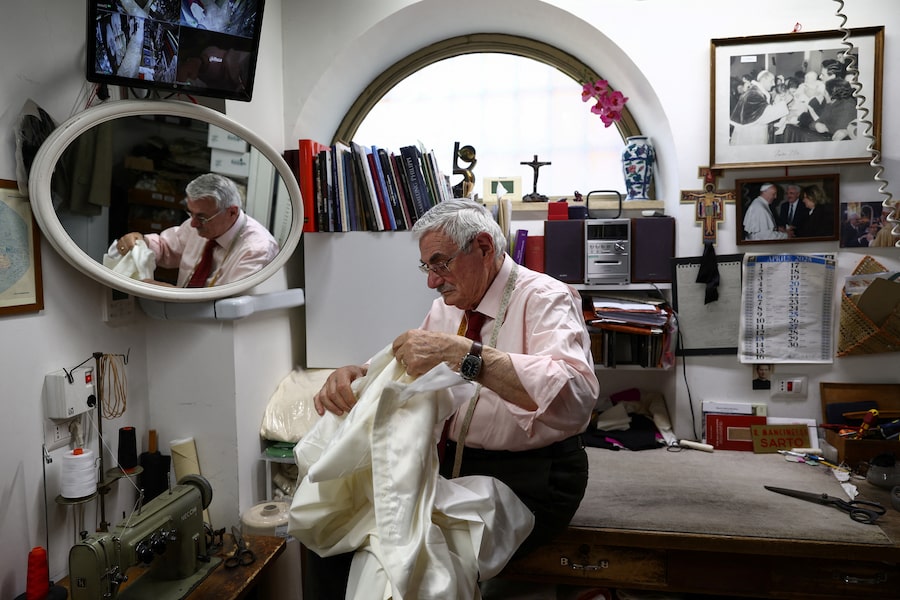
The shop opened in 1962 in Rome’s small, crammed Medieval Borgo neighbourhood in the shadow of St. Peter’s Basilica. In the tailor’s room at the back of the shop, founder and master tailor Raniero Mancinelli, who is 86, was making white, light-wool cassocks in three sizes for the conclave.
Confused, I asked whether the reports about the Holy See going with old clothing stock for the conclave were inaccurate. Had he received an order at Gammarelli’s expense? No; he was making the cassocks on spec. “I just wanted to make them,” he said. “They will be a gift for the conclave.” Since there would be no charge, he assumed the Holy See would take them.


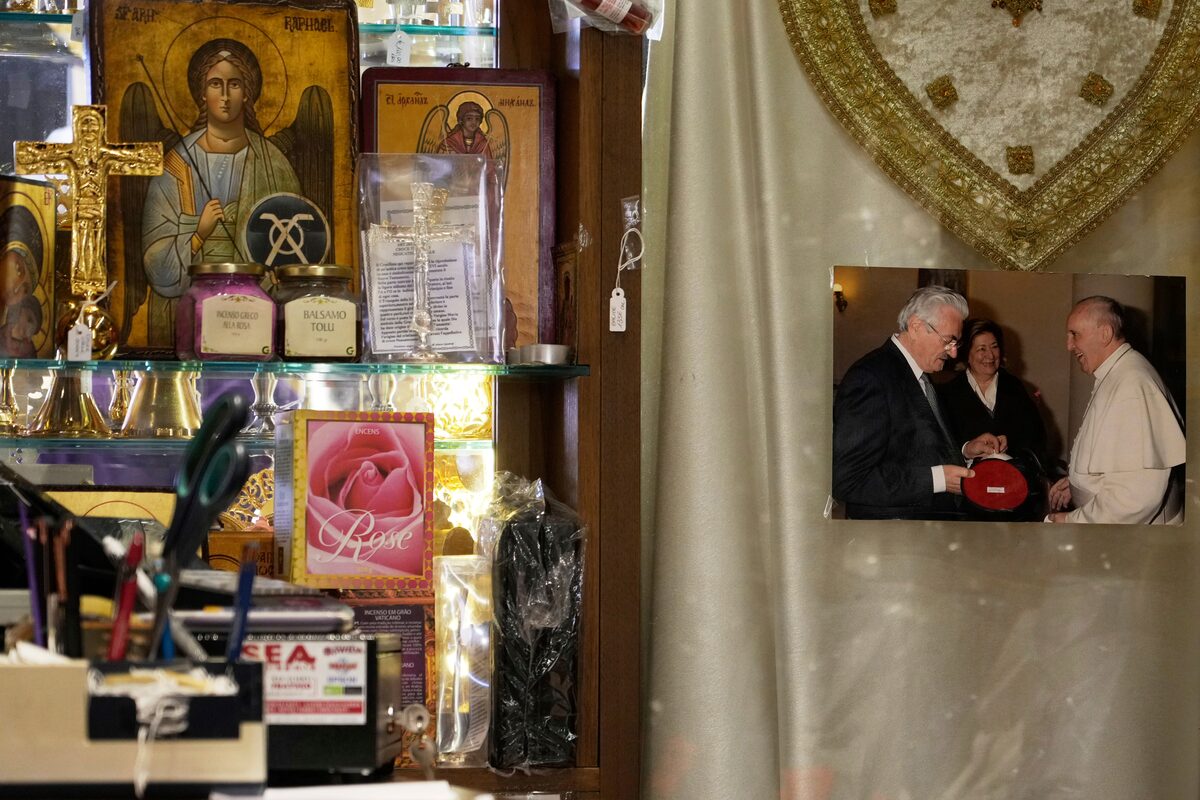
The Mancinelli shop was alive with customers on the late afternoon last Wednesday. Several priests from Latin America were trying on fasce, the decorative silk scarves that are draped over a priest’s shoulders, and mitrie, the tall headdresses, generally worn by senior clerics, that taper to a point in the front and the back. “A lot of priests and cardinals come here,” said Lionel Alfaro, a priest from Nicaragua who was buying several fasce, each about three metres long, at €20 a metre. “They are very friendly in this shop.”
Mr. Mancinelli greeted many clients as if they were old friends, which some were, by tucking his arm in theirs and giving them a big smile. His daughter, Laura, helps to run the shop while he and Laura’s son, Lorenzo, do the tailoring.
Mr. Mancinelli was born in Le Marche, the central Italian region between the Apennine Mountains and the Adriatic Sea, near Urbino, birthplace of the Renaissance painter Raphael. He has been a tailor since his teen years, found a niche market in ecclesiastical garments and, to be close to his clients, opened a shop on the edge of the Vatican. “I have worked as a tailor all my life. It’s the only thing I know,” he said. “I have met three popes and made garments for them – John Paul, Benedict and Francis.”
On the wall of the shop are photos of him and his wife, Giovanna, greeting the three popes. One of the photos shows John Paul II opening a white box containing white Mancinelli clothes. Among his clients, he said, are the Canadian cardinals Thomas Collins of Toronto and Marc Ouellet of Quebec.
I asked if any of his cardinal clients might be papal candidates in the conclave. “I know a lot of cardinals,” he said. “But only the Holy Spirit knows who the next pope will be. I hope the new one, whoever he is, will wear the cassock I made.”

Guglielmo Mangiapane/Reuters