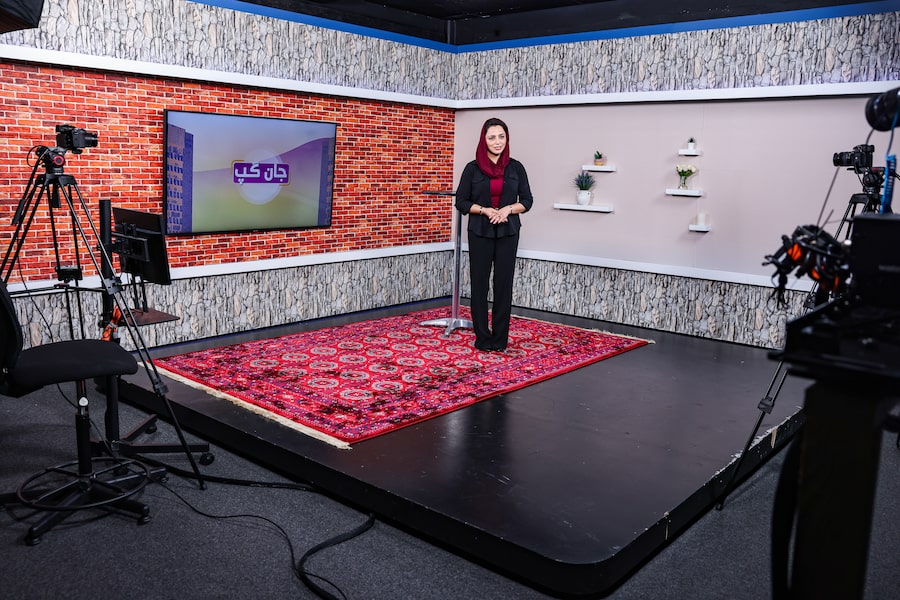
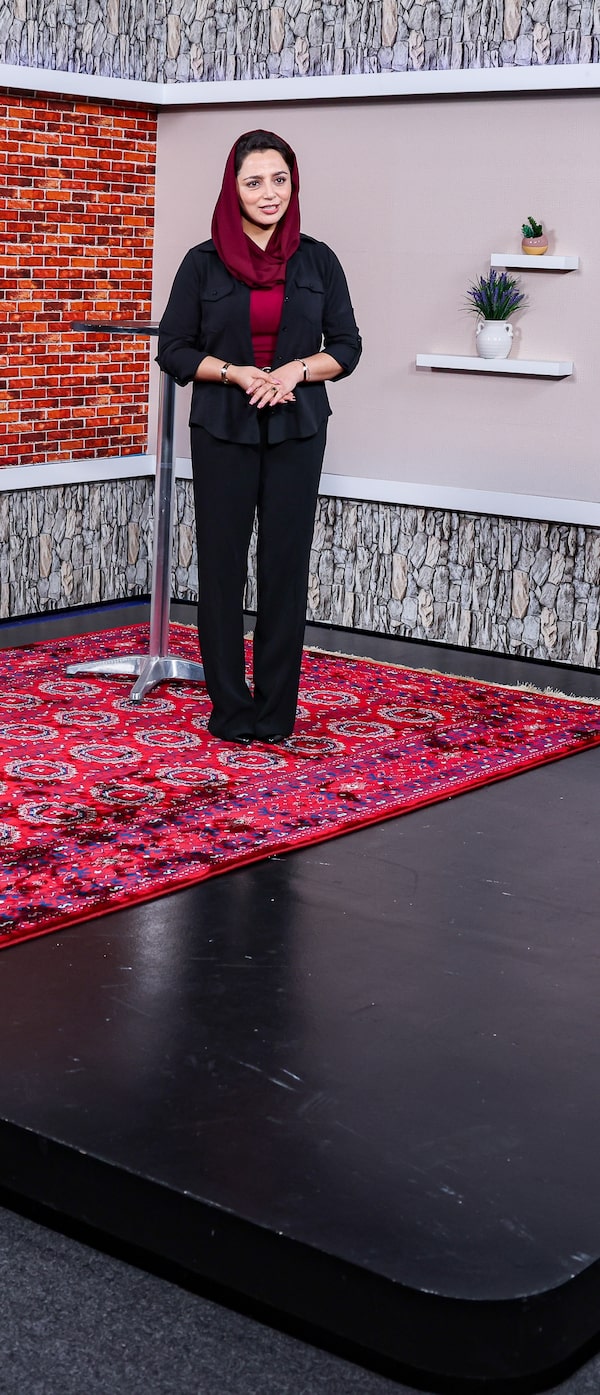
It’s just past seven on a Saturday evening in Afghanistan, and the satellite dishes that adorn the country’s apartment blocks and mud-walled compounds are bringing millions of families the outlawed sight of a woman with most of her hair and all of her face visible, as well as a chance to talk with her about the difficulties and injustices of life under the Taliban.
Sadaf Rahimi, the 25-year-old host of the country’s most popular phone-in TV show, most weeks addresses viewers with her head fully uncovered, but today, for Ramadan, she walks onto the show’s cozy set with a chic plum hijab far back on her head – a “bad hijab” that is itself illegal and potentially subject to imprisonment under Taliban laws, which require every part of a woman’s body but her eyes to be concealed and which generally prevent women from hosting TV shows or appearing in public without a man.
She addresses viewers in cheerful Dari: “Hello dear friends, good day to you all. I hope that wherever you are, you are well, healthy and joining us on your favourite program. Welcome to Jan-e-Gap.” The show’s name means “soul of the conversation,” and it might be described as a cross-country checkup for a country whose people are not at all well.
This week’s topic, she says, will be one long requested by viewers: the alarming shortage of female doctors in hospitals and clinics after the Taliban shut down medical schools for women when they seized power in 2021.
A buzz of urban background noise fills the Amu TV studio as a call is patched in. “Let’s see who our friend is and what their opinion is,” Ms. Rahimi says. Soon the studio is filled with voices from across Afghanistan, from big cities and rural villages. Mojdeh from Kabul offers her harrowing story about a critically ill woman going untreated because her husband wouldn’t let her be examined by a man. Mursal from the northern city of Kunduz says her 400-bed hospital has almost no female nurses, to say nothing of doctors.
Ms. Rahimi draws out her callers and openly denounces the hypocrisy of the theocratic regime. The callers respond vociferously, denouncing “Taliban lies.”
At one point, a man who seems to be a Taliban official calls in – a frequent occurrence on the show, which gives the regime a larger audience than their own, highly censored TV stations. He argues that everything is fine and that women should see it as their duty to be treated by male doctors. His claims are ridiculed by callers − “In Islam, there is no such thing as a nurse or a doctor,” one says, eliciting laughter.
Learn more about how Amu TV comes together behind the scenes in Sterling, Va.
Yuri Panin/The Globe and Mail
At several points during the hour, callers express amazement that in 2026 they’re able to speak this openly on a TV show that’s available free to more than a third of Afghan households. How, some callers ask, can you do this in Afghanistan today?
That’s because Ms. Rahimi and her network are not in Afghanistan. She is standing in a small broadcast studio tucked into a strip mall in northern Virginia. Her show goes live across Afghanistan at 9:30 each Saturday morning, right after an equally independent and critical newscast that provides live footage and interviews from across Afghanistan, provided by hundreds of volunteer videographers who often work in disguise and risk arrest by the Taliban. This week, they had dramatic footage of the Pakistani missile attack on Kabul that the UN says killed 143 people.
She, like everyone involved with the network, is a refugee who started her career in Afghanistan’s vibrant TV scene of the 2000s and 2010s and now struggles to make a life for herself in North America.

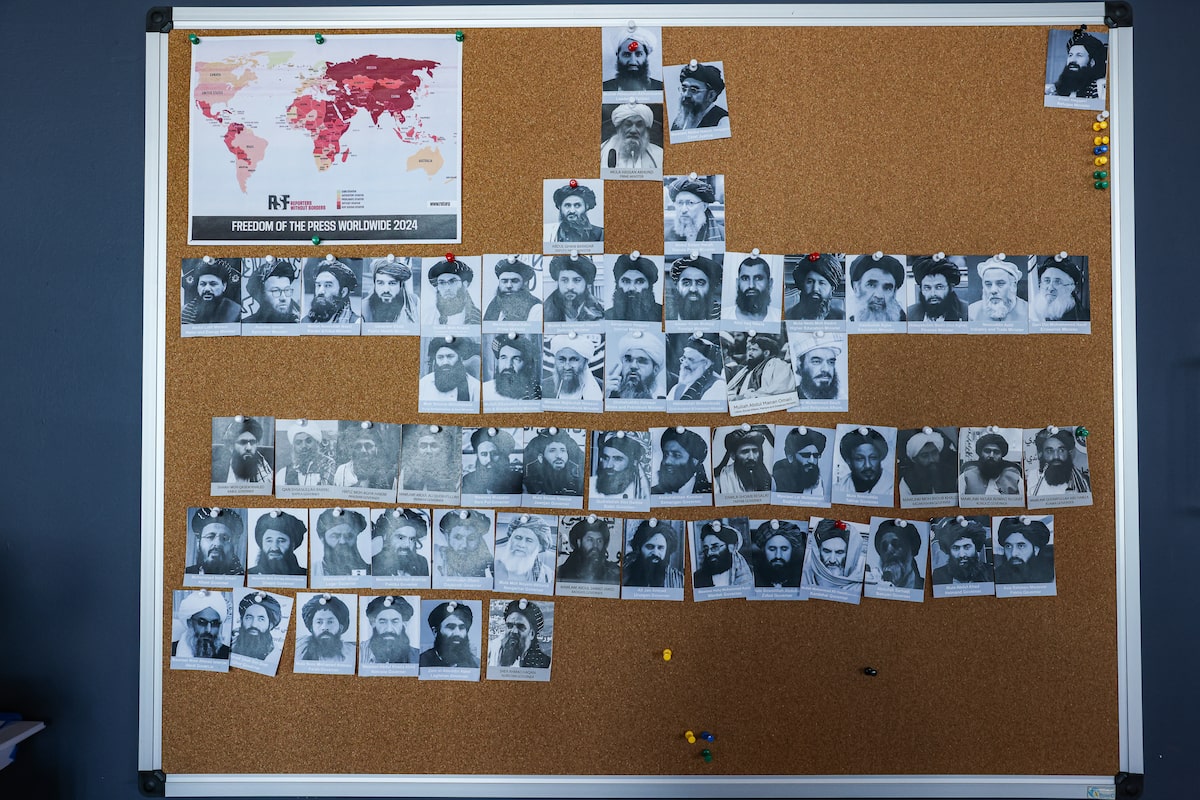
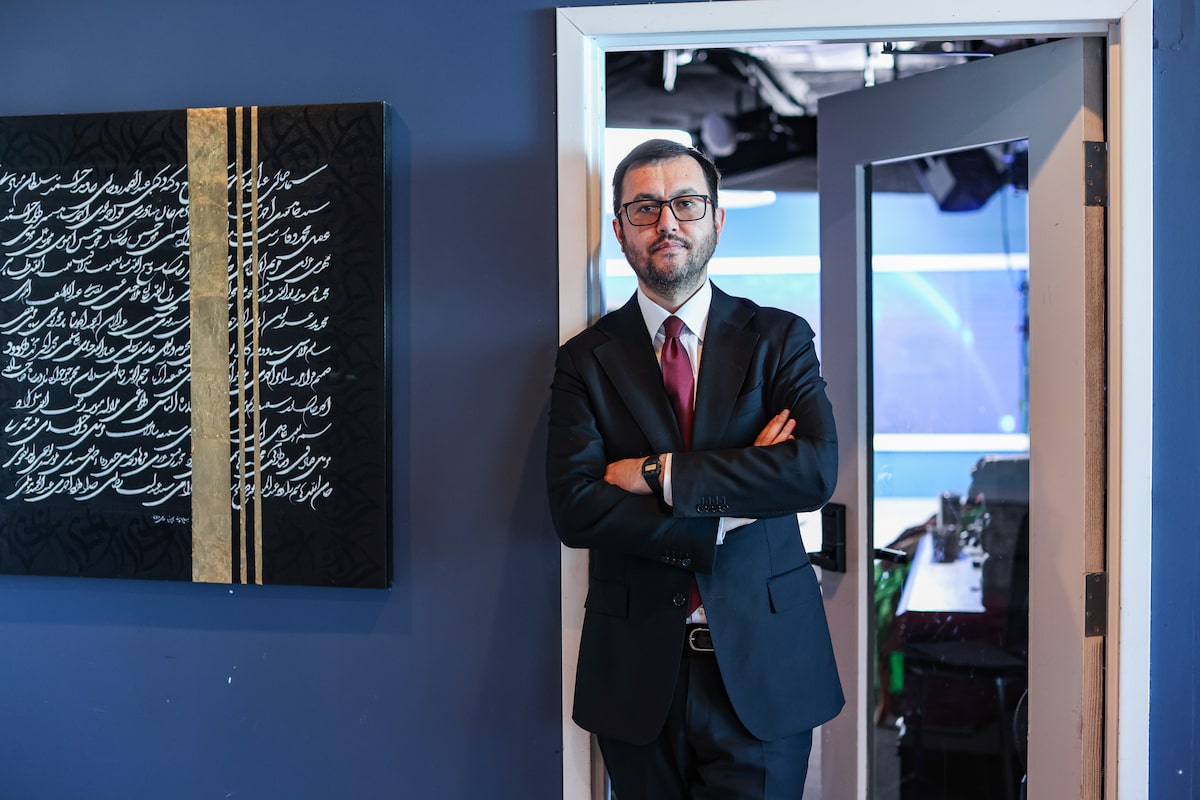
Overseeing the show’s production from the control room today is Lotfullah Najafizada, 38, a cofounder of Amu TV and one of several Afghan-Canadians who’ve run the network on a shoestring budget since its launch in 2022. During the week, he runs the network’s business operations from the basement of his Toronto home.
Almost five years ago, Mr. Najafizada’s very successful career in Afghan TV news suddenly came to an end when he and his family were forced to flee to Canada when the Taliban took over the country and seized control of his station.
He’d been the head of TOLOnews, a channel acclaimed for its critical and professional coverage of Afghan conflicts – a position that had made him a prime target of the Taliban. In 2016, when the Taliban were still an opposition militia, a suicide bomber killed seven of his staff.
Yet when he and his former TOLOnews colleague Sami Mahdi began discussing an offshore Afghan TV network in 2022, (Mr. Mahdi got asylum in the United States), they knew they did not want to make it an activist, anti-Taliban voice or a patronizing propaganda message from the diaspora; they simply wanted to recreate the sort of high-quality journalism and open debate that Afghans had enjoyed for 20 years.
“I don’t consider us opposition media, not even ‘exile,’ because we have so many colleagues [volunteer reporters] working on the ground in Afghanistan,” he said.
“Our job is not to topple the Taliban. Our job is to inform the Afghan people and entertain. … We are pro-democracy, we are for women’s rights, but I believe that is where most Afghans stand.”

Sami Mahdi, a former colleague of Mr. Najafizada in Afghanistan, is now Amu TV’s editor-in-chief and co-founder.
They took advantage of a loophole in Afghan television: The satellites that deliver TV to most Afghan homes are not controlled by the Taliban. The day Amu TV launched, its shows were sitting there on the onscreen menus of at least 18 million Afghan households, alongside the much less exciting programming of the Taliban-controlled networks. One study showed that 3.2 million people were regularly watching it only six months after its launch, a number its founders believe has multiplied several times.
But funding the station has been difficult. USAID had provided some of the budget for TOLOnews and other Afghan domestic stations starting in the 2000s, but the Biden administration decided that U.S.-based exile media should not be part of its mission, Mr. Najafizada said. In its stead, they secured a modest grant from the National Endowment for Democracy, a private agency funded by the U.S. Congress. That status has protected it from the Trump administration cuts that all but eliminated USAID, but this year’s grant has been held up by congressional budget debates, and Amu TV is barely functioning.

Mr. Najafizada had hoped for Amu TV to operate out of Canada, but finding the money to support such a move has been difficult.
What its founders really wanted was to operate out of Canada. Not only is the country home to several of its senior staff and a large population of exiled Afghan journalists, but it’s a safer place to operate – several of Amu TV’s staff and on-air personalities are facing frozen or cancelled refugee claims or deportation threats in the U.S. But they found that there is no Canadian agency or program, public or private, to support free media in authoritarian countries, at least not if that media comes from Canada.
“It’s a missed opportunity for Canada to support this type of media,” Mr. Najafizada said. “We would love to have a stronger hub in Canada – it’s where I live, where my kids go to school, where my family is – so we can produce more content here. That depends on support from Canadian sources, which we haven’t secured. If that’s in place, we will have a stronger presence here.”
Over in the control room, the Android smartphone plugged into the console looks like it’s about to burst into flames, its WhatsApp screen scrolling a constant Niagara of calls and texts from every corner of Afghanistan. Over the next hour, more than 3,000 people will call in; on other episodes, such as the mid-February one devoted to the Taliban’s ban on Afghans’ beloved celebrations of Valentine’s Day, the show will receive more than 6,000. And that volume of calls appears to be limited only by the technology they’re able to afford.
Running the entire show is Amu TV’s head of news, Noor Ahmad Naqshbandi, who cues the cameras, shouts out directions to himself, rushes into the studio to adjust the host’s microphone and hurriedly selects calls from the smartphone’s cascading screen. It normally takes at least four people to do these jobs; when Mr. Naqshbandi worked in a similar control room in Afghanistan a decade ago, there were 12. Yet he is only a part-time employee who supports himself by driving Uber other days of the week.

From Virginia, Mr. Najafizada and Mr. Mahdi work with a team of mini-studios in France and Turkey.
As soon as they’re finished directing Jan-e-Gap, the two executives rush into the conference room for a news meeting, joined on a Zoom screen by staff at Amu TV’s mini-studios in Paris and Istanbul.
Mr. Najafizada sees the call-in show and the newscast as ways to recreate the sort of open, critical dialogue that has long been part of Afghan society, from the freewheeling debate that once dominated tea shops and mosque courtyards to the journalism that flourished during the country’s democratic decades after 2001.
“My thinking was that we bring the finest Afghan journalists who are overseas, who have freedom to report, and couple them with journalists who are on the ground, who have access. And that’s when you can produce content that keeps journalism alive for the Afghan people inside the country.”
On the set of Jan-e-Gap, that often manifests itself as an hour-long national catharsis. Ms. Rahimi, whose journalism career in Afghanistan had just begun when the Taliban took over, admits she once burst into tears on air while hearing the story of a lone Afghan woman whose family had disappeared after fleeing to Iran.
“We are trying to speak to people about their challenges,” she says shortly after the broadcast is finished. “You know, there is no one in Afghanistan to hear their voice, there is no organization, no place to hear their problems and the difficulties they have. This is the only door they can knock on and express their problems. I was very sad hearing these stories, but at least we can hear, at least we can know what is going on in Afghanistan.”

With research by Wazhma Hamidi