Outside a nutrition centre in South Sudan, 10-year-old Akem Akuot wraps her thin arms around her brother Garang, who is 3. His eyes are glossy, and his head falls heavily onto his sister’s chest.
She props him up and tips a pink cup of porridge into his mouth. As it pools around his lips, dripping onto his chin, he motions for more.
It’s a hot afternoon in November, not far from the town of Bor, which lies about 200 kilometres north of Juba, the capital. The children are at a cooking demonstration organized by Save the Children – an international non-governmental organization – where nutritionists gathered mostly pregnant and lactating mothers to teach them how to cook meals using a variety of food groups and local ingredients. But with many here having little access to food, the cooking demonstration is also a crucial opportunity to eat.

The families at this cooking demonstration in Bor often have little access to food at home. There are other regions of South Sudan where the hunger crisis is even more acute.
More than a dozen women gather on blankets and chairs, many comforting their babies after cooking pots of rice, vegetables, fish and meat. Akem and her little brother came with a distant relative on this day, but aid workers often see the pair on their own.
Akem walks on the shoulder of the wide and dusty road that’s shared with cattle, goats, tuk-tuks and motorbikes to bring her brother here every Monday to pick up packages of Plumpy’Nut, a plastic-wrapped paste with the protein and vitamins that he needs to recover from malnutrition.
“It’s challenging to take care of the little boy,” says Akem, who speaks so softly she’s almost inaudible. But she doesn’t have a choice, she adds, as her mother must go into the forest to collect charcoal, sometimes for days at a time. One of Akem’s other siblings is responsible for selling it.
If their mother comes home empty-handed, they go without food. Foraging in the forest for charcoal is dangerous work, with armed groups stalking the area.
But this is what it’s like in South Sudan, where people are struggling to survive. The hunger crisis, the result of a number of factors – including government corruption, escalating factional violence, extreme poverty and climate change – is further fuelled by a reduction in foreign aid from the United States and other Western countries.
According to the Integrated Food Security Phase Classification (IPC), nearly six million people are facing high levels of acute food insecurity and famine is looming in parts of the country.
The Globe and Mail recently visited Save the Children in South Sudan to report on how one of the largest hunger crises in the world is poised to become even worse.

South Sudan became the world’s newest country in July, 2011, when it separated from Sudan. By late 2013, the country was plunged into a civil war that has killed hundreds of thousands of people and displaced millions.
A 2018 peace agreement was meant to end the war, stipulating that the parties led by President Salva Kiir and opposition leader Riek Machar would share power, usher in a permanent constitution and prepare for elections. But the agreement was never fully implemented, and it’s been undermined by violence between government and opposition forces.
Joanne Minns, Canada’s ambassador to South Sudan, told The Globe that the country is at a turning point, and if its leaders fail to act quickly, it could be plunged back into war. “Collapse would not only impact South Sudan, it would deepen Sudan’s instability and send shock waves across broader East Africa. The 2018 peace agreement is more than a framework. It is the only credible path to democracy and stability.”
And without stability in the country, its people will continue to starve. “People cannot farm. You go farming, you get shot by gangs,” said Daniel Akech, a senior analyst for South Sudan at the International Crisis Group, an independent policy organization. He pointed out that devastating floods have also made it difficult for farmers to cultivate.
But in addition to violence and climate change, the United Nations said in a September report that government corruption is also to blame for the humanitarian crisis. Yasmin Sooka, chairperson of the UN Commission on Human Rights in South Sudan, said in a statement that corruption is not only exacerbating the food shortage and armed conflict over resources but also collapsing the health systems.
“The suffering of South Sudanese civilians is a direct consequence of the brazen plundering of public revenues since independence in 2011,” Ms. Sooka said.

The UN's critical report on South Sudan was two weeks old when Vice-President Josephine Joseph Lagu spoke to the General Assembly about the state of her country.Richard Drew/The Associated Press
The government told the Associated Press that many of the commission’s allegations are “absurd.”
The UN also said public health, education and the justice system are in crisis, most civil servants are not paid, or not paid enough, and that the international community spends more on the country’s basic services than the government does.
Edward Chol, a civil servant who works in nutrition in Bor, said the government launched a nutrition strategy and is working with partners to improve the situation. He said that a lack of resources has meant that he is no longer able to visit certain areas to conduct nutrition assessments, monitoring that is crucial to improving services. He hasn’t been paid for eight months, he added.
“Lack of resources has affected our work. The team here at the state ministry of health, they have no motivation,” he said. “We are trying to manage.”
The International Crisis Group’s Mr. Akech says the UN report only tells part of the story, and that the war in neighbouring Sudan has also had a huge impact on South Sudan’s economy.
Political turmoil and conflict have meant that South Sudan has depended on foreign assistance for a long time, Mr. Akech said, but over the years, there has been donor fatigue, with international donors realizing they weren’t getting much of a return on investment.

This year's shutdown of USAID was just one way in which the Trump White House has greatly scaled back foreign aid, with serious consequences for nations such as South Sudan.J. Scott Applewhite/The Associated Press
The Trump administration’s reduction in foreign aid earlier this year has left the local government exposed, he said, because they haven’t invested in their own emergency response systems.
The reduced U.S. support meant Save the Children had to cut more than 200 positions in the country, said Abraham Kulang, the organization’s head of program implementation in South Sudan. With fewer staff, some of the NGO’s treatment centres have been forced to close, and the ones that remain aren’t able to provide as much support to pregnant and breastfeeding mothers or malnourished children.
“Early identification in the community always saves lives and reduces the severity of disease, and that has become limited because there are no staff who are going up to that level to identify cases earlier,” he said.
Danny Glenwright, president of Save the Children Canada, said the result of aid cuts is stark. “Children are facing acute hunger, and we’re closing those clinics where they go to get treated.”
Other Western nations have failed to fill the gap, even inflicting their own aid cuts. The United Kingdom and other European countries have slashed their foreign assistance budgets. The Canadian government is cutting $2.7-billion from foreign aid over four years, but it has not yet said where the cuts will be made.
Mr. Glenwright said that Save the Children is disappointed in the Canadian government’s decision to cut foreign assistance, including to health programs, at a time when children are going hungry.
“As you see, the cuts are directly impacting people and people’s lives and livelihoods,” he said.

The World Food Programme, which has a South Sudanese logistics base in Bentiu, has to be more careful where it deploys its dwindling supplies.RIAN COPE/AFP via Getty Images
Funding cuts have forced the UN’s World Food Programme (WFP) – the largest humanitarian organization that provides food assistance – to prioritize only communities facing emergency and catastrophic levels of hunger.
The organization had hoped to provide such aid for 4.2 million people in South Sudan, said Tomson Phiri, a spokesperson for WFP in the country, but they could only reach 3.7 million – and even then, with reduced rations.
“In some areas, rations have been sliced by up to half, whereas in the worst-affected areas we have intensified rations to 70 per cent.” He said a shortfall of US$485-million in 2026 threatens the WFP’s ability to prevent the crisis from deteriorating further.
UNICEF, the UN’s children’s rights agency, said that 186 nutrition centres have closed across South Sudan since the beginning of 2025, and so have more than a third of the safe spaces it supports for women and girls. After her visit to the country, UNICEF’s executive director Catherine Russell said she is urging the government and the international community to step up efforts to protect children.
In addition to nutrition centres, non-governmental organizations also support programs in hospitals.
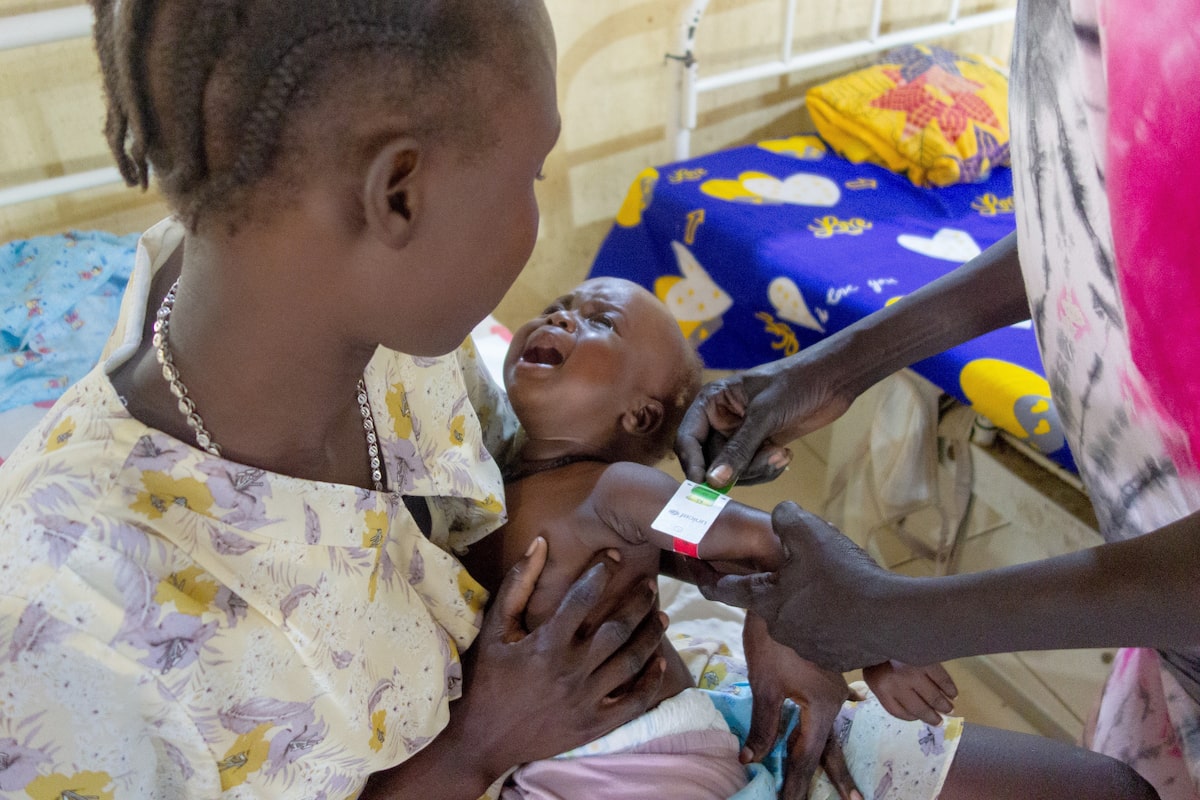
Inside the pediatric ward at the hospital in Bor, 23-year-old Nyaror Agau sits on a bed with her daughter in her arms. She’s in a stabilization centre run by Save the Children, which is reserved for children who are severely malnourished and have compounding illnesses. Ms. Agau’s daughter, who isn’t yet two years old, has malaria and pneumonia.
Ms. Agau said she travelled by boat, holding her daughter, who was restless with a fever, to reach this hospital. Her child used to stand and play, but now she’s too weak, she says. At the stabilization centre, her daughter will receive medication for her illnesses and be treated for malnutrition.

Nyaror Agau's daughter is recovering from malnutrition in Bor.
Once a baby is treated here, nutritionists enroll them in an outpatient program and follow their progress.
In the ward, women stretch out on beds with blankets they’ve brought from home under a web of tangled mosquito nets. A ceiling fan pushes around the hot, stale air, and occasionally a chicken or a cat wanders through.
Adol Bol, 22, props herself up with one arm and breastfeeds her six-month-old daughter, who was admitted for diarrhea and vomiting. She isn’t feeding well and is growing thin, Ms. Bol says. “We even go days without food.”
A health care worker visits Ms. Bol’s bedside and measures the circumference of her daughter’s arm and weighs her. The little girl squirms and cries as she is laid down to have her height measured. The results show that she is at risk of malnutrition. At this stage, Save the Children nutritionists will advise her on how to take care of herself and her baby.
“I know if I go hungry, the child will have nothing to breastfeed. I won’t be able to produce milk,” Ms. Bol says. “Go and tell those who were helping us that we still need support. We are hungry, we are suffering.”


Adol Bol worries about her six-month-old daughter, and the hunger they endure at home.
On the grounds of the hospital, where pigs and goats roam between buildings, other nutritionists sit at a long table inside a warm building where they treat malnourished children and offer their mothers advice.
Here, Aluel Kelei, a 31-year-old counsellor, talks to mothers about how to take care of malnourished children. She instructs them on how to eat the therapeutic foods they provide and tells them, because it’s treatment, that sharing is not allowed. She gives them tips on hygiene to prevent disease and teaches them how to create a kitchen garden.
Ms. Kelei says many more people in the community struggle with hunger since the aid cuts. And farming remains dangerous.
“When you’re able to go and cultivate and farm, people always come and shoot you while you’re farming,” she says.
Criminals also abduct cattle and children. And on top of insecurity, the aid workers who are trying to support others are also struggling themselves.
“We are preaching balanced diets,” Ms. Kelei says, laughing and shaking her head. She says the aid workers themselves “cannot even eat two meals a day, even one. You can reach to the level of one meal a day.”
When the mothers complain that they have no money to buy food, and the centre is no longer providing it, Ms. Kelei explains that U.S. cuts have put them in that position.
“Now we tell them: ‘If God has blessed you today with something, try to eat that thing today, and tomorrow you look for another one.’ ”


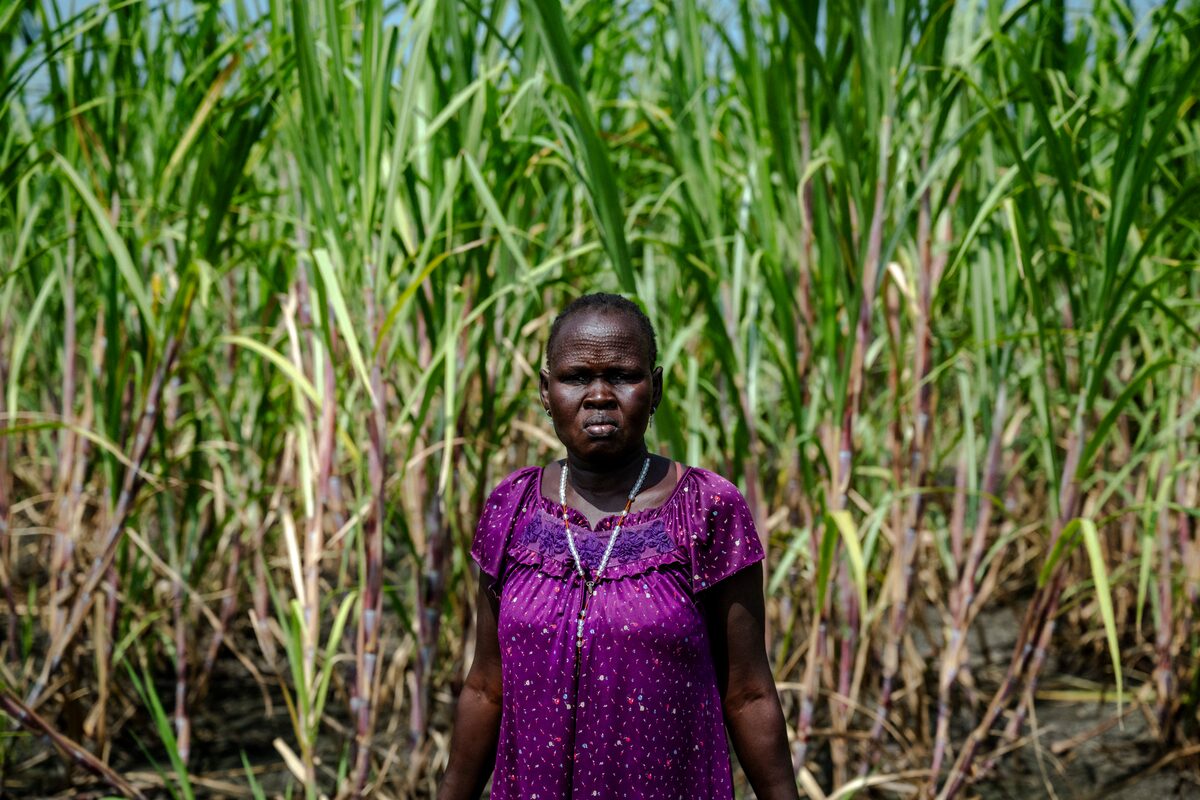
The afternoon sun begins to drop outside the nutrition centre, where 10-year-old Akem had been feeding her brother Garang.
She pulls over a plastic chair and talks about their routine. When there’s food, she cooks porridge for them in the morning. In the afternoons, she washes his clothes, and when her mom doesn’t make it home, she puts him to bed and then falls asleep beside him. Once a week, she brings him here to pick up his Plumpy’Nut. Studying Garang’s face, she says she knows he’s unwell and is worried about him.
This is the first time she’s been to the cooking demonstration, she says, adding that she thinks it’s helpful because her brother can eat different food.
When asked if it was also an opportunity for her to eat, she says she will if there’s enough, but the priority is her brother. Akem says she had to quit school after primary because her family couldn’t afford it, and she has to look after Garang. But she hopes to return one day, and eventually become a nutrition counsellor herself who can help kids like her brother.
“In the future, if maybe I go to school and finish school, I’ll be supporting these kinds of malnourished children.”

Akem Akuot, feeding three-year-old Garang, hopes to one day be in a position to help other children struggling with malnourishment.
Eyes on Africa: More from The Globe and Mail
The Decibel podcast
The United Arab Emirates, accused of arming militias in Darfur, is under mounting pressure to stop. When Mark Carney went on a trade mission to the UAE, Africa bureau chief Geoffrey York spoke with The Decibel about why Canada seems reluctant to press Abu Dhabi too hard on the Sudan issue. Subscribe for more episodes.
From our correspondents
When Tigray became a ‘Wild West’ of illegal gold mining, Canadian firms staked a claim
Egypt is pivoting away from the U.S. and toward China
Trump threatens military attack on Nigeria in response to alleged persecution of Christians