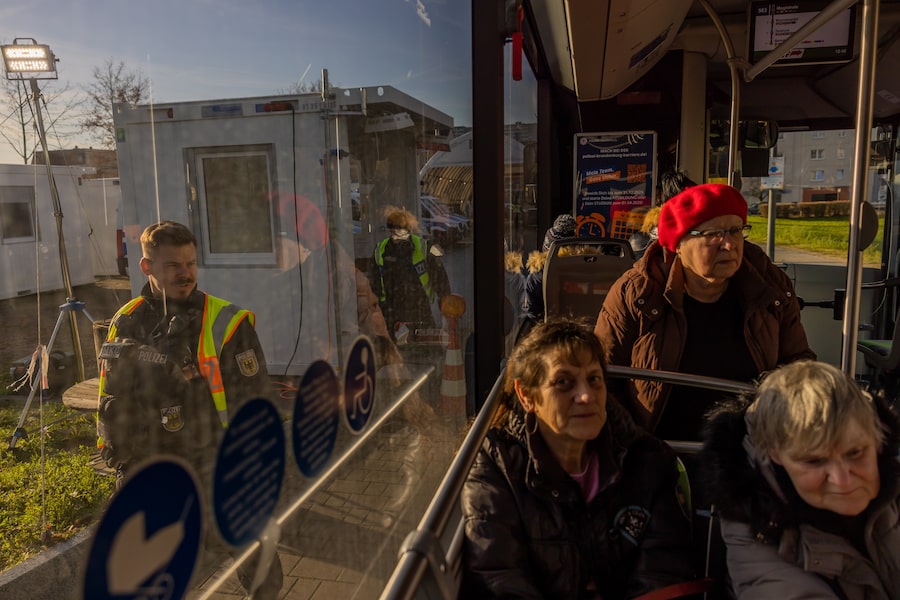
The No. 983 bus slowed as it headed across the bridge that stretches over the Oder River and connects the twin cities of Slubice, Poland, and Frankfurt an der Oder, Germany. Every passenger knew what was coming.
As the bus approached the Frankfurt side, two German border guards ordered the driver to pull over. They boarded and shouted “passports and ID cards” in German and English.
The officers made their way slowly down the aisle, taking photos of each passenger’s document. Michal and Olga Siecinski sat tensely in a seat near the back door. They’re refugees from Ukraine who live in Frankfurt and cross over to Slubice regularly. Mr. Siecinski had forgotten his Ukrainian passport at home. All he had was a temporary visa issued by the German government. It wasn’t good enough, the officer said. The couple pleaded until he finally relented. “Next time bring your passport,” he said sternly.

Olga and Michal Siecinski did not have the documents the German border guard asked for when they took the No. 983 bus into Frankfurt an der Oder, sister city of Slubice, Poland.
Not that long ago, no one in Slubice or Frankfurt would have dreamed of carrying their passports on the bus. After all, Germany and Poland are part of the European Union, which was founded on the principle of free movement and no borders between members.
But that principle has been suspended here and along more than a dozen other member borders, raising questions about the future of the EU’s cherished ideal.
The No. 983 bus is now stopped regularly by German and Polish border guards. Authorities in both countries insist that random checks on the Slubice-Frankfurt bridge are a temporary but necessary measure to address the flow of illegal migrants.
Germany started its patrols here three years ago, as part of a larger program to reduce the number of asylum seekers. The government has set up similar checkpoints along the country’s borders with France, Luxembourg, Belgium, the Netherlands, Denmark, Austria, Switzerland and the Czech Republic.
The move has been controversial, and it has put pressure on other EU countries to follow suit.
Under a current European Union agreement, asylum seekers can be returned to the first EU country they entered. Germany has relied on that deal to impose temporary restrictions and turn away migrants at the border. Nine other EU members have adopted similar controls.
Poland responded last summer with checks on the Slubice side of the bridge; that government has also introduced controls on the country’s border with Lithuania.

Until two years ago, Europeans could cross the bridge on the Oder River without needing a passport, but that changed as Germany set up checkpoints along its borders.
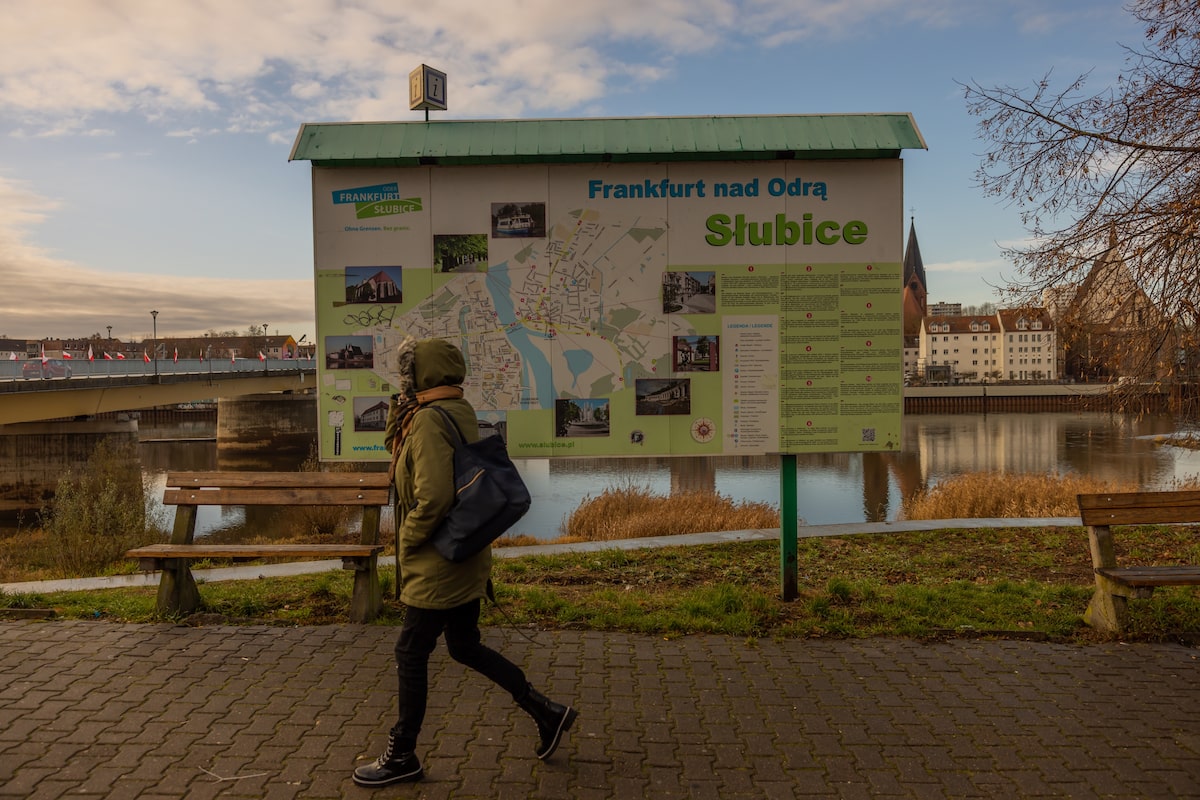

Officials from the Polish and German governments argue the heightened scrutiny has stopped thousands of illegal entries – more than 18,600 alone since last May along Germany’s nine borders, according to the German Interior Ministry.
But critics say the crackdown is more for show, and that only a handful of illegal migrants have been stopped on the Slubice-Frankfurt bridge. Meanwhile, officials on both sides say the checks have caused a drop in cross-border shopping and sparked complaints from businesses about delayed deliveries.
There’s a deeper concern, too, about the symbolic damage the controls have done to the decades of co-operation between Slubice and Frankfurt, which have been held up as models for what the EU aspires to be. Ever since Poland joined the bloc in 2004 the two cities – Frankfurt has a population of 60,000 and Slubice nearly 20,000 – have worked together under the motto “Without borders.” They’ve developed a shared heating system, set up bilingual schools and combined programs between the European University Viadrina in Frankfurt and the Collegium Polonicum in Slubice. Around 20,000 cars cross the bridge every day, carrying students, workers, shoppers, friends and relatives from city to city.
“I have been trying for the last 30 years to engage myself and my work to build this common community and I feel like I’m punished through the German and Polish national governments,” said Tomasz Pilarski, who is from Slubice and crosses the bridge regularly to his job in Frankfurt, where he heads the city’s marketing office.
“It’s completely stupid and it’s hard,” said Sören Bollmann, who lives in Frankfurt and runs the Frankfurt-Slubice Cooperation Center. “We are one European Union and now you see the bus, for instance, which is controlled and everybody has to show their identity. Where’s the sense?”
Mr. Bollmann is representative of a lot of people here. He grew up in Germany and married a Polish woman; they moved to Frankfurt-Slubice because of the easy access to both countries. Their children have become so used to speaking Polish and German they regard themselves as “Slubfurters,” a common local term.

Sören Bollmann, head of the Frankfurt-Slubice Cooperation Center, sees little sense in policies that now make it harder to travel.
After years of such interwoven lives, many people view the reintroduction of border controls as a throwback to the dark days of the communist era, when the border was virtually sealed and crossing the bridge was almost impossible.
Before the Second World War, the two cities were German and known as Frankfurt and Dammvorstadt. The latter was renamed Slubice after the war, when all German land east of the Oder River was granted to Poland.
The redrawing of the boundary caused massive upheaval. Germans on the Polish side were expelled and Slubice was resettled by Poles who had been forced to leave their country’s eastern territories in another redrawing of borders.
The resulting communities in Slubice and Frankfurt eyed each other with suspicion. The mutual coldness continued through the postwar period, when Frankfurt was integrated into East Germany and Slubice was ruled by communist Poland.
Interactions between the cities was kept to a minimum and controls on the bridge tightened further in the 1980s, with the rise of the anti-communist Solidarity movement in Poland, led by shipyard worker Lech Walesa.
The fall of the Berlin Wall and the reunification of Germany in 1990 prompted some easing of the restrictions, but it wasn’t until after Poland joined the EU in 2004 that the bridge fully opened.

Marzena Slodownik remembers the Cold War frustrations of life on the border in Slubice, where she is now mayor.
Slubice Mayor Marzena Slodownik, 54, vividly recalls how hard it was to cross the bridge before German reunification. “I remember when I was a teenager, we just stood up on the Polish side and we couldn’t come across the border. We just saw Frankfurt and that’s all,” she said.
Her grandmother and two aunts worked in a factory in Frankfurt and every now and then they would return home to Slubice with bananas and oranges, rare delicacies in communist Poland.
She also remembers how it felt to walk freely across the bridge for the first time in 2004. “That year, my youngest son was born, and I was just walking across the bridge with him in a carriage. I couldn’t imagine that I’m doing this.”
She has no patience for the Border Defence Movement, a Polish group of volunteers who have started informal patrols along the bridge. They are among those who support tighter controls and want the governments to go even further.
“We are basically normal people who just love Poland, and the main goal is to keep Poland safe,” said member Aneta Barcik, crediting the group for pressuring the Polish government to finally station border police on the Slubice side of the bridge.
Ms. Barcik lived in Hamburg for 25 years, but returned to Poland eight years ago after she felt the city had become unsafe owing to uncontrolled immigration. She insisted the border defence group isn’t xenophobic. “The only problem that we see is the problem with people who don’t have any documents.”
The group says it’s guarding against illegal migration and attempts by German border police to secretly send asylum seekers into Poland.
“It’s a new situation in the world,” Ms. Barcik said. “We have huge migration movement – people who are coming to Europe and they don’t respect our culture. They actually very often ruin the culture.”

Aneta Barcik belongs to the Border Defence Movement, which she insists is not xenophobic – only opposed to illegal immigration, which she blames for conditions that led her to move away from Hamburg.
Last summer, controversy erupted when a young man believed to be an asylum seeker from the Middle East was stuck on the bridge. He’d been sent across by German police but was refused entry on the Polish side. He spent the next several hours walking back and forth, unable to enter either country, before finally being allowed to return to Germany.
For some residents, the incident illustrates why the checks matter.
“It’s good, it’s important,” said Percy Kruger, 19, as he waited for the No. 983 bus to take him back home to Frankfurt from Slubice. “No illegal immigrants. I don’t want them. I want to be walking around my streets and feel safe.”
Ms. Slodownik bristles at those comments. Such fears are unfounded, the mayor said.
“I’m going several times per week to Frankfurt, and doesn’t matter the time, I don’t feel that there is a problem of security. I feel comfortable.”
Municipal officials in both cities have been lobbying Berlin and Warsaw to drop the checks. The two mayors would rather focus on how to deepen co-operation, such as the joint move to expand the No. 983 bus service and plans to build two new bridges, one for cars and one for pedestrians.
“Slubice couldn’t work without Frankfurt, and Frankfurt couldn’t work without Slubice,” Ms. Slodownik said. “We are not living here like two countries, but like one organism.”

Beyond borders: More from The Globe and Mail
The Decibel podcast
In public opinion polls, Canadians used to broadly agree that ambitious immigration growth was a good thing. In 2024, that consensus crashed. To find out why, The Decibel asked professor Rupa Banerjee and Tony Keller, author of Borderline Chaos: How Canada Got Immigration Right, and Then Wrong. Subscribe for more episodes.
Commentary
Debra Thompson: Trump has taken the mask off about immigrants
Marcus Gee: A thriving Syrian family shows why we shouldn’t give up on immigration