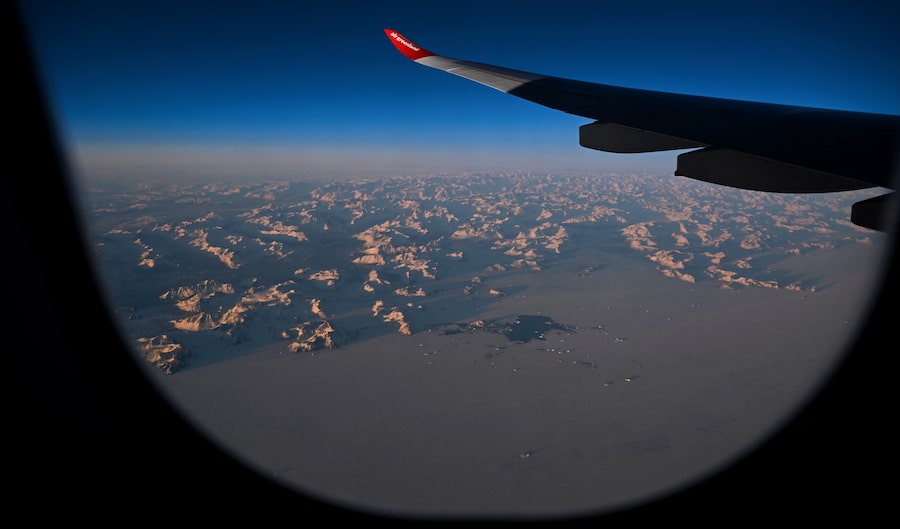
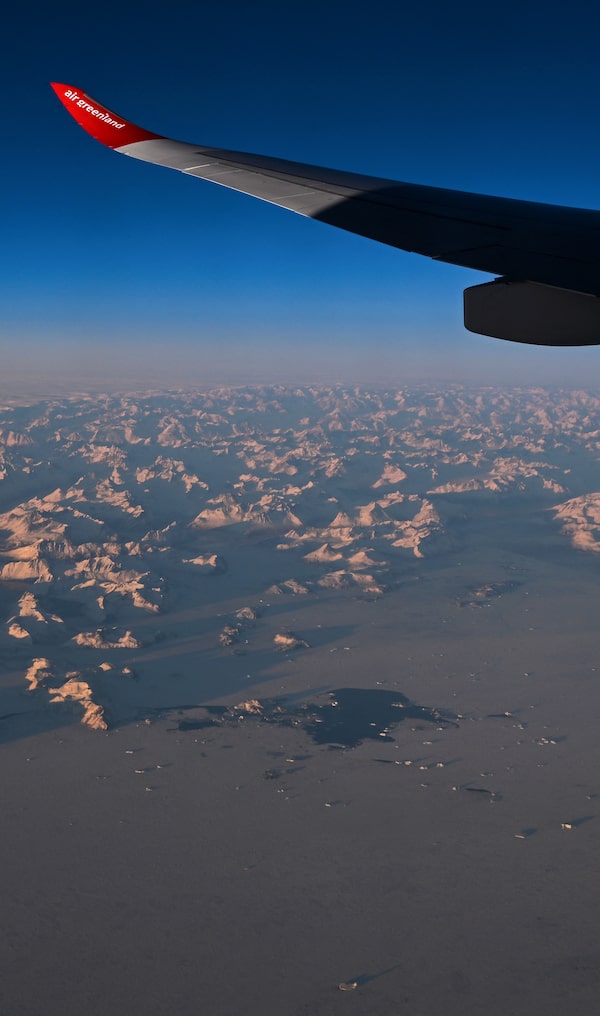
On any given day, squadrons of jetliners slip through the skies over Greenland, tracing the more fuel-efficient polar routes that connect the distant corners of the planet. On a recent morning, those overflying the world’s largest island included a KLM flight from Tokyo to Amsterdam, a Lufthansa plane winging its way from Frankfurt to Vancouver and Qatar Airways on a 12,000-kilometre journey from Doha to Atlanta.
For passengers, crossing Greenland is as unremarkable as any other aspect of modern aviation – a chance, perhaps, to peer down at the sprawling ice sheet in between naps.
But for some in Greenland, the island’s airspace is a natural resource that has been unfairly placed in the hands of other countries. For decades, air traffic over the island has been controlled not by Greenland or Denmark but by Iceland and Canada.

Canada and Iceland each control part of Greenland's high-altitude airspace. Their flags flew side by side when Canada's Foreign Affairs Minister recently opened a consulate in Nuuk, the capital.Siegfried Modola/The Globe and Mail
It’s an arrangement that is “hampering us,” said Vittus Qujaukitsoq, a Greenlandic politician who has served as the autonomous Danish territory’s Minister of Finance, Interior and Foreign Affairs.
“We are losing revenues that we are entitled to get and that could benefit our economic independence.”
Mr. Qujaukitsoq has spent years researching the value of resources that, he believes, have been unfairly taken from Greenland. The most important is seafood caught in the island’s waters, which he says generates billions of dollars a year in tax revenue for Denmark.
But he estimates that Greenland, were it to assert the right to control its airspace, could bring in $30-million to $40-million a year in revenue from that work.
Together, the cash from seafood and airspace would, by his calculation, be sufficient to fund Greenland by supplanting the roughly $850-million a year Denmark provides the island in a block grant.
Securing that revenue would give Greenland a measure of economic independence, reversing a current situation in which the island is, “against our will, losing revenue that we are entitled to,” Mr. Qujaukitsoq said.
But it would also mean remaking a critical piece of global transportation infrastructure, an arrangement that has been in place for decades.


International agreements to control North Atlantic airspace date to the years after the conclusion of the Second World War, as regular civilian air transport gathered speed with the advent of the jet age. Agreements struck by the International Civil Aviation Organization, which is headquartered in Montreal, divided Atlantic airspace into oceanic control zones, with Shanwick controlled out of the U.K. and Ireland, Reykjavik controlled from Iceland and Gander controlled from Newfoundland.
Reykjavik oversees high-altitude aircraft flying over much of Greenland. Gander covers its southern reaches – below 63 degrees 30 minutes of latitude – and a large area of the western Atlantic, a region that saw more than 500,000 flights in 2024.
NAV Canada, which oversees Canada’s civilian airspace, charges a flat fee of roughly $210 a flight for the transatlantic services it provides. Iceland’s charges can reach slightly double that.
None of the money is passed on to Denmark or Greenland.
But neither are those fees intended to generate profit.
Service providers “are only reimbursed the actual cost via this charging scheme,” said Randi Aggerholm Baasch, a spokesperson for Naviair, the Danish air traffic control company. “No funds are transferred to the local government in either Greenland, Iceland or Denmark.”

The ravens of Nuuk can come and go as they please, but any planes flying close to the city will answer to Danish authorities. State-owned Naviair is in charge of Danish air traffic control.Ina FASSBENDER/AFP via Getty Images

Controllers rely on state-of-the-art satellite technology to keep planes flying safely. The arrays in Nuuk are strategically important for contacting satellites in polar orbits.Ina FASSBENDER / AFP via Getty Images
International agreements to manage airspace specifically over Greenland date to 1956. Denmark controls the island’s lower levels – up to 19,500 feet – but has for decades entrusted higher altitudes to Iceland and Canada, which have built sophisticated operations to operate transatlantic airspace.
Fees are regularly adjusted to cover the cost of service, which has dramatically improved in recent years.
The advent of satellite-based tracking and communications systems – some of them partly developed by NAV Canada – has allowed for controllers to remain in constant contact with aircraft, allowing them to more precisely control their movement and allow a greater concentration of planes on the most optimal routes. Before those systems, each aircraft was given a protected area of roughly 1,200 square kilometres – twice the city of Toronto – to ensure it was kept away from other planes at a given altitude. Today, that protected area has shrunk by nearly 90 per cent.
“That means the choices that individual flights have to get the most fuel-efficient altitude and routings go way, way, way up – and it doesn’t take long to start getting enormous fuel savings. You could easily save a couple thousand dollars a flight,” said John Crichton, the founding chair of NAV Canada, who served as its president from 1997 to 2015.
Countries have sovereignty over their own airspace, and if “Denmark wanted to take that airspace itself and provide the control service, they could,” Mr. Crichton said. “It’s all technically possible. Whether or not it would make any sense economically, that’s another matter. I suspect it wouldn’t.”
Only a fraction of transatlantic flights actually cross Greenland – Mr. Crichton suspects it may be as low as 10 per cent.

The average transatlantic traveller may not notice whose airspace they cross en route, but for governments, it can make a big difference in who collects the fees.Liesa Johannssen/Reuters
Elsewhere in Europe, most countries have hung on to national control of airspace, despite a decades-long effort to achieve the Single European Sky, which, by allowing more efficient flight routing, could reduce fuel use over the continent by as much as 10 per cent.
“It is not a good idea to chop up the airspace because it means that there are more transition interfaces, and they all tend to make flights more costly,” said Thorgeir Pálsson, who led Isavia, the Icelandic air traffic control company, from 1992 to 2010.
Still, he said, it is “very understandable” why Greenland would be interested in asserting control over its own airspace.
Doing so would be unlikely to create new government revenue under the current cost-recovery model. But it would bring high-paying jobs. At the moment, Isavia employs 280 people in its air navigation services division.
In Gander, meanwhile, NAV Canada employs more than 60 controllers to handle oceanic flights. They can earn more than $250,000 a year.
For Greenland, creating the capacity to control its airspace would involve a costly investment in equipment and would almost certainly mean butting heads with an industry that, Mr. Pálsson said, is fond of the current arrangement for transatlantic flight.
But creating that could bring its own gains.
“The profit is having people with a degree of capability and training,” he said.
“If they are well-paying jobs, they are of course valuable to society,” he added. “It is a matter of economic activity.”

On the ground in Greenland: More from The Globe and Mail
From our foreign correspondents
Thanks to Trump’s threats, tourism in Greenland is booming
Warming temperatures sow uncertainty for hunters and tour operators
For biathletes, Olympic racing suits pay homage to a threatened homeland
Video: Canada’s new consulate in Nuuk
The Globe’s Paul Waldie, reporting on the official debut of a Canadian consulate in Nuuk, shares his observations on what the rare diplomatic gesture means in the geopolitics of the Trump era.
The Globe and Mail