They traversed the dangers of the Panamanian jungle. They were robbed, some assaulted, as they navigated the roads and tracks that delivered them northward through the heart of the Americas. They confronted cartels and waded through rivers into the U.S., where they began to build new lives.
Now, some of the millions of people who crossed illegally into the United States over the past few years are thinking about setting out again, this time to Canada. Their determination to keep from returning home could portend new strains along the wide open spaces of the 8,900-kilometre frontier that divides two of the most prosperous countries on Earth.
Donald Trump won re-election on promises to launch a mass effort to clear undocumented immigrants from the country. With fewer than two months until he is once again president, little is known about how his administration would proceed, who it would target or how many people it would prove possible to remove from the country.
But in the countless cities across the U.S. where migrants have established tenuous lives, Mr. Trump’s imminent return to the White House has provoked fresh anxieties, and thoughts of seeking safety elsewhere.
“I can’t go back to Venezuela,” said Maria Pérez, 41, who has spent the past 14 months in Colorado. “They would kill me.” She left her home after the father of her children was kidnapped and murdered in a dispute related to his work for a construction union.

Since arriving from Venezuela a few months ago, Maria Perez has been a regular attendee of the Spanish Sunday morning service at Denver Friends Church.
If she is threatened with deportation from the U.S., she is prepared to leave, in hopes that another country can provide a place to make a new home. A cousin in Canada has been urging her to come. “She tells me to go there, says there are opportunities for me and my children,” Ms. Pérez said.
Maybe, she said, she could get a bus. But she will set out on foot if that’s what it takes.
After all, “we already walked through eight countries.”
Many who make this journey are likely to be turned back. Long-standing agreements bar entry to Canada by most refugee claimants from the U.S., with only a few exceptions for unaccompanied minors and those with family north of the border.
But such legal considerations have not weighed heavily on the minds of those who already entered the U.S. outside normal crossings, including the tens of thousands now in Colorado.


Denver is roughly midway between the U.S. borders with Mexico and Canada. In the past year, it has become a major destination for migrants, some of whom were bused here by Texas Governor Greg Abbott. By some counts, Denver received a greater number of migrants per capita than any other major city in the U.S., an influx that has also brought the city to the national fore.
In October, Mr. Trump came to the Denver suburb of Aurora, where authorities have arrested members of Tren de Aragua, a Venezuelan gang. At one point, U.S. intelligence services suspected that the gang intended to make Denver its U.S. headquarters, according to internal police documents reported by the Denver Gazette.
During a rally in Aurora, Mr. Trump promised action against “an army of illegal-alien gang members and migrant criminals from the dungeons of the third world,” saying that in “no place is it more evident than right here.”
After winning re-election, Mr. Trump selected Tom Homan, former director of U.S. Immigration and Customs Enforcement, to be in charge of “Deportation of Illegal Aliens back to their Country of Origin,” he wrote on social media.
Mr. Homan has pledged to “run the biggest deportation force this country has ever seen.” Mr. Trump has also confirmed that he is preparing to declare a national emergency and deploy the country’s military to conduct deportations.
Denver is already preparing to respond. The city’s mayor, Mike Johnston, last week described how a resistance against federal deportation agents could take place, with police “stationed at the county line to keep them out” and tens of thousands of local residents aligned in protest.
“It’s like the Tiananmen Square moment with the rose and the gun, right?,” he told Denverite, a local news publication. He later said he regretted making that comparison, although he is willing to personally go to jail to block deportation efforts.
For others in Colorado, Mr. Trump’s personal attention to the area has brought its own anxieties. If deportations begin, “I think Denver and Aurora are going to be targeted,” said a woman who has led a non-profit in the city that provides clothing and other services to migrants. The Globe and Mail is not identifying her, because she fears repercussions for continuing to help migrants.
In recent weeks, local authorities have begun questioning those providing aid to migrants, asking about assistance given to help them start small businesses, seek asylum and secure food.
Before the election, the woman was a vocal critic of Mr. Trump. She held a sign outside his rally that said: “Keep the immigrants, deport Republicans.”
Now, she is herself preparing to leave. “If the military starts rolling in here, we’re going,” she said. She has already decided on a small town in another state. “We’ve researched schools, we have a plan to go if we need to,” the woman said.
She has also urged migrants to get out of Colorado. But Mr. Trump’s election, and the uncertainties of how exactly he will act, have created a paralysis of indecision.

Members of the local migrant community attend a Spanish Sunday morning service at Denver Friends Church.

Keith Reeser is the senior pastor at Denver Friends Church, which has provided shelter space to migrants.
“It’s really jostled people into a traumatic response of – ‘Do we need to hide?’ ‘Do we need to run?’ ‘Do we just stay home?’ ‘Does this blow over?’ ‘What do we do here?’ ” said Keith Reeser, senior pastor at Denver Friends Church, which has provided shelter space to migrants and now offers Sunday services in Spanish.
Mr. Reeser has found himself grappling with unexpected questions.
Can churches become sanctuaries to protect migrants from federal agents? Will the advent of deportation inspire a new kind of underground railroad? What kind of help will everyday Americans be willing to offer? Perhaps more importantly, what lines will American citizens be willing to cross to offer help?
“I’m not going to be aiding and abetting fugitives,” Mr. Reeser said. But if a migrant has committed no evident wrongdoing, “I’m going to help them.”
He has had conversations with church members, too, about how they would respond.
“What would you do if someone knocked on your door and they’re holding two kids and say, ‘We’re getting deported. Can you take our two children?’ ” Mr. Reeser said.
“We need to be prepared if it comes to something as drastic as that in January.”
For now, however, his best advice is for migrants to seek protection by applying for asylum.
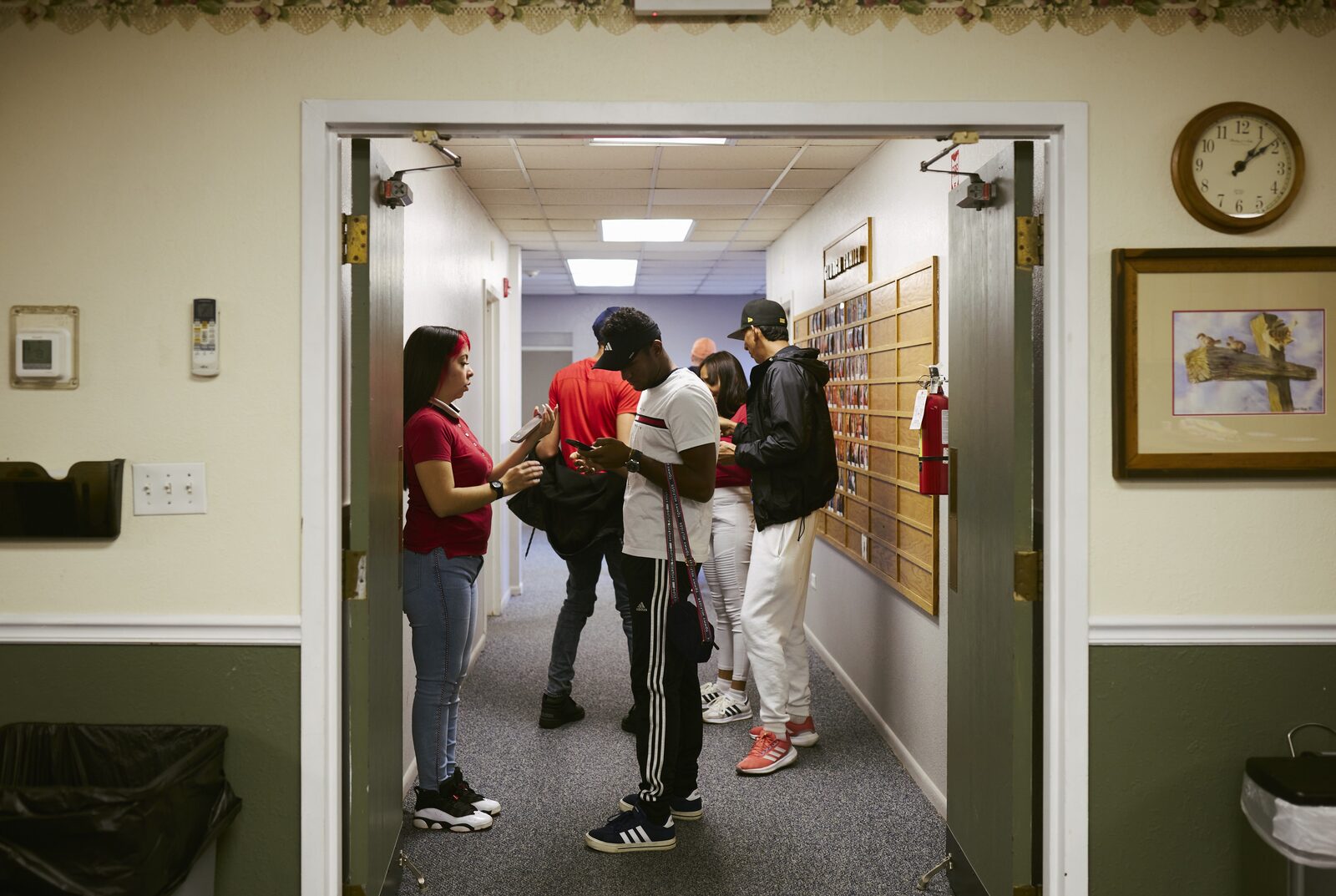
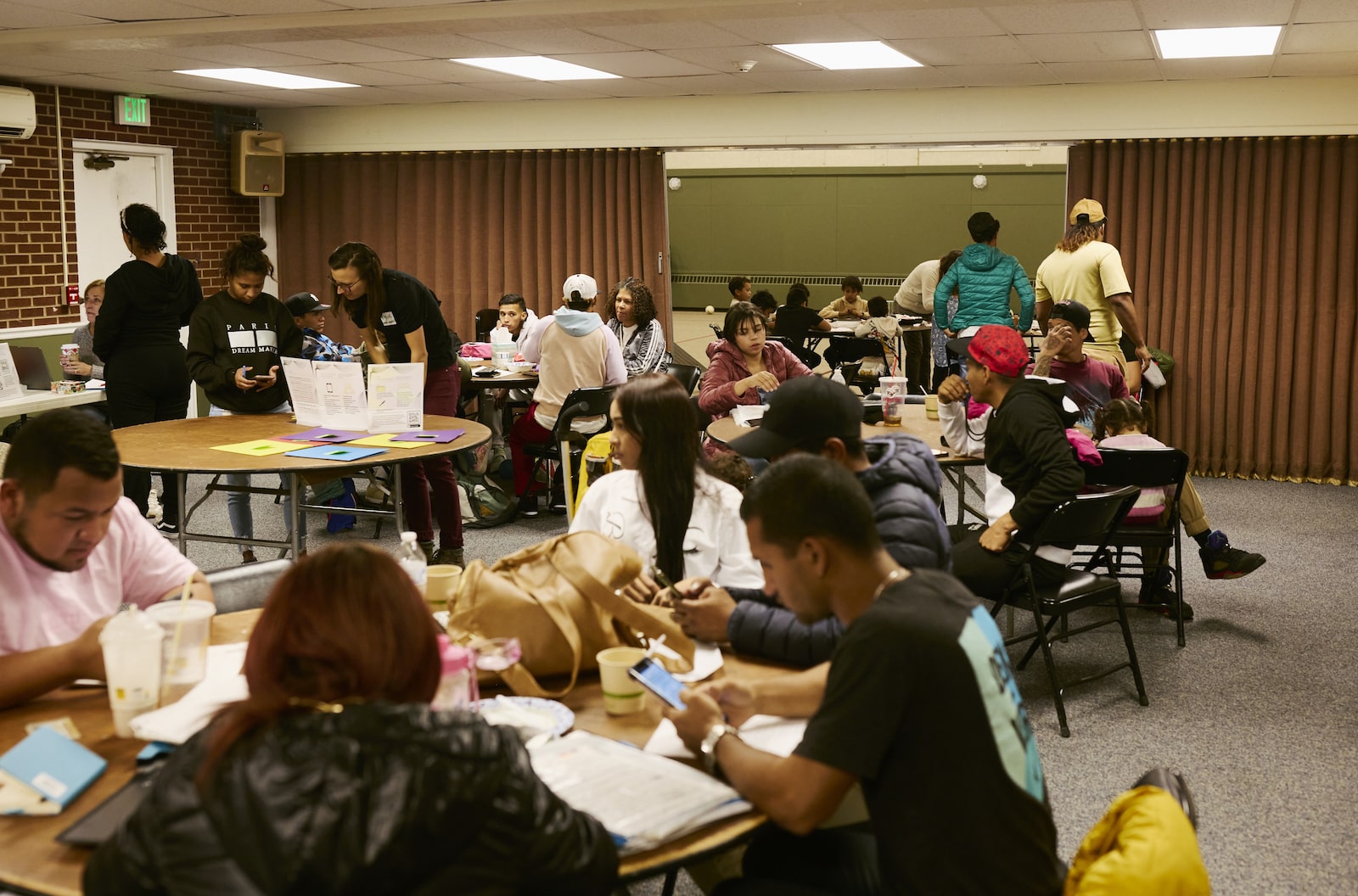
Across Denver, volunteers have helped many migrants assemble the paperwork and navigate the digital systems to submit asylum claims. On a recent afternoon in the city, Roraima Pérez, 55, juggled three cellphones as she worked with the dozens of people who had attended an asylum clinic.
“There’s a lot of worry. People don’t have any status. And they see asylum as a way of avoiding a deportation order,” she said.

After navigating the complexities of her own asylum process, Roraima Perez decided to help fellow Venezuelan migrants understand the tedious procedures for securing safety in the United States.
Among Venezuelans, most are claiming political persecution, arguing that they are at risk because of connections to opposition parties in a country where, according to Amnesty International, critics have been “arbitrarily detained, forcibly disappeared and tortured with the acquiescence of the judicial system.”
An asylum claim can provide a lengthy reprieve from deportation, as applicants work through the plodding pace of an overstretched system that can take years to schedule an initial hearing and allows for the ability to appeal an initial ruling. Current U.S. law allows claimants to live and work in the country while their application is reviewed.
Roraima Pérez, a migrant herself, has helped dozens of fellow Venezuelans apply. Since the election, by her count, the numbers have tripled.
She worries that Mr. Trump could summarily rewrite the law.
But the idea that a president could simply strike away asylum protections is fanciful, said Andrea Ryall, a Denver woman who has co-ordinated volunteers to help migrants, including through a non-profit called Hope Has No Borders.
“That’s king stuff. That’s dictator stuff. In our country, you can’t just change the law,” she said – at least, not without going through the correct legislative processes.
Any deportation plan, meanwhile, will require the co-operation of other countries, and Venezuela, for example, stopped accepting repatriation flights earlier this year.
Allies of Mr. Trump have discussed the possibility of using a 1798 law – last invoked against Japanese, German and Italian nationals without U.S. citizenship during the Second World War – to round up and deport people deemed “alien enemies.” Ms. Ryall worries that this will include the creation of internment facilities – what she calls “concentration camps” – to hold migrants.
It’s a notion that strikes her as fundamentally at odds with the ideals of the United States.
“What I worry most about is the lack of humanity and how we handle what comes next,” she said.
She has begun to seriously consider moving away, perhaps to Europe. “I don’t want to live here,” she said. “I don’t want to raise my kids here.”
But even as Ms. Ryall is seeking to leave, migrants – including those she has spent the past year helping – remain fixed on staying. Some have gone to extraordinary lengths to cement connections to the U.S.

Saray Acacio's daughter Richele Valentina was born in the U.S after Acacio, who was then pregnant, and her son made the treacherous journey from Venezuela into the U.S. in September.
Saray Acacio, 37, was close to giving birth when she crossed the neck-deep waters of the Rio Grande in September. Twenty days later, she welcomed a daughter, Richele Valentina, who became a U.S. citizen by virtue of her birth in Texas. Ms. Acacio, who worked as a preschool teacher in Venezuela, has visions of a future where her daughter can teach her English. “It’s something to be proud of,” she said.
“All people have the right to opportunities,” she argued. She can understand why Mr. Trump would want to evict criminals. “But not all of us are bad,” she said.
Still, she crossed illegally into the U.S., and has begun to worry that the difference in status with her daughter creates a risk that they will be separated. “I would die,” she said.
Mr. Trump has called for an end to the granting of citizenship for people who entered the country illegally. His long-time adviser Stephen Miller, whom Mr. Trump has named as deputy chief of staff for policy, has also spoken about stripping citizenship from people deemed to have obtained it wrongfully. It’s not clear whether such an effort could legally apply to children already born in the country.
Nonetheless, Ms. Acacio has begun thinking about what to do if she comes under deportation pressure. Other Venezuelans have told her to go to the 49th parallel.

“Canada seems safe to me, since it’s close,” said Luis Enrique Malave, 35.
A welder and drilling-rig roughneck, Mr. Malave entered the U.S. in January, after getting permission to do so. He has secured a work permit, and found jobs installing cabinets. He has tried to stick to legal pathways, including when he brought his wife and seven-year-old son into the U.S. in October.
“I knew the election was coming, so I was able to bring her just before,” he said.
In the meantime, he has done his best to fit into his new country. He wears a Bass Pro Shops trucker cap and a Hurley sweatshirt. He wants to contribute.
“When it comes time to file my taxes, I’m going to be ready to pay them,” he said.
At the same time, he is keeping an eye northward. He succeeded in fashioning a new life in one country. If necessary, perhaps he could one day do the same in another.
Canada, he said, “is an option. It’s like a Plan B.”