
Until not long ago, Egypt deftly presented visitors with the best and worst tourism experience in a single spot: the pyramids of Giza.
Every year, millions of visitors made the pyramids their first Egyptian port of call. After all, who would not want to see them – the pinnacle of Egyptian engineering, symbols of divine power and eternal afterlife and, in the Great Pyramid’s case, the last surviving structure of the Seven Wonders of the Ancient World?
Unfortunately, most had the smiles wiped off their faces the moment they arrived. They found the entrance building shabby, the ticket and security employees surly. They were immediately surrounded by touts hawking everything from cheap souvenirs to rides on doddering camels that had spent their lives frying in the desert sun. There were no washrooms. The din of private cars lining up to drive to the pyramids was annoying. The whole experience was disorderly, dirty and daunting.

This new entrance to the Giza pyramid complex made its debut in the spring.Khaled Desouki/AFP via Getty Images
But in April, the entrance and the entire Giza Plateau (the elevated bit of desert that contains the pyramids), reopened after a US$30-million overhaul by Orascom Pyramids Entertainment decades in the making. There is no comparison.
“We used to be ashamed of the visitor experience here,” said Amr Gazarin, chief executive officer of Orascom Pyramids, a division of Egyptian development giant Orascom Investment Holding. “It was a zoo here, it was ugly. Transforming the visitor experience was our moral duty.”
The clapped out entrance eyesore and the touts are gone, replaced by an elegant entrance hall made of local limestone one shade lighter than the pyramids. Cars are banned: Air-conditioned electric buses ferry visitors to seven drop-off spots near the pyramids and the Sphinx. Unobtrusive, low-profile gift shops and restaurants are all fashioned in the same limestone colour. There is even a medical centre to treat overwhelmed, sun-drenched visitors.


Even better, the Giza Plateau is finally connected to the new Grand Egyptian Museum.
The 490,000-square-metre structure, home to 100,000 artifacts representing 7,000 years of history, is being billed as the world’s largest museum devoted to a single civilization and ranks as Egypt’s biggest cultural project since the 1960s, when the temples of Abu Simbel and Philae were moved to save them from the flooding caused by the construction of the Aswan High Dam on the Nile.
Parts of the GEM have been informally open for a couple of years – the official opening pageantry is set for Nov. 1 – and visitors travelling between the museum and the pyramids had to traipse along a horrifically busy highway or flag down one of Cairo’s rickety taxis. Now, the attractions are linked by a 1.3-kilometre raised walkway wide enough for both pedestrians and small electric shuttle buses.
Combined, the new plateau, the walkway and the GEM itself – especially the GEM, with its centrepiece Tutankhamun collection – have transformed tourism in the country. To see ancient Egypt at its best has gone from hassle to pleasure in one convenient spot.


The more gratifying visitor experience is part of the financially stressed Egyptian government’s plan to boost tourism numbers. It may already be working: Government data show 8.7 million tourist arrivals in the first six months of 2025, up by almost a quarter from the same period last year.
The strategy began to take shape in the 1980s, when various new museums and other cultural projects were conceived. They were a long time coming. The UNESCO-inspired National Museum of Egyptian Civilization, located in central Cairo near the City of the Dead, partially opened to the public in 2017. The institution breathed new life into an old concept. Instead of displaying only pharaonic-era objects, its galleries trace 35,000 years of regional history, covering the Archaic, pharaonic, Greco-Roman, Coptic, medieval, Islamic and modern eras. Among its treasures are 22 royal mummies.

The existing Egyptian Museum in downtown Cairo opened in the 1900s, when the country was nominally part of the Ottoman Empire but occupied by the British.Khaled Desouki/AFP via Getty Images
Before it opened, visitors to Cairo seeking an historical itinerary were pretty much limited to the pyramids and the old Egyptian Museum on Tahrir Square downtown. Touring the lovely pink, neoclassical pile was, and still is, like stepping into a set of Raiders of the Lost Ark. Its 120,000 objects, from elaborate sarcophagi to towering pharaonic statues, are displayed haphazardly in halls and galleries. The wood and glass cabinets are handsome yet dusty; the lighting is poor, the labelling inadequate.
Still, the Egyptian Museum’s intriguing, romantic mess attracts several thousand visitors a day. It was saved during the 2011 Arab Spring revolution, when Cairenes formed a human ring around the building to protect it from looters. It was a part of their history and their childhood education, and they would not hear of its closure.
But the Egyptian government envisioned something grander. They wanted to display the country’s vast collection of artifacts, especially the treasures that were hidden in storage depots, in a building that would transform the entire Giza Plateau into a global tourist hot spot.
“It was part of the greater plan to preserve ancient Egypt in a protected environment, to present these wonders for an Egyptian and international audience in a fitting way for this fantastic collection,” said Tarek Tawfik, a prominent Egyptian archeologist who was head of the GEM until 2019.


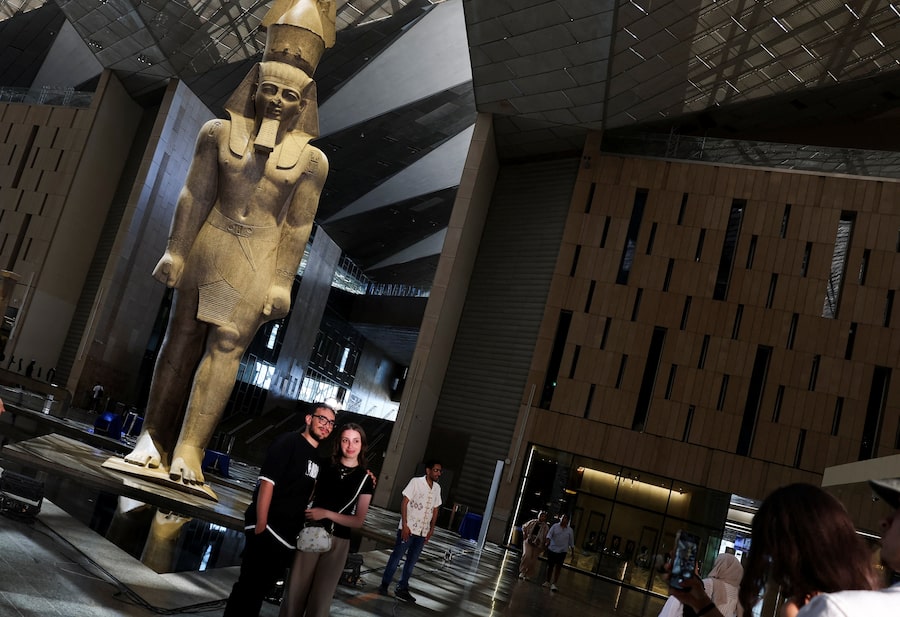
The Ramses statue arrived in 2018, after years of restoration work on the Giza plateau. It was unearthed in pieces in the 1820s, and once stood at Cairo's central train station.Mohamed Abd El Ghany/Reuters
In the end, the GEM would take about the same time to build – 20 years – as the Great Pyramid, also known as the Khufu pyramid, which was constructed of 2.3 million stone blocks weighing about 2.5 tonnes each.
The COVID-19 pandemic, political upheaval during the Arab Spring revolutions and the recent wars in the Middle East were behind the several false starts.
In an act of benevolent international diplomacy, the GEM, whose final cost landed at about US$1.1-billion, was largely financed by loans from Japan International Cooperation Agency. Dublin’s Heneghan Peng Architects, led by the wife-and-husband team of Roisin Heneghan and Shih-Fu Peng, won the global competition to design the museum in 2003.
They have created a building that is enormous in scale – it’s three times the size of the Louvre – with an 800-metre-long façade composed of bevelled alabaster and glass triangles that echo the stark angularity of the pyramids. The building rises up to the Giza Plateau, with its top floor on roughly even level with the base of the pyramids.
The entrance takes the visitor into a soaring, airy atrium with a 40-metre ceiling. At its centre is a colossal, 12-metre statue of Rames II from the 13-century BC. The pharaoh is smiling, as if to greet visitors.
The aptly named Grand Staircase serves as the curtain raiser to the main galleries. Its design was inspired by Mr. Tawfik, who wanted a bold yet graceful opening statement for visitors. It ascends through the atrium, taking visitors to the top floor, where windows perfectly frame the pyramids.

Tourists can stop and look at statues of Egypt's ancient rulers on the steps to the main galleries.Amr Abdallah Dalsh/Reuters
The wide, tiered staircase is full of statues and sarcophagi arranged chronologically, from the predynastic era at the bottom to the Greco-Roman era at the top. Spacious, well-lit galleries – one of which houses the Tutankhamun collection – extend from each side.
No doubt every category of tourist to the GEM will make a beeline to this exhibit. The Boy King’s gallery marks the first time that all 5,000 objects buried with him, including his golden funerary mask, found in his tomb in 1922 by British archeologist Howard Carter, are displayed in a single area. The exhibit is complemented by an immersive-technology experience that allows visitors to step into Tutankhamun’s world.
Mr. Gazarin, of Orascom Pyramids, says the revamped Giza Plateau and the GEM are already triggering a surge in tourism. He expects 4 million visitors at the pyramids alone this year, up from 2.5 million last year.
“Here, in one spot, you have the Grand Egyptian Museum, you have the pyramids,” he said. “We are making this the capital for archeological visits in the world.”

Amr Abdallah Dalsh/Reuters
Antique road shows: More from The Globe and Mail
The Decibel podcast
No museum shows the public all of its treasures at once, least of all art galleries. In Canada, 95 to 99 per cent of any institution’s collection is in storage. Last year, visual arts critic Kate Taylor explored how tax incentives created this space crunch, and told The Decibel what curators are doing about it. Subscribe for more episodes.
Cultural heritage around the world
Indigenous artifacts at Vatican Museums heading back to Canada
The destruction of Gaza’s heritage sites threatens to erase symbols of Palestinian identity
History repeats itself for Canadian culture in the U.S. trade war