
For more than 5,000 years the Gaza Strip has been a meeting point of civilizations, from the Canaanites and Pharaohs to the Romans and Ottomans, all of whom left a mark in the many monuments, archeological sites and places of worship that reflected Gaza’s proud heritage.
But after two years of war, many of the identifying landmarks of the armies and people who have passed through this 40-kilometre stretch of land on the Mediterranean coast are gone or in danger of disappearing.
Palestinians are only now taking in the full extent of the loss after Israel paused its relentless bombardment last Friday, under the terms of the Israel-Hamas ceasefire negotiated by international mediators in Egypt. In Gaza City, a few excavators were optimistically clearing the wreckage this week. But the task ahead is enormous. At least 60 per cent of buildings across the Gaza Strip – including 90 per cent of those in Gaza City – have been damaged or destroyed, according to the United Nations.

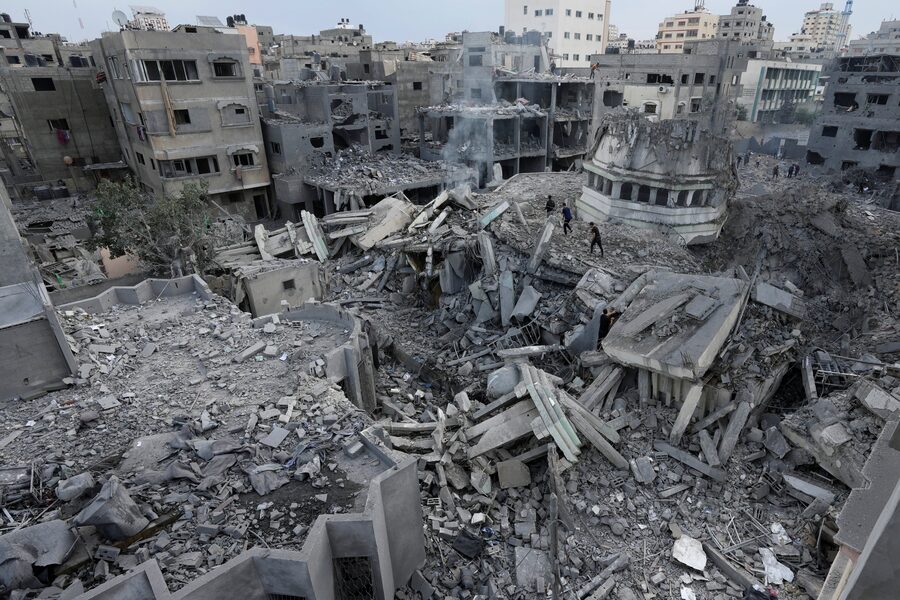
Palestinians walk past the destroyed Abu Khudra mosque in Gaza City in August. After two years of war, at least 60 per cent of buildings in the Gaza Strip have been damaged or completely destroyed by Israeli strikes, according to the UN.OMAR AL-QATTAA/AFP/Getty Images
For many Palestinians, the war has been not just a military confrontation or another round of fighting in a long-standing conflict. It has been existential, targeting the very idea of Gaza as a memory and the history it holds as a symbol of Palestinian identity. As of Oct. 7, UNESCO had verified damage to 114 cultural heritage sites – including religious buildings, archeological sites, archives, a museum and other structures of artistic interest – and is carrying out a preliminary assessment using satellite imagery and analysis. The Palestinian Ministry of Tourism and Antiquities has stated it is more than 200, out of an approximately 325 known locations of historical importance.
Among the first-hand witnesses to the destruction was Elias al Jaladah, a member of the Orthodox Church Council in Gaza, who was inside the 4th-century St. Porphyrius Church when it was bombed in the early days of the war. Part of the building collapsed, killing dozens of civilians inside.
“The war is not limited to targeting people, but carries within it a systematic attempt to erase the historical identity of the Palestinian people and to wipe out the memory of ancient Gaza, which dates back to before the birth of Christ,” he said.


The enclave’s story has always been one of resilience in the face of repeated devastation. First settled around 15th-century BC by the Canaanites, Gaza was the administrative, commercial and cultural heart of the region, connecting the Mediterranean coast to Egypt and the Arabian Peninsula with desert routes.
Gaza’s strategic location attracted many invaders, its fortunes rising and falling as the Assyrians, Babylonians, Greeks, Romans and Ottomans, among others, came and went. As a bridge between Asia and Africa, it was a commercial and cultural port that attracted scholars, traders and pilgrims. The earliest Christian communities settled here: About eight kilometres south of Gaza City lies the 4th-century Saint Hilarion complex, the first monastic community in the Middle East. It is believed to have been damaged during Israeli air strikes in December, 2023.

People walk through the ruins of the Great Omari Mosque in October, 2024. The holy site was largely destroyed by an Israeli air strike in 2023.Dawoud Abu Alkas/Reuters
The Arabs conquered Gaza in 635 AD, bringing Islam with them. When the 7th-century sandstone Great Omari Mosque collapsed after an air strike in 2023, it was not just the loss of one of the oldest buildings in the Holy Land, but a blow to the spiritual and cultural roots of the city.
The Ottomans ruled Gaza starting in the 16th century. By the time British took over in 1917, Gaza was a fishing town. After the state of Israel was established in 1948, tens of thousands of Palestinian refugees entered the strip, where they’ve since lived in crowded camps and along tightly packed streets.


The Old Town in Gaza City, with its mosques, churches, baths and markets, showcased the cultural and historic mix. Its oldest sections date to the Phoenician era, around 1,500 BC, and have been the worst affected by the war. Neighbourhoods such as Shuja’iya, Zeitoun, Tuffah and Daraj, which form the heart of the Old Town, were heavily bombarded, said Ismail Thawabteh, director-general of the government media office in Gaza.
Many historians say the recent destruction was one of the most comprehensive in Gaza’s long history, threatening not only buildings but also the continuity of Gaza’s urban and cultural identity.
“Through its crimes, the occupation seeks to erase everything connected to history and deep roots, as part of its colonial project based on denying the Palestinian people’s existence on their own land,” Mr. al Jaladah said, referring to Israel.
Several international treaties and conventions prohibit harm to cultural heritage in wartime. Under the 1954 Hague Convention, for example, the destruction of such places is forbidden, and warring parties are expected to take specific measures for their protection. But Gaza is one of the most densely populated areas in the world, with buildings in proximity to one another. Cultural sites became collateral damage, struck by fragments flying from nearby locations targeted as Hamas hideouts.


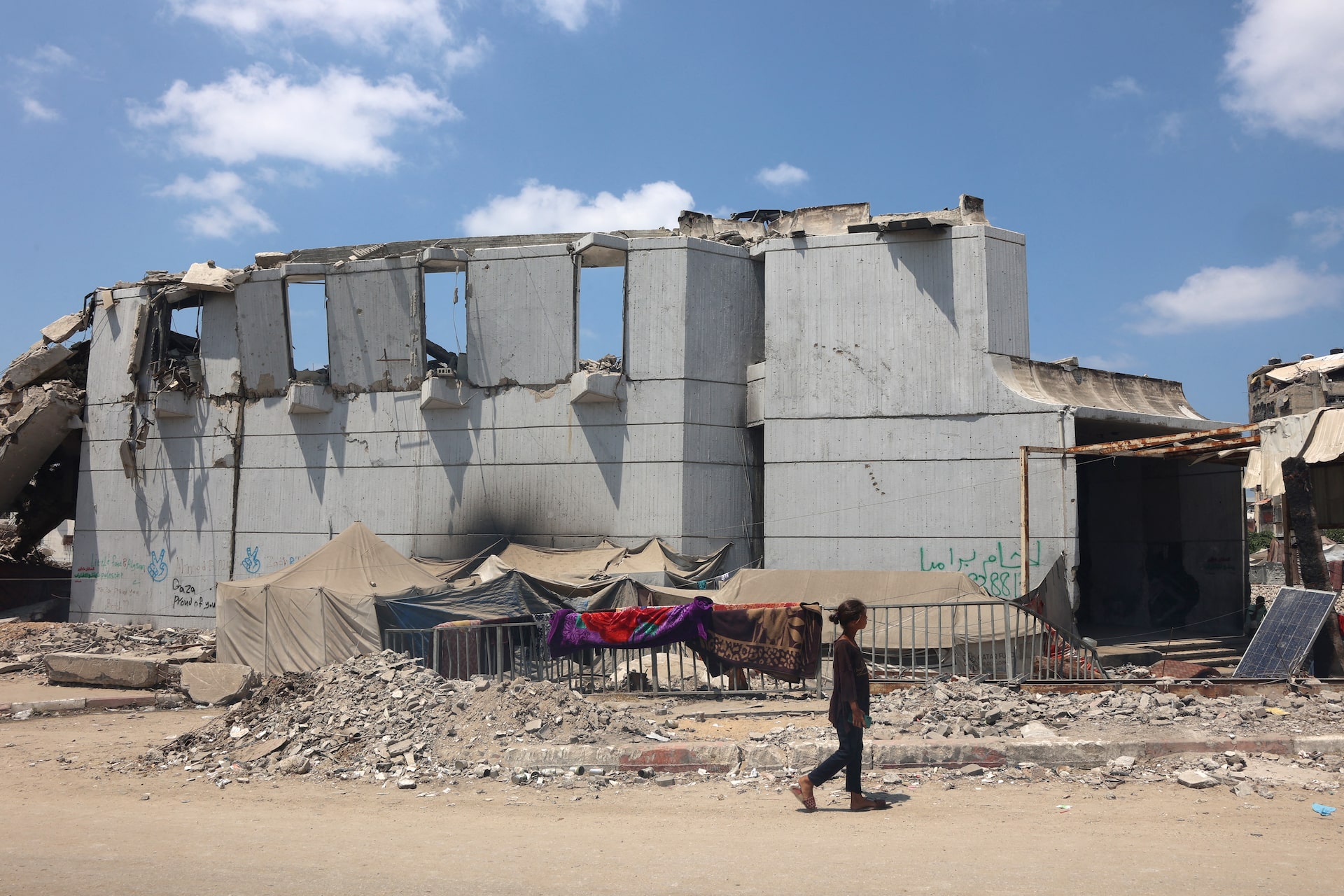
Universities, libraries and cultural centres forming the heart of civic life were also hit. The Islamic University of Gaza and Al-Azhar University have been almost completely destroyed; the Rashad Al Shawa Cultural Center, the city’s intellectual and cultural hub, was levelled. The Rimal neighbourhood, home to newspaper offices, public libraries and the Unknown Soldier Square – once a popular public space for families – has almost disappeared from the map.
Local reports indicated that the Akkad Museum in Khan Yunis, which held around 2,800 rare, ancient artifacts, was completely destroyed, meaning the loss of a historical record spanning thousands of years.

People stand on a platform overlooking ruins at the fourth-century Saint Hilarion Monastery archaeological site in the central Gaza Strip, in August, 2024. On Sept. 11, 2025, nearly three decades of archaeological finds in Gaza were hurriedly evacuated from a Gaza City building threatened by an Israeli strike.EYAD BABA/AFP/Getty Images
Some residents of Gaza have been collecting stones and fragments of historic sites, and trying to save manuscripts and artifacts from the rubble, Mr. al Jaladah said.
“The persistence reflects the deep connection between the people and their land, and a struggle not just for physical survival but to protect the memory that forms the core of their existence,” he said.
Mohammed Abdeljawad, an archaeology expert from the Ministry of Tourism and Antiquities in Gaza, said the scale of the loss was such that it will be very difficult, if not impossible, to carry out restoration work.
“This is a loss not just for Palestinians but for all of human heritage,” he said.