
Israel has expanded the range of its Iranian targets every day since its opening attacks early last Friday. At first, the Natanz uranium-enrichment site was on the hit list, then the police headquarters in Tehran, the Revolutionary Guards’ intelligence directorate and the state television broadcaster. They were all severely damaged or destroyed.
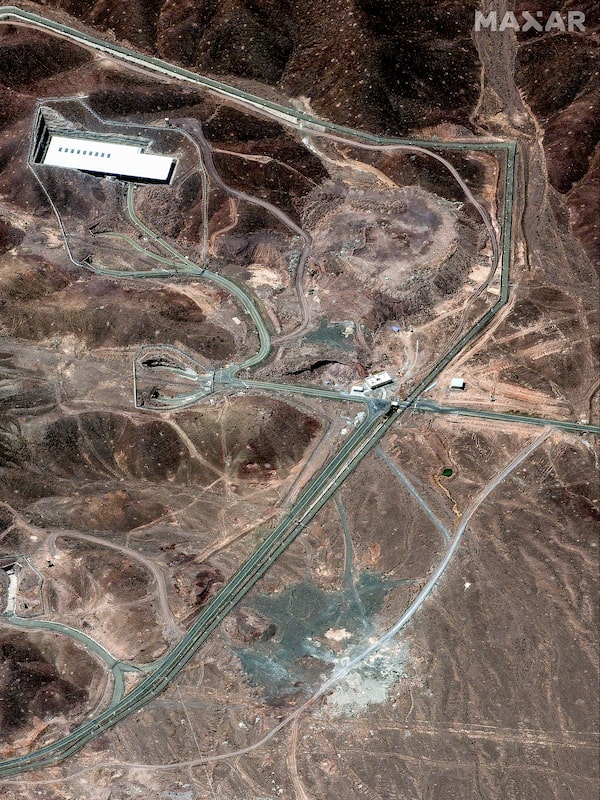
The one key target that has, so far, remained largely untouched is the Fordow uranium fuel enrichment plant near the city of Qom, in central Iran, about 150 kilometres south of Tehran. Israel believes Fordow lies at the heart of Iran’s nuclear bomb ambitions; ditto the Americans.
For Israel, Fordow is the bigger prize than Natanz – for good reason. Fordow was designed to enrich uranium to much higher levels than Natanz, potentially to the point of providing enough uranium for several bombs. On June 9, the Institute for Science and International Security of Washington said that Fordow’s fuel enrichment effort was so far advanced that it could produce 25 kilograms of weapons-grade uranium “in as little as two to three days.”
But Fordow is no easy target. Royal United Services Institute, a security think tank in London, has estimated that the enrichment plant lies 80 to 90 metres underground, protected by thick layers of granite or reinforced concrete or both. Other estimates put it even deeper. That means Israel will almost certainly be unable to destroy it without the help of the U.S. Air Force and its formidable bunker-buster bombs.
“The likely strategy is for Israel to try to rope in the U.S. to finish the destruction of the site,” Jean-François Bélanger, assistant professor at the Royal Danish Defense College, said.
Israel could get its wish. On Tuesday, after U.S. President Donald Trump demanded Iran’s “unconditional surrender,” Vice-President JD Vance said on social media that Mr. Trump “may decide he needs to take further action to end Iranian enrichment.”

GBU-57 bombs like this one are dubbed ‘bunker busters’ for their use in penetrating underground targets.U.s. Air Force via AP
Sayed Ghoneim, a retired Egyptian general who is chairman of the Institute for Global Security and Defense Affairs in Abu Dhabi, said the only weapon capable of penetrating a site that deep and well-protected is the U.S. Air Force’s GBU-57 MOP (massive ordnance penetrator) bomb, a precision-guided device that weighs 13,000 kg. It can only be dropped by heavy strategic bombers such as the massive B-52, which Israel does not operate.
Since a single GBU can penetrate about 60 metres of reinforced concrete, Mr. Ghoneim said “repeated strikes” of the bombs might be required.
Israeli diplomats agree that Israel alone cannot eliminate Fordow.
“For Fordow to be taken out by a bomb from the sky, the only country in the world that has that bomb is the United States,” Israel’s Ambassador to the U.S., Yechiel Leiter, told the U.S. digital network Merit TV on Monday. “And that’s a decision the United States has to take, whether or not it chooses to actually pursue that course.”

Israelis take shelter at a metro station in Ramat Gan during an air-raid warning on Tuesday. Both the United States and Israel are nuclear powers, though Israel neither confirms nor denies that.Oded Balilty/The Associated Press

Protesters in New York’s Times Square rally in support of Iran and Palestine on Monday as the U.S. President returned early from the G7 summit to deal with the situation in the Middle East.Eduardo Munoz/Reuters
The International Atomic Energy Agency revealed the existence of the Fordow in September, 2009, though its development had been monitored by Western intelligence agencies for years.
A few days after the IAEA disclosure, then-U.S. President Barack Obama said “the size and configuration of this facility” was “inconsistent with a peaceful program.”
Israel is a nuclear power itself, though it has never confirmed or denied that it has an arsenal of nuclear weapons. Nor has it signed the Nuclear Non-Proliferation Treaty or allowed inspections of its sites. But the country has always been determined to prevent rivals in the Middle East, especially Iran, from building the bomb.
Iran has insisted that its uranium-enrichment efforts are for peaceful purposes only, a claim supported by U.S. assessments.
In her March testimony to lawmakers, Tulsi Gabbard, the U.S. Director of National Intelligence, said the intelligence community “continues to assess that Iran is not building a nuclear weapon and Supreme Leader Khamenei has not authorized the nuclear weapons program he suspended in 2003.”
Still, enrichment has continued. Last week, the IAEA said that Iran had some 400 kg of uranium enriched to 60 per cent purity, which is short of the 90 per cent usually associated with weapons-grade level, up from 275 kg at the start of the year.


Fordow may be at the top of Israel’s hit list, but it is not the only Iran nuclear site the country wants to put out of action. On Friday, the Israeli air force destroyed the above-ground buildings at the Natanz uranium-enrichment site, which was designed only for fairly low-level enrichment, plus its electricity supply. Israel claimed that “the underground area of the site was damaged,” including the enrichment hall with centrifuges, which lie about eight metres below the surface.
Rafael Grossi, director general of the IAEA, had a somewhat different story. While he confirmed that Natanz’s above-ground infrastructure had been blown up, he told the agency’s governors on Monday that “there has been no indication of a physical attack on the underground cascade hall containing part of the pilot fuel enrichment plant and the main fuel enrichment plant.”
On Saturday, ISNA, the semi-official Iranian news site, said that Israel had attacked Fordow. The IAEA said the plant appeared undamaged.
Iran vs. Israel: More from The Globe and Mail
The Decibel podcast
The escalating war in the Middle East is the most serious security threat to Iran in nearly 50 years, The Globe’s Mark MacKinnon says. He updated The Decibel on what Israel hopes to gain and where the Trump administration stands. Subscribe for more episodes.
From our reporters
Trump says Iran must give up nuclear-weapons program
Iranians in Canada brace for the effects of Israel’s attacks through the diaspora
David Shribman: For the U.S., the crisis in Iran is the latest episode in a long, tortured history