

Donald Trump is on his way to the Middle East this weekend to oversee the implementation of a ceasefire deal that may prove to be either his signature diplomatic achievement or just one more false dawn in the long Israeli-Palestinian conflict.
The U.S. President has hailed his 20-point plan for Gaza as pointing the way to a “Strong, Durable, and Everlasting Peace,” bringing an end to more than two years of devastating war that spread at times to Lebanon, Syria, Iran and Yemen.
But there are widespread concerns about the lack of detail in Mr. Trump’s vision, which offers no long-term political solutions for Gaza. Both Israeli Prime Minister Benjamin Netanyahu and the surviving Hamas leaders, however, appear to have concluded that appeasing Mr. Trump by going along with his plan is the best course for now.
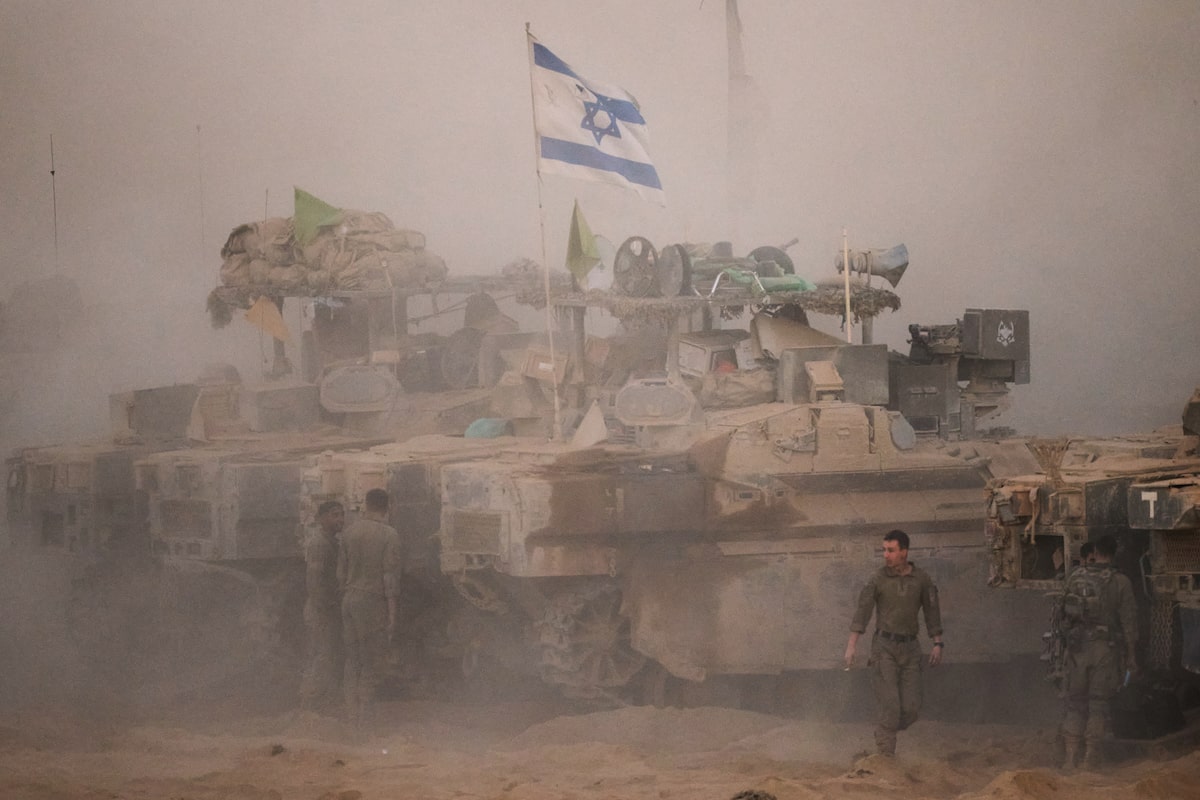
The ceasefire formally took hold at noon Jerusalem time Friday, after the Israeli cabinet approved the implementation of the first phase of Mr. Trump’s plan. That announcement was followed by a redeployment of Israeli troops within the Gaza Strip.
Soon afterward, long lines of displaced Palestinians could be seen walking along Gaza’s shattered roads, heading toward homes they had fled earlier in the conflict.
If the truce holds, Hamas is due Monday to release the last 20 living hostages it has been holding since its invasion of southern Israel on Oct. 7, 2023.
Israel, in turn, has agreed to end its military operation in Gaza, which has killed tens of thousands of people and displaced nearly the entire prewar population of 2.2 million.
Israeli troops, however, will remain inside the territory. Maps distributed by the Israeli government indicate the country’s military will retain control of 53 per cent of Gaza after the limited withdrawal. Later phases of the ceasefire would see Israel gradually pull further back so that it controls 40 per cent, then 15 per cent, of the narrow coastal strip.
Aid organizations said Thursday that desperately needed humanitarian assistance was on standby to enter Gaza as soon as a ceasefire took hold. United Nations agencies declared in August that famine, caused by a months-long Israeli siege, was affecting at least 500,000 Gazans.
Israel’s Army Radio reported Friday that 600 trucks of aid would be allowed into Gaza each day under the terms of the ceasefire.


Here's what you need to know about Gaza and the Israel-Hamas war, including the ceasefire deal, the toll of the war so far and what comes next.
As part of the deal, Israel is also expected to release hundreds of Palestinian prisoners it is holding in its jails. Shosh Bedrosian, a spokesperson for Mr. Netanyahu, however, denied reports that Marwan Barghouti, a leader of the secular Fatah movement and the most prominent Palestinian leader behind bars, would be included in the release.
Israel has also agreed to return the remains of dead Gazans in exchange for the bodies of 28 other hostages who have been declared dead in absentia. It wasn’t clear how many of the bodies Hamas would be able to locate, as much of the group’s leadership was killed in a series of Israeli assassinations. Israel was reportedly resisting a Hamas demand that it release the bodies of Yahya and Mohammed Sinwar, the brothers who were the masterminds of the Oct. 7 attacks.
Khalil al-Hayya, a senior Hamas official and negotiator, said in a speech Thursday that Israel had agreed to release some 2,000 Palestinian prisoners, including all women and children held in Israeli jails. He said Israel had also agreed to reopen the Rafah crossing between Gaza and Egypt.
Mr. al-Hayya said Hamas had received assurances from the Trump administration, as well as from Turkey, Qatar and Egypt – countries that acted as mediators during negotiations – that the war was indeed over and that Israel would not resume its offensive after the hostages had been released.
Even with the details remaining vague, the release of the remaining hostages would represent a major diplomatic triumph for Mr. Trump.
He is expected to travel to the region Sunday and address Israel’s parliament, the Knesset, soon afterward.

The ceasefire news added extra elation to Friday's Sukkot festivities in Hostages Square, a Tel Aviv plaza now used to commemmorate the Oct. 7 attacks.Ariel Schalit/The Associated Press

A tunnel installation in Hostage Square gives visitors some idea of the cramped spaces where Hamas has held Israeli hostages.AHMAD GHARABLI/AFP via Getty Images
“It wouldn’t have happened without Trump. I mean, he’s pushing Netanyahu into doing this,” said Mitchell Barak, a Jerusalem-based pollster and one-time adviser to Mr. Netanyahu.
Long-time Israeli peace negotiator Gershon Baskin, who maintained contact with Hamas officials throughout the war, said Mr. Trump’s deal was roughly the same as one the Islamist militia agreed to in September, 2024. “This deal could have been done a long time ago,” he wrote in an e-mail.
Israeli politics delayed an agreement – until Mr. Trump pushed it through. Mr. Barak said the deal, which is being widely welcomed inside Israel, is unpopular with key figures in Mr. Netanyahu’s coalition government. The end of the war in Gaza, he said, would likely put Israel on a course for early elections.
Still, Mr. Barak said, it is clear the deal is a ceasefire, not a peace agreement. “Peace means the two sides respect and recognize each other. We don’t recognize them. And they don’t recognize us.”
While Mr. Netanyahu and the exiled leaders of Hamas have separately expressed their willingness to abide by the terms of the first phase of Mr. Trump’s 20-point plan, there is far less clarity about what comes next. A previous ceasefire deal, agreed to in January, lasted two months before collapsing in March, just as the two sides were supposed to proceed to the second phase. There’s more hope this deal can hold because of Mr. Trump’s unusually deep personal involvement.
But Hamas has not yet publicly agreed to disarm or have its weapons decommissioned – key Israeli demands that were included in the latter phases of Mr. Trump’s plan. And while Hamas has agreed to give up governance of Gaza, which it ruled from 2007 until the start of the war, it has made it clear that it expects a Palestinian-led administration to take its place.

Residents of the West Bank, like this barber in Nablus following Thursday's ceasefire news on TV, have had little information on what events in Gaza will mean for Palestinian statehood.Majdi Mohammed/The Associated Press
Mr. Trump’s proposal calls for Gaza to be governed by an international “Board of Peace” that he would personally chair, with former British prime minister Tony Blair also sitting on the board. Security in the territory would be provided by a force from unnamed “Arab and international partners.”
Mr. Trump’s plan also makes no specific mention of a future Palestinian state, a key demand of the Palestinian Authority and Israel’s Arab neighbours, but something Mr. Netanyahu has vowed will never happen.
“If no Palestinian state is born, then the world is set to prolong the ‘ticking-bomb’ approach in handling the Arab-Israeli conflict,” said Sabri Saidam, an adviser to Palestinian President Mahmoud Abbas. He called the ceasefire agreement “a step in the right direction, but it’s one of many steps.”

President Mahmoud Abbas leads the Palestinian Authority in Ramallah, where these demonstrators celebrated him last month with banners reading 'you kept your promise.'Nasser Nasser/The Associated Press
The Palestinian Authority headed by Mr. Abbas has limited self-governing powers in the West Bank, which has been under Israeli military occupation since a 1967 war. The creation of a Palestinian state in Gaza and the West Bank, based on pre-1967 borders, is supported by a growing number of Western governments, including Ottawa, which recognized an independent Palestine at last month’s United Nations General Assembly.
In Gaza, such diplomatic wrangling seems distant next to the possibility of ending a war that has taken a staggering human toll.
The local Health Ministry has reported that more than 67,000 people have been killed over the past two years, including upwards of 18,000 children. More than 90 per cent of residential buildings were either damaged or destroyed, according to the UN Office for the Coordination of Humanitarian Affairs, while only 14 of Gaza’s 36 hospitals were functioning or partially functioning as of Thursday.
There are no provisions for justice or accountability in Mr. Trump’s plan. The ferocity and tactics used by the Israeli military in its assault on Gaza led the International Criminal Court to issue warrants last year for the arrest of Mr. Netanyahu and his former defence minister, Yoav Gallant, in connection with alleged war crimes. (The ICC also charged both Sinwar brothers, as well as Hamas political leader Ismail Haniyeh, with war crimes over their roles in the Oct. 7 attacks, which left 1,200 people dead and saw 251 others taken as hostages to Gaza. All three Hamas figures were later killed by Israeli fire.)
Separately, an independent UN commission determined last month that Israel “committed genocide” over the course of the war in Gaza, and the Jewish state has found itself increasingly isolated on the international stage.
What the deal does is point the way toward the end of the ordeal for the remaining hostages and their families. But some of those who lost loved ones acknowledged that the solution offered by the U.S. President is only a temporary one.
“This is a beginning of something, not the end, and so it is fragile,” said Yonatan Zeigen, whose mother, Canadian-born peace activist Vivian Silver, was among those killed in the Oct. 7 attacks. “There is a lot of work to do in order to make this deal become a foundation of a viable future based on equality, security and well-being for all Israelis and Palestinians.”

Maya Levin/AFP via Getty Images
War in the Middle East: More from The Globe and Mail
The Decibel podcast
The second anniversary of Oct. 7 was a day of soul-searching, and sometimes division, for Canadian Jewish communities. Decibel producer Michal Stein and columnist Marsha Lederman discussed how they’re processing the unfolding events in Israel and Gaza. Subscribe for more episodes.
Commentary
Raja Khouri: As a Palestinian, this is what I wish the Jewish community could hear
Hussein Ibish: An Israel-Hamas deal makes sense for both sides – but huge obstacles remain
Canada’s recognition of Palestine is a small but necessary step