
A man walks past destroyed buildings on Thursday after repeated Israeli airstrikes in the area in Dahieh in southern Beirut.
Beirut’s Camille Chamoun Sports City Stadium, the largest arena in Lebanon, has rarely hosted actual sporting events since the Beirut port explosion, triggered by the apparently accidental ignition of thousands of tonnes of ammonium nitrate, levelled much of the city centre in 2020.
Now, the stadium – which was later converted into a food warehouse, and in early 2025 was the site of the funeral for Hezbollah leader Hassan Nasrallah, who was assassinated by the Israelis five months earlier – is Lebanon’s single biggest camp for internally displaced persons (IDPs), as Israel’s attacks continue to expand beyond the southern suburbs and into the capital. Air strikes hit a building in downtown Beirut on Thursday, close to the Prime Minister’s office and the seafront, far from Hezbollah strongholds. Israel says it is trying to eliminate the remnants of the pro-Iran Hezbollah fighters.
On Wednesday, people were pouring into the arena with the assistance of the Lebanese Red Cross and various UN agencies, including UNICEF. Parents, grandparents and children were being settled in large blue and white tents in the covered, cavernous areas below the 50,000 tiered seats.

Families flee after an evacuation alert and minutes before an Israeli airstrike in the El Bachoura area on Thursday. An estimated 700,000 people have been displaced across Lebanon, according to the UN’s refugee agency.
By noon on Wednesday, 700 IDPs had arrived. Lama Shehayeb, head of disaster management for the Lebanese Red Cross, said she expected the number to double quickly as the number of IDPs soared. Earlier in the week, UNHCR, the UN’s refugee agency, estimated that about 700,000 people had been displaced across Lebanon.
“The main purpose of this shelter is to get the IDPs off the streets,” she said, referring to the many thousands of Lebanese living in their cars, on the beaches, in tents and in hotels throughout the city. “This whole situation is getting worse. There will be many more refugees coming.”
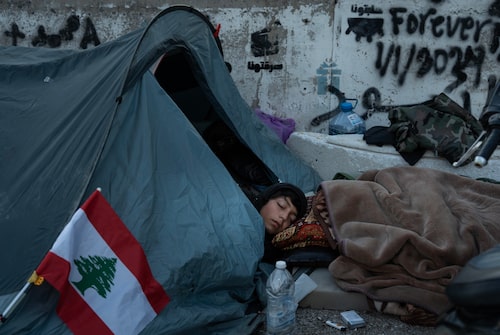
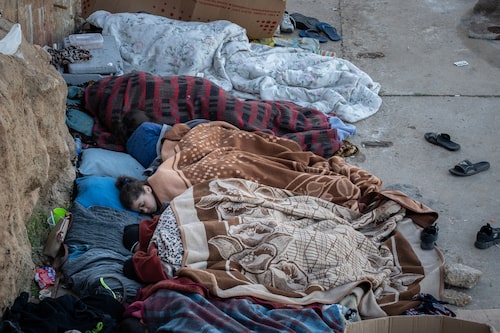
She was right: Another wave of IDPs arrived Thursday morning after south Beirut came under heavy overnight Israeli attack in response to a Hezbollah rocket volley. Israel said Hezbollah fired approximately 200 rockets, 80 of which landed in Lebanese territory. The others reached northern Israel, sending residents scurrying into bomb shelters. Israel also hit central Beirut, where IDPs had been sleeping rough. Lebanon’s Health Ministry said at least seven people were killed in the strike.
One of the stadium’s IDP arrivals was Ahmad Rida, 43, a father of six who was in a wheelchair outside of his tent. He said his home in southern Lebanon was destroyed in the 2024 Hezbollah-Israel war, after which he moved his family to south Beirut. The Israeli bombing this week forced them to evacuate; they arrived at the stadium after spending three days living on the street.
While they felt safe in the stadium, he was not happy. His children were out of school, they had no freedom, and he complained about filthy toilets and erratic meals.
“It’s like living in a jail here,” he said. “I wish we could go back to our home in the south, but we would be killed there.”
As he talked to The Globe and Mail, an Israeli missile struck a building about a kilometre away from the stadium, sending a column of grey smoke into the air.
Elsewhere in Beirut, away from the dangerous southern suburbs, the city is shifting onto a kind of war footing as hundreds of thousands of Lebanese arrive from southern Lebanon, the Bekaa Valley along the Syrian border, and other areas in Lebanon that Israel says are full of Hezbollah fighters and their weapons depots.
Small hotels across the city were filling with IDPs. In many of them, several families were stuffed into a single room, with everyone sleeping on the floor. Some schools were also being converted into dormitories, preventing local children from attending classes.
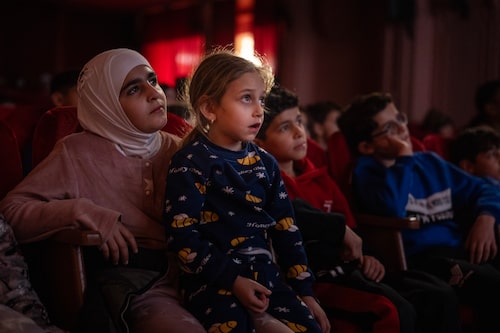
Community spirit is emerging as the Hezbollah-Israel war intensifies. In Hamra, in the once-buzzy centre of Beirut, the owners of Le Colisée cinema – built in 1945 and recently restored to its former glory – have given it a new role as an IDP centre. About 30 Lebanese who were displaced from the south have moved in. But the cinema is still operating. In the evening, it shows movies for kids, giving them and their parents a brief respite from the war.
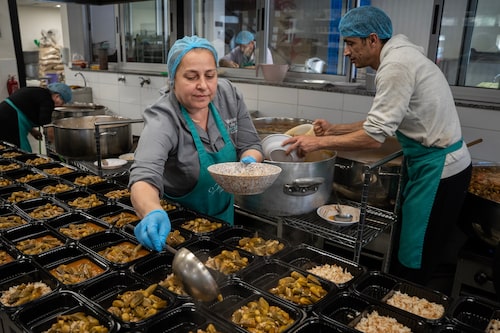
Not far away, La Cuisine de Mariam, a soup kitchen funded by Lebanese charities, including several in Canada (where there are about 400,000 Canadians of Lebanese origin), was producing 5,000 meals a day for IDPs and residents of Beirut who lacked the income to afford regular meals. Before the war, the kitchen was making about 3,000 meals a day.
On Wednesday, head chef Elias Somsom and a dozen volunteers were busy stirring huge vats filled with mushroom soup, rice and a blend of beef and okra. Others prepared fresh salads and packed the meals in plastic containers.
Dounia Taouk, the kitchen’s founder, said the war has seen the cooking and delivery teams work flat out. “We are here night and day,” she said. “We feel like one big family, and we help everyone in need. We don’t ask anyone about their backgrounds. We are working for humanity.”
With a report from the Associated Press