
Faithful queue to enter St. Peter's Basilica to pay respects as Pope Francis lies in state, at the Vatican, April 23, 2025.Remo Casilli/Reuters
They are known as the papabili, the cardinals – for they are always cardinals – who are considered candidates to become the new pope. An awkward translation would be “pope-able.”
Officially, the race to replace Pope Francis, who died on Monday at the age of 88 and whose funeral is set for Saturday, will begin during the conclave, the secret vote among the elector cardinals – those under 80 – in about two weeks (only in the Vatican can a 70-year-old be considered a young buck). Unofficially, the race began months ago, when Francis’s health went into rapid decline, raising doubts that he would emerge from the hospital in good shape, or emerge at all.
The guessing game began about that time. Will the new pope be a conservative or a liberal, or somewhere in between? Could he be from Africa or Asia, the two regions where the Catholic Church is especially strong? After Polish, German and Argentine popes in succession, will the powerful Italian contingent in the conclave form a voting bloc to propel one of their own onto the papal throne?
The cardinals themselves never talk about the papabili, and those with ambitions for the top job in the Christian world, one that comes with effective dictatorial powers – the Vatican is no democracy – rarely, if ever, promote themselves publicly or privately. Humility and restraint are considered virtues; arrogance and swagger are punished. “He who enters the conclave as pope leaves it as cardinal,” is a popular saying among Vaticanologists.
What happens after Pope Francis’s death? An ancient process shrouded in mystery and white smoke
The math suggests that a near clone, or at least a cardinal who shares some or many of the liberal views of Francis, will succeed him. That’s because 110 of the 135 elector cardinals were appointed by him. Thomas Reese, the American Jesuit priest who writes for Religion News Service, said, “The odds are still in favour of continuity between this pope and the next. … The cardinals will not reject him by electing someone who does not respect his legacy.”
Others inside and outside the Vatican are not so sure. One senior Vatican official told The Globe and Mail that picking a winner is a fool’s game. Since the vote is secret, the cardinals, he said, tend to vote independently, guided by their instincts and consciences, not party lines. He also noted that Francis appointed cardinals across the political and nationality spectrum, meaning he did not always pick kindred spirits. The Globe is not naming him because of the dishonour of breaking the conclave omertà.
World and religious leaders commemorate Pope Francis
The Holy See website reveals the broad composition of the elector cardinals. Just 53 are European (of whom 17 are Italian); 23 are from Asia; 18 from Africa; 21 from Central and South America; 16 from North America (four of them Canadian); and four from Oceania.
Catholics who spoke to The Globe while they mourned the death of Francis in St. Peter’s Square were open to the idea of an African or Asian pope. “The next pope could be African or Asian because the church must show gratitude to the growth in those areas,” said Fabrizio Nina, an engineer from southern Italy.
Paulo Decorari, a retired banker from Rome, said, “It might be too early for an African, since they tend to be deeply conservative. Maybe an Asian.”
Every Vaticanologist and every Italian newspaper have somewhat different lists of contenders to replace Francis. Here are some names that pop up across them.
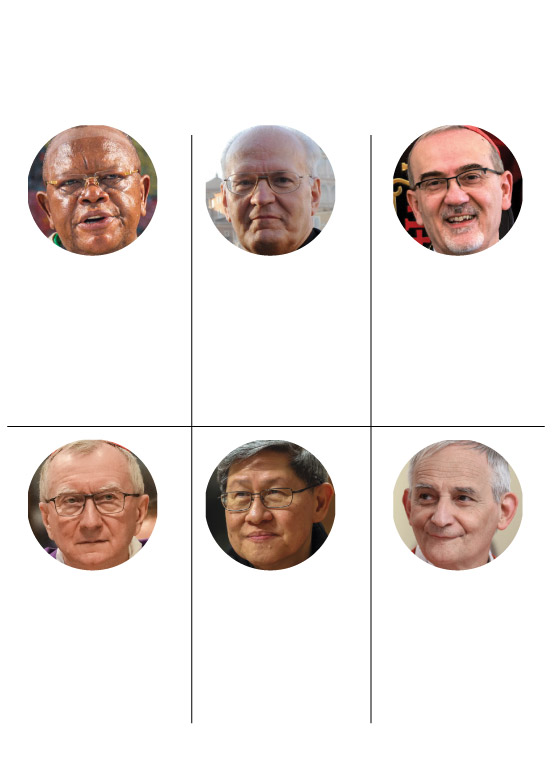
Candidates to succeed Pope Francis
Experts say there is no single front-runner to be the next pope,
but several names have been cited as indications of which direction
the Roman Catholic Church might take
Fridolin Ambongo
Besungu, 65,
Archbishop of Kinshasa,
capital of the Democratic
Republic of the Congo.
Francis made him a
cardinal in 2019
Peter Erdo, 72,
Hungarian cardinal and
Archbishop of Eszterg-
om-Budapest is seen
as strong choice
among conservatives
Pierbattista Pizzaballa,
60, Vatican’s top official
for Middle East affairs.
Made a cardinal in 2023,
he is admired for his
understanding of
Christians, Muslims
and Jews
Pietro Parolin, 70,
Soft-spoken Italian has
been number two at
Vatican since 2013,
when Francis made him
secretary of state
Luis Antonio
Tagle, 67,
Liberal-leaning
Filipino was made
a cardinal by Pope
Benedict XVI
in 2012. Would be
first Asian pope
Matteo Zuppi, 69,
Archbishop of Bologna
is closely tied to Sant’
Egidio Community,
Rome-based Catholic
charity known for its
service to the poor and
conflict resolution
Source: graphic news
Pictures: Getty Images, Newscom
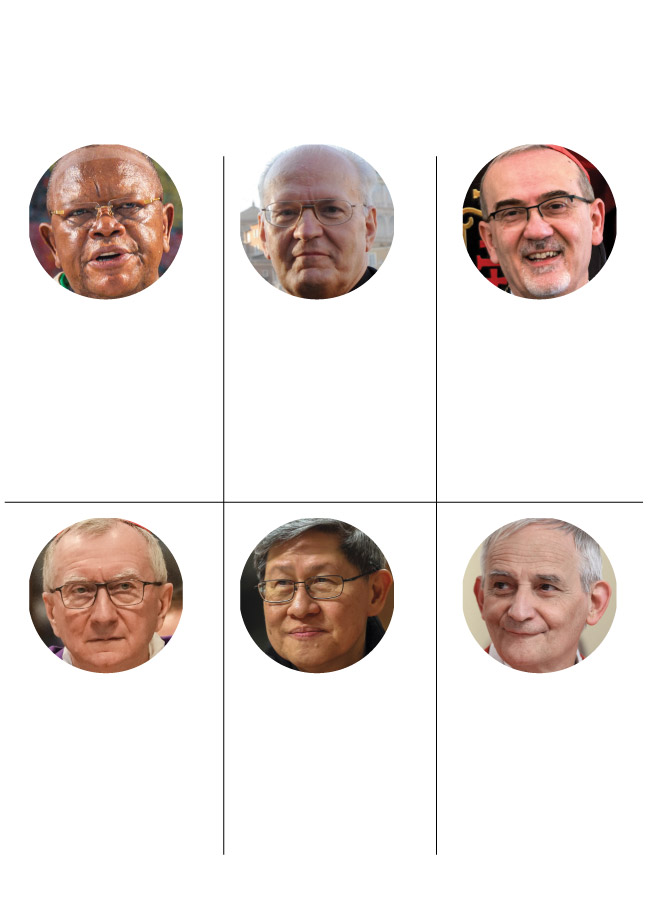
Candidates to succeed Pope Francis
Experts say there is no single front-runner to be the next pope,
but several names have been cited as indications of which direction
the Roman Catholic Church might take
Peter Erdo, 72,
Hungarian cardinal and
Archbishop of Eszter-
gom-Budapest is seen
as strong choice
among conservatives
Fridolin Ambongo
Besungu, 65,
Archbishop of Kinshasa,
capital of the Democratic
Republic of the Congo.
Francis made him a
cardinal in 2019
Pierbattista Pizzaballa,
60, Vatican’s top official
for Middle East affairs.
Made a cardinal in 2023,
he is admired for his
understanding of Christ-
ians, Muslims and Jews
Luis Antonio
Tagle, 67,
Liberal-leaning
Filipino was made
a cardinal by Pope
Benedict XVI
in 2012. Would be
first Asian pope
Pietro Parolin, 70,
Soft-spoken Italian has
been number two at
Vatican since 2013,
when Francis made him
secretary of state
Matteo Zuppi, 69,
Archbishop of Bologna
is closely tied to Sant’
Egidio Community,
Rome-based Catholic
charity known for its
service to the poor and
conflict resolution
Source: graphic news
Pictures: Getty Images, Newscom
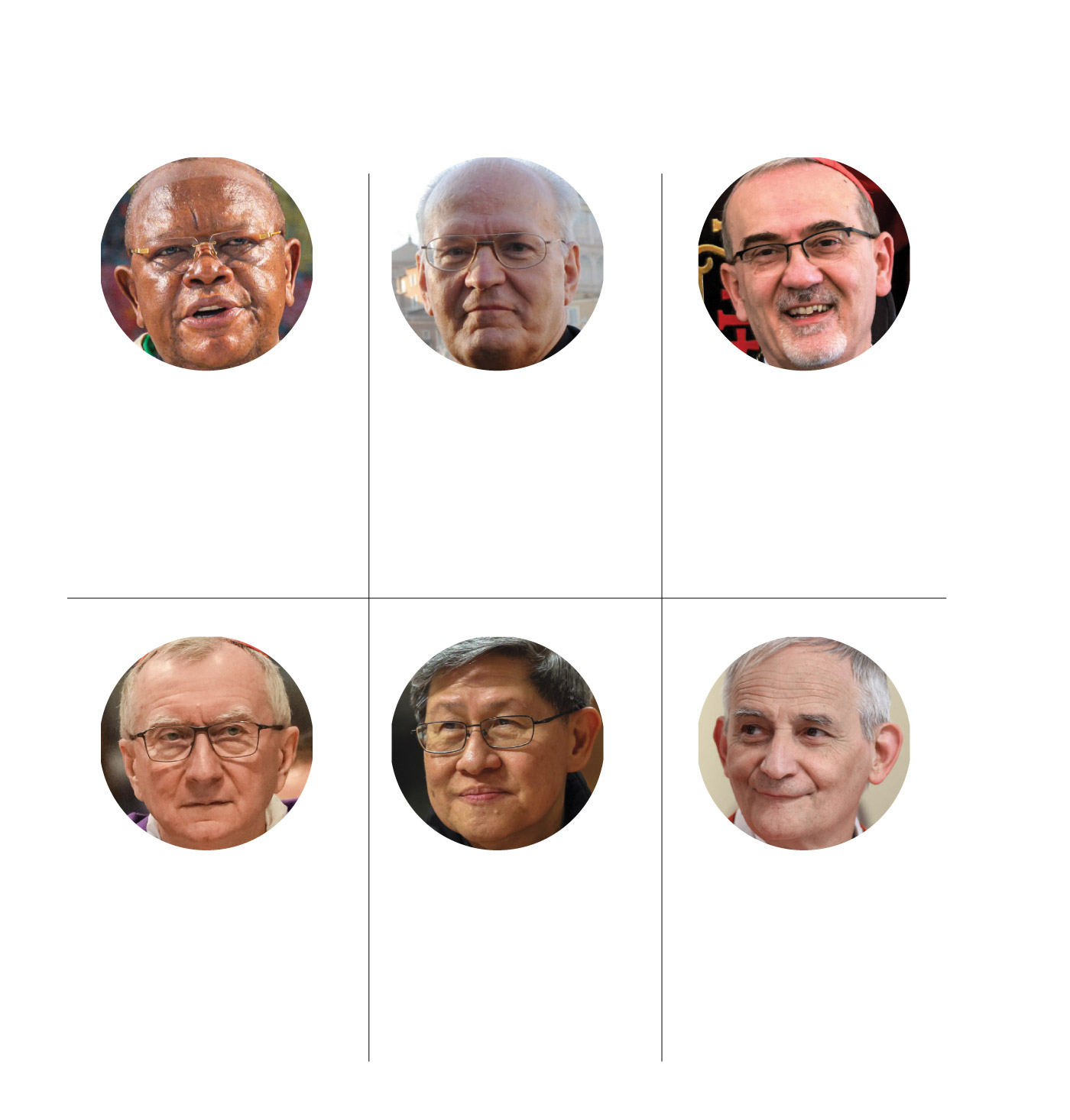
Candidates to succeed Pope Francis
Experts say there is no single front-runner to be the next pope, but several names have been
cited as indications of which direction the Roman Catholic Church might take
Peter Erdo, 72,
Hungarian cardinal and
Archbishop of Esztergom-
Budapest is seen as strong
choice among conser-
vatives
Fridolin Ambongo
Besungu, 65,
Archbishop of Kinshasa,
capital of the Democratic
Republic of the Congo.
Francis made him a cardinal
in 2019
Pierbattista Pizzaballa,
60, Vatican’s top official
for Middle East affairs.
Made a cardinal in 2023, he is
admired for his understanding
of Christians, Muslims
and Jews
Luis Antonio
Tagle, 67,
Liberal-leaning
Filipino was made
a cardinal by Pope
Benedict XVI
in 2012. Would be
first Asian pope
Pietro Parolin, 70,
Soft-spoken Italian has
been number two at
Vatican since 2013,
when Francis made him
secretary of state
Matteo Zuppi, 69,
Archbishop of Bologna
is closely tied to Sant’
Egidio Community,
Rome-based Catholic
charity known for its
service to the poor and
conflict resolution
Source: graphic news
Pictures: Getty Images, Newscom
Luis Antonio Gokim Tagle, 67, Filipino

Cardinal Luis Tagle appears in the Basilica of Santa Sabina in Rome for the liturgy of the ashes presided over by Pope Francis on Ash Wednesday on Feb. 14, 2024.Gregorio Borgia/The Associated Press
Cardinal Tagle is often called the “Asian Francis” because of his attention to social justice, and because of his smiley good humour. The nickname of the former archbishop of Manila is “Chito.” Pope Benedict XVI appointed him cardinal in 2012, and Francis moved him to Rome seven years later, where he was made head of the Vatican’s missionary arm, formerly known as the Dicastery for Evangelization. Previously, he was head of Caritas Internationalis, the Vatican’s confederation of relief and development agencies (now suffering from President Donald Trump’s eradication of USAID, which was one of Caritas’s main funders). Working in his favour are his social-media presence – he has his own YouTube channel – and his fluency in English and in Italian, the Vatican’s working language.
Pietro Parolin, 70, Italian

The Vatican's Secretary of State Cardinal Pietro Parolin looks on at the end of the Rosary for Pope Francis at the Papal Basilica of Saint Mary Major, following the death of the pontiff, in Rome, on April 22.Susana Vera/Reuters
The Vatican’s secretary of state is a career diplomat and had been Francis’s No. 2 since 2013, managing the complex, and often dysfunctional, machinery of the world’s oldest institution. He speaks several languages – he was the Holy See representative in Venezuela, Mexico and Nigeria – and is seen as a continuity figure who can keep Francis’s dedication to an open church alive. The downside is that, under him, the Vatican’s finances deteriorated, and his peace agreement with China, which allows Beijing to recommend bishop candidates before they are approved by the Pope, was criticized for handing too much power to Communist Party rulers. Still, many Vatican watchers think he has good odds of landing the prince of princes’ job.
Matteo Maria Zuppi, 69, Italian

President of the Episcopal Conference of Italy, Italian Cardinal Matteo Maria Zuppi, reacts during the 77th General Assembly of the Italian Bishops' Conference on May 25, 2023 in The Vatican.FILIPPO MONTEFORTE/AFP/Getty Images
Like Francis, he is known as a “street priest.” He is highly regarded among liberal cardinals for his passion for social justice and helping the poor, and his acceptance of LGBTQ Catholics and the divorced. Those traits may not endear him to the conservative cardinals who want a return to a traditional church. He was made archbishop of the central Italian city of Bologna in 2015 and cardinal by 2019. While he is considered down to earth – he often uses a bicycle to get around – his diplomatic streak captured the imaginations of previous popes. He helped to mediate the peace process that ended Mozambique’s civil war in 1992, and he was Francis’s papal envoy for the Russia-Ukraine war, concentrating on the repatriation of Ukrainian children deported to Russia.
Fridolin Ambongo Besungu, 65, Congolese

Congolese Cardinal Fridolin Ambongo Besungu speaks during a mass in commemoration of the late Pope Francis at the Notre Dame du Congo Cathedral, in Kinshasa, on April 21.HARDY BOPE/AFP/Getty Images
Cardinal Besungu, the Archbishop of Kinshasa, the capital of the Democratic Republic of the Congo, is known for his strongly conservative family values – he rejected Francis’s guidance on the blessings of same-sex couples – but is admired within the church for his attention to social-justice issues, especially the reckless exploitation of natural resources. In Rome, he once said that “the future is renewable energy.” (The DRC, the largest source of cobalt used in electric car batteries, has come under scrutiny for child labour in mines.) Working in his favour is that sub-Saharan Africa – the DRC, Zambia, Mozambique and Malawi, among other countries – is seeing the church’s greatest growth.
Pierbattista Pizzaballa, 60, Italian

Cardinal Pierbattista Pizzaballa, Latin Patriarch of Jerusalem, walks during a press conference at the patriarchate headquarters in the old city of Jerusalem, on April 22.MENAHEM KAHANA/AFP/Getty Images
Cardinal Pizzaballa, who is from northern Italy, was made a cardinal two years ago and will be among the youngest electors in the conclave. He has vast Middle East experience, having lived in Jerusalem for three decades; he speaks Hebrew and English. Francis appointed him Latin Patriarch of Jerusalem in 2020. He condemned the Hamas attack on Israel on Oct. 7, 2023, and the subsequent destruction of Gaza by Israel. At one point, he offered himself in exchange for Israeli hostages. He has condemned the attacks on Gazan civilians and, on his visit to Bethlehem at Christmas, 2023, wore a Palestinian keffiyeh. He is considered a long shot to become pope but is said to be admired within the church for his deep understanding of the Christian, Muslim and Jewish peoples and their religions in the Middle East.
Peter Erdo, 72, Hungarian

Hungarian Cardinal Peter Erdo is interviewed by the Associated Press, in Budapest, on April 20, 2023.Denes Erdos/The Canadian Press
Cardinal Erdo, who was handed the red hat by Pope John Paul II in 2003, will appeal to the conservative electors, all the more so since he was considered a leading candidate in the last conclave, in 2013. He is the Archbishop of Esztergom-Budapest and, in spite of his traditional views, earned the respect of Francis and never clashed with him, at least not publicly, perhaps because he was admired for his evangelization drive in wealthy, secular countries. He has opposed the idea of allowing divorced and remarried Catholics to receive holy communion and, during the 2015 European migrant crisis, declared that churches taking in refugees would amount to human trafficking. His friendship with Hungarian Prime Minister Viktor Orban, the pro-Russian rogue among European Union leaders, may work against him.
With reports from Reuters and France 24