
Israel's Iron Dome anti-missile system intercepts rockets launched from the Gaza Strip, as seen from the city of Ashkelon, Israel, Oct. 9, 2023.Amir Cohen/Reuters
The war in the Middle East is laying bare how bigger doesn’t necessarily mean better in modern warfare defined by cheap munitions and saturation attacks meant to overwhelm the enemy’s defences.
Since the U.S. and Israel launched their war on Iran on Feb. 28, and Iran began retaliating against Israel and U.S. bases in Persian Gulf states, both sides have been trading missiles and drones at a rapid rate. Much like the capabilities Ukraine developed in its defence against Russia’s full-scale invasion, anti-missile and counterdrone technologies have become critical.
But herein lies the issue for military powerhouses such as the U.S. and Israel when fighting a smaller opponent. While the two countries possess extremely advanced anti-missile systems, experts say these systems are quickly becoming too expensive to continuously deploy against Iran’s low-cost weapons.
“One of the problems that we’re seeing in the Middle East is the Gulf states and the Americans are doing a really good job shooting down missiles, but they’re taking embarrassing losses from the drones,” said Michael Armstrong, an associate professor of operations research at Brock University.

U.S. Patriot missile defense systems at a U.S army base in Pyeongtaek, South Korea, March 12.Kim Hong-Ji/Reuters
The tactics of interception
Take the U.S., for example. One of its primary air defences is the Phased Array Tracking Radar to Intercept on Target system, commonly known as the Patriot missile defence system. Manufactured by U.S.-based Raytheon Technologies, using interceptor missiles made by U.S.-based Lockheed Martin, it’s currently the country’s best defence against short-range ballistic missiles. It costs more than US$1-billion.
Each Patriot battery, the basic firing unit, has several major components. These include two 150-kilowatt generators mounted on a vehicle, a radar unit, control station, launcher stations, a high-powered antenna and interceptor missiles.
Using its radar, it can detect and track incoming missiles at a range of approximately 150 kilometres. Once a target is identified, human operators at the control station calculate trajectories and co-ordinate the launch of interceptor missiles. After launch, the missiles are guided to their targets using the radar.
Depending on the model, their interception range is somewhere between 20 and 60 km. Some interceptors explode near an incoming missile, disabling it with shrapnel, while others strike the missile directly.
Each Patriot launcher station can carry four to 16 missiles, depending on the model. It looks like a shipping container on wheels that, using two hydraulic legs, can be angled upward. About 90 soldiers are typically assigned to a single Patriot battery, but only three are required to operate it in combat from the control station.
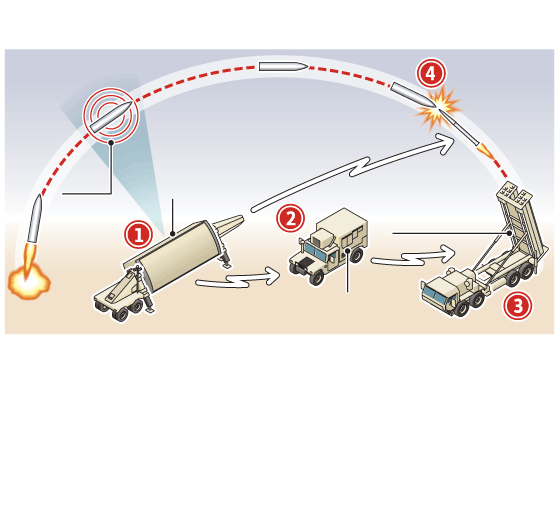
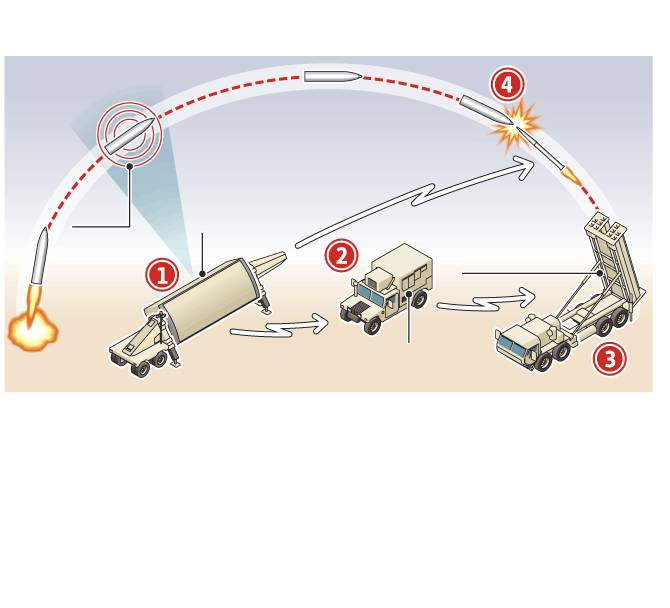
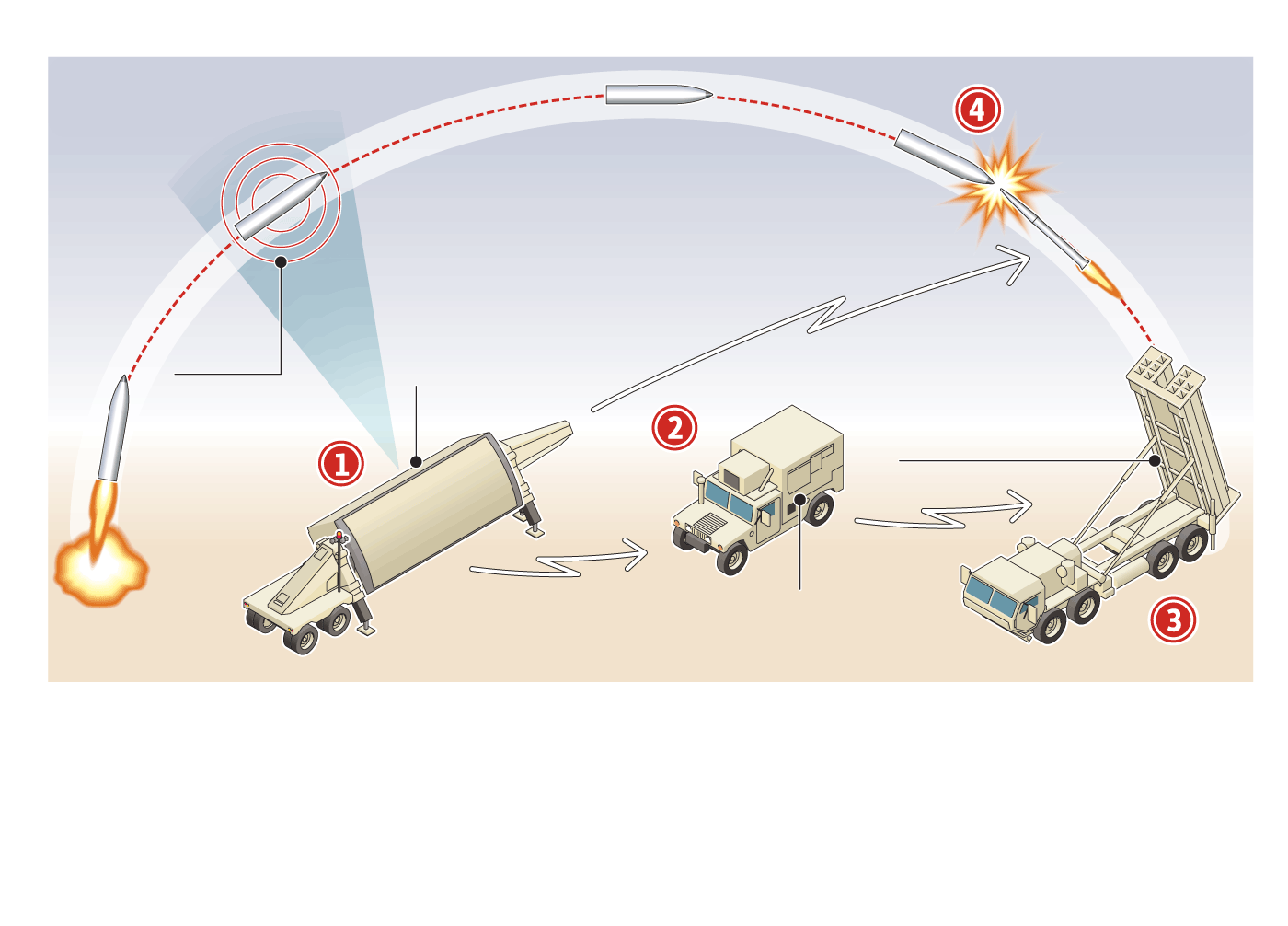
Patriot adds to the U.S.’s other air defences, such as Lockheed Martin’s THAAD, or Terminal High Altitude Area Defence, which is similar to the Patriot but with greater range. THAAD can detect and track targets as far as 3,000 km away and intercept them 200 km away.
How THAAD works
5
TERMINAL
MID-COURSE
PHASE
ASCENT
PHASE
PHASE
In-flight target
AN/TPY-2
updates
X-band
Launcher
radar
carries eight
Radar
interceptors
3
tracking
2
Truck-mounted
4
computers
1. Radar: Can detect hostile missiles up to 2,000 km
away.
2. Fire
control: Radar data help verify threat before launch.
3. Launcher: Targeting data guide the interceptor to incoming missiles. Can intercept at altitudes of 40 to 150 km, and ranges of up to 200 km.
4. Interceptor: Infrared seeker used to home in on target.
Sources: graphic news; CSIS; Lockheed Martin; Reuters
How THAAD works
5
TERMINAL
MID-COURSE
PHASE
ASCENT
PHASE
PHASE
In-flight target
AN/TPY-2
updates
X-band
Launcher
radar
carries eight
Radar
interceptors
3
tracking
2
Truck-mounted
4
computers
1. Radar: Can detect hostile missiles up to 2,000 km
away.
2. Fire
control: Radar data help verify threat before launch.
3. Launcher: Targeting data guide the interceptor to incoming missiles. Can intercept at altitudes of 40 to 150 km, and ranges of up to 200 km.
4. Interceptor: Infrared seeker used to home in on target.
Sources: graphic news; CSIS; Lockheed Martin; Reuters
How THAAD works
TERMINAL
MID-COURSE
PHASE
ASCENT
PHASE
PHASE
In-flight target
updates
AN/TPY-2
X-band
radar
Launcher
carries eight
Radar
interceptors
tracking
Truck-mounted
computers
1. Radar:
Can detect hostile missiles up to 2,000 km away.
2. Fire control:
Radar data help verify threat before launch.
3. Launcher:
Targeting data guide the interceptor to incoming missiles. Can intercept at altitudes of 40 to 150 km, and ranges of up to 200 km.
4. Interceptor: Infrared seeker used to home in on target.
Sources: graphic news; CSIS; Lockheed Martin; Reuters
Israel’s missile defence capabilities are similar, if not a little more advanced. Its multilayer system consists of the Iron Dome, David’s Sling and the Arrow, to counter attacks from short-, medium- and long-range ballistic missiles. Each system is operationally similar to the Patriot, with slight variances in capabilities such as range.
From detection to strike, these systems are designed to work fast. The Iron Dome, for example, should be able to detect, track and intercept a threat within 15 seconds, Prof. Armstrong said.
However, these are considered legacy systems, said Paul Ziadé, the CEO of Calgary-based North Vector Dynamics, which builds counterdrone technologies. That’s why the U.S. and Israel are also deploying more modern, non-traditional interceptors, he said. For example, Israel’s Iron Beam laser air defence system, which uses directed energy to burn incoming threats, was reportedly used to take out Lebanese rockets in early March.
Iran, meanwhile, has one of the widest-ranging missile and drone inventories in the world to use in its offensive strategy. But when it comes to anti-missile or counterdrone capabilities, its systems are not nearly as advanced as those of its opponents, Prof. Armstrong said − hence, why the U.S. and Israel have been able to strike targets in Iran seemingly with impunity.
The economics of war
There’s a glaring asymmetry between the cost of this war for the U.S. and Israel and the cost for Iran.
On paper, Iran’s weaponry is no match for the expensive arsenal the U.S. and Israel possess, said Steve Feldstein, senior fellow at the Carnegie Endowment for International Peace in the Democracy, Conflict, and Governance Program.
But that doesn’t mean they’re losing the battle in the skies. While the U.S. and Israel are relying on billion-dollar anti-missile systems to protect themselves, Iran is launching hundreds of low-cost drones that are costing its adversaries exponentially more to shoot down than it does to make them.
“The best that Iran can do at this point is try to exploit these asymmetries, put in place as many cheap drones as it can and force the U.S., Israel and the Gulf states to expend enormous sums of money defending against their cheap drones and hope that, over time, that becomes an unsustainable situation,” Mr. Feldstein said.
According to an analysis by the Washington, D.C.-based Center for Strategic and International Studies (CSIS), the latest missile model used in the Patriot system costs about US$4.1-million.
The THAAD system is similarly expensive. Various estimates put the cost of each interceptor at more than US$12-million, and according to U.S. government budget documents, the cost of a launcher in the mid-2010s was about US$9-million.
Israel’s Iron Dome missiles cost far less, about US$40,000, but with all its components combined, it’s still a hefty price to pay for protection.
Especially if you’re defending against an Iranian Shahed drone, which costs about US$35,000, according to CSIS.
This is an issue for the U.S., which hasn’t yet caught up in terms of preparing its military for the world of drone warfare, Prof. Armstrong said.
Only days into the conflict, for example, multiple news outlets reported that billion-dollar American radar systems were struck by Shahed drones.
“A multimillion-dollar interceptor makes economic sense if you’re trying to defend against one multimillion-dollar cruise missile or one multimillion-dollar ballistic missile. It doesn’t make economic sense when you’re trying to defend against 10 or 50 cheap drones,” he said.
A battle of ammunition
If this war carries on the way it’s going, Mr. Feldstein said, the U.S. will have to become pickier about what it chooses to shoot down with its interceptors.
“One of the outcomes of that might be that you start to see the Iranians essentially target lower-priority but higher-vulnerability targets,” he said, such as military outposts peripheral to the conflict or civilian infrastructure, including hotels, banks and data centres − which is exactly what Iran threatened to do this week.
U.S. Defense Secretary Pete Hegseth has repeatedly said that air strikes will intensify by the day, but when it comes to defence, it’s unclear how many interceptors the U.S. has left after almost two weeks of fighting.
According to the U.S. Congressional Research Service, the U.S. has eight THAAD batteries, which include six launchers and 48 interceptors each. In January, Lockheed Martin signed a deal with the U.S. Department of Defence to quadruple its THAAD interceptor production, from 96 to 400 a year. But this will do little to aid the U.S. in its current conflict.
The U.S. Army also has about 15 Patriot battalions of four batteries each. And in July, 2025, General James Mingus, a former vice-chief of staff for the army, said the military had plans to add four more battalions.
Israel, on the other hand, had 10 operational Iron Dome batteries, with three to four launchers each, as of May, 2021, according to CSIS. It’s unclear how many David’s Sling or Arrow systems it has.
The number of drones and missiles Iran has at its disposal is also unknown, but it’s estimated to have already launched hundreds in strikes on U.S. military bases and other critical infrastructure. “The new face of warfare, and what Iran is currently doing is, for the lack of a better term, death by 1,000 cuts,” Mr. Ziadé said.
At this point in the war, Prof. Armstrong said, politicians and strategists on each side are likely beginning to ask themselves, “What if I run out of defence before the other guy runs out of offence?”