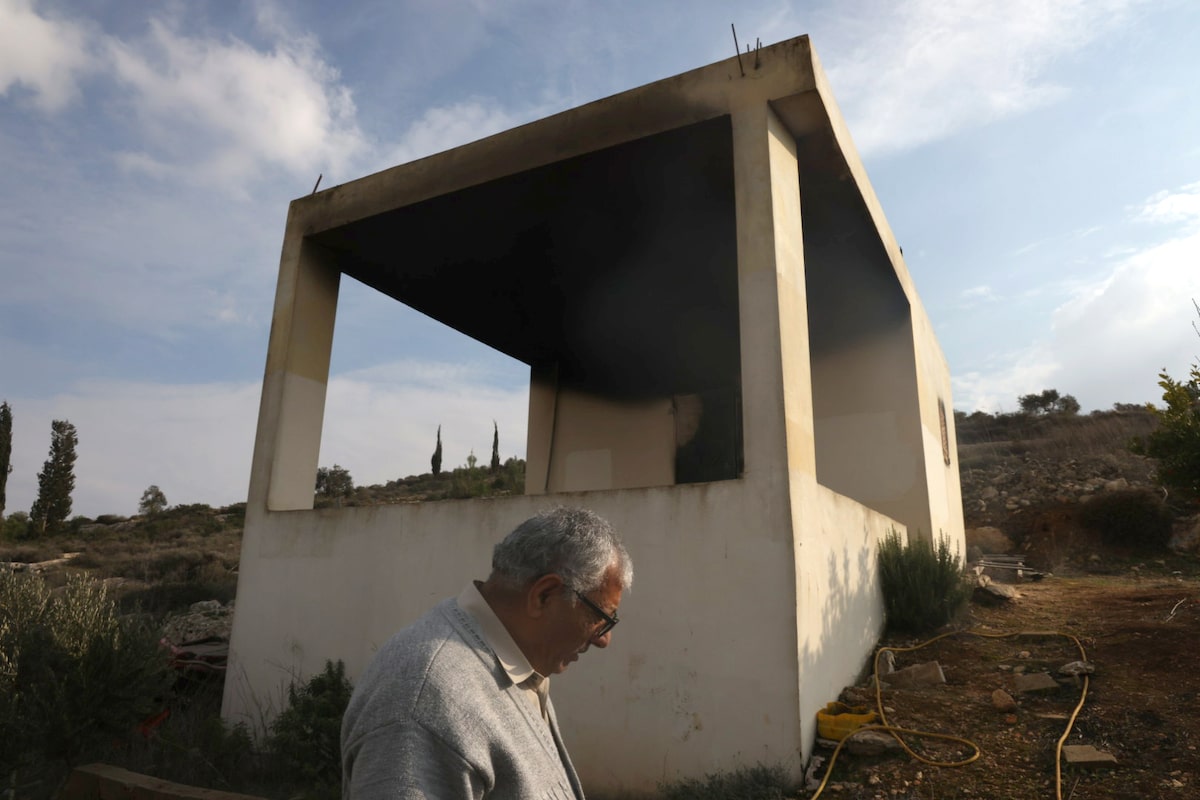
Seventy-three-year-old Nael Saedah walked between fruit trees that led to his farmhouse outside of Turmosayya in the occupied West Bank. His place was torched by Israeli settlers on Jan. 19, as the ceasefire agreement between Israel and Hamas came into effect in Gaza. Mr. Saedah pointed to the farmhouse’s roof, black and charred from the blaze.
“That’s my poor room,” he said, glancing up at the place he was proud to bring his family for picnics. His one-room farmhouse is perched on a hill surrounded by olive groves. But settlers have been creeping closer, with new houses spreading down hills, in what he calls “land-grabbing.”
The night the settlers burnt his room isn’t the first time they came.
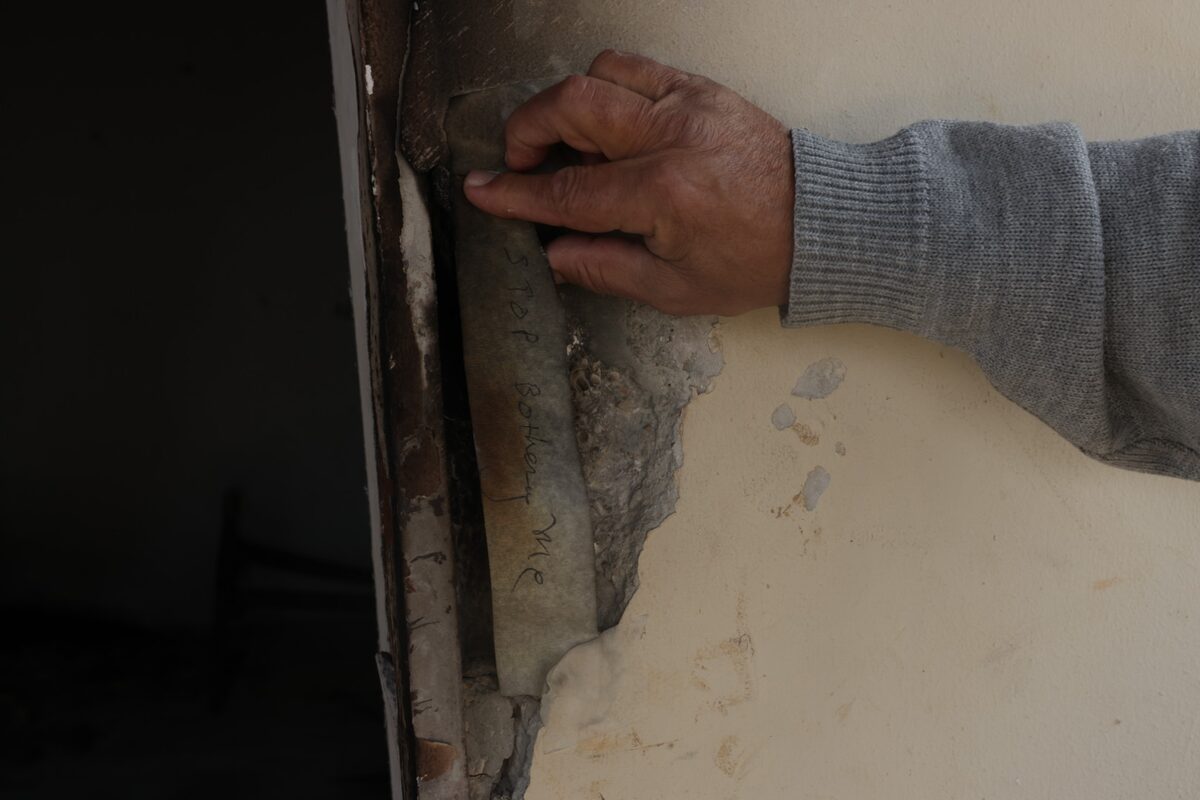
Previously, they stole his fireplace and prayer rug. They painted 7/10 on its exterior, referring to the date of the Hamas-led attack that started the war, alongside “revenge” in Hebrew and the Star of David. Blotchy white paint covers it over. Mr. Saedah begged them to stop, writing “stop bothering me” on a small piece of paper that dangled by the door. It didn’t work.
Inside, all of his belongings have been reduced to ashes. Mr. Saedah looked around at the ruins.
“This is very painful because I worked really hard for that.”


Violence against Palestinians in the West Bank has been increasing at the hands of Israeli settlers and the Israel Defence Forces (IDF), the United Nations says. The night the ceasefire agreement went into effect between Israel and Hamas in Gaza, settlers in the West Bank unleashed a wave of attacks. Soon after, the Israeli military launched an operation in Jenin refugee camp.
On Tuesday, President Donald Trump, with Israeli Prime Minister Benjamin Netanyahu standing next to him, emboldened far-right Israeli settlers by once again floating the idea that all Palestinians should be moved out of Gaza. The Nachala Movement, which supports building Jewish settlements in the occupied West Bank, reacted to Mr. Trump’s comments by saying they should hurry and establish settlements in Gaza, according to Reuters. Jewish settlements are illegal under international law, although Israel disputes this.
The Office of the United Nations High Commissioner for Human Rights (OHCHR) raised the alarm days after the ceasefire agreement came into effect, saying in a statement that Israel’s military operation in Jenin refugee camp involved “disproportionate” use of force. In addition to the military’s involvement, the office said there had been “an uptick in settler attacks” on Palestinian villages.
UN human rights office spokesperson Thameen Al-Kheetan called on Israel to halt settlement expansion and evacuate all settlements as required by international law. According to the UN, Israeli forces have killed 53 Palestinians, including eight children, in the West Bank – this number includes 30 Palestinians killed in Jenin – so far this year. The United Nations Office for the Coordination of Humanitarian Affairs (OCHA) said that between Jan. 21 and Jan. 27, it documented 17 incidents of settler violence that resulted in casualties or property damage.

Israeli soldiers take Palestinians into custody after Jan. 22′s military raid on Jenin.GIL COHEN-MAGEN/AFP via Getty Images
A fragile ceasefire agreement between Hamas and Israel came into effect on Jan. 19, halting the war in Gaza which began on Oct. 7, 2023, when Hamas launched an assault that killed more than 1,200 Israelis. More than 47,000 Palestinians have been killed, according to the Palestinian Health Ministry.
The Globe saw Mr. Saedah’s farmhouse that had been lit on fire as well as another farmhouse torched just outside of Turmosayya. The Globe also spoke with residents who were targeted in Sinjil and saw the aftermath of attacks in that community. The families said the assailants had come from nearby settlements.
The IDF said that evening it received a report concerning violent riots in Turmosayya, Sinjil and Ein Sinya. “During the riots, several Israeli citizens arrived in the area and set fire to a house and properties in the area.”
The IDF said that its forces, as well as Israel police, went to the villages and responded to the violence. They said Israel’s security forces are working to find and apprehend those involved and so far two people have been detained.
Separately, and only days later on Jan. 21, the Israeli army launched the deadly military operation in Jenin, in the north, forcing thousands of civilians to flee.
When asked about the operation, the IDF said it operates wherever is necessary “especially in areas with high levels of terrorism, such as Jenin.” The Israeli military has long targeted Jenin camp, claiming that it harbours terrorists and this time saying it’s going after Hamas and Islamic Jihad.

A journalist watches the rising smoke in Jenin on Feb. 2, where Israeli forces were continuing an offensive dubbed Iron Wall. Thousands of civilians have fled the West Bank city.Mohammad Mansour/AFP via Getty Images
In addition to settler violence and Israeli military operations, even more roadblocks than are usual are crisscrossing the West Bank, severely restricting Palestinians from being able to get to work or anywhere else.
Yaser Alkam, a lawyer and head of foreign relations in Turmosayya’s municipality, said sometimes people spend the night in their cars because the IDF has set up a roadblock, preventing people from moving. He said his town is surrounded by two settlements that have grown so much they are almost connected.
Mr. Alkam, a Palestinian-American, said 80 per cent of Turmosayya’s population hold American passports. English is often heard on the streets. It’s a wealthy community, with large, beautiful homes. But Mr. Alkam said most people are afraid of going out at night. “We live in fear all the time,” he said. “The most basic rights that any human should enjoy we’re not able to enjoy because of fear of attacks.”
It’s also not safe for residents to access their own land, he said, saying they’re prevented from reaching about 50,000 acres because of armed settlers. Their huge dilemma, he said, is that there has not been any way to stop the violence.
The Palestinian Authority governs parts of the West Bank but in many areas, such as Turmosayya and its surroundings, the security is controlled by Israel.
“We as Palestinians are peace-loving people, what we’re asking for is the most basic human right which is to be safe in our home and our land. That’s it.”

Yaser Alkam, the head of foreign relations in Turmosayya, brought The Globe to a farmhouse that was burned in a settler attack, which he said locals are ill-equipped to guard against.Janice Dickson/The Globe and Mail
Mr. Alkam pointed out that Mr. Trump’s administration recently removed sanctions against settlers who commit violent attacks against Palestinians, and that the Israeli government has done away with administrative detention, which allowed police to detain settlers involved in attacks without charging them.
“We’re helpless and what are we going to do? We’re not armed. We’re not people who are willing to fight. We’re just letting it go. We’re hoping that people are going to do something about it,” Mr. Alkam said.
Mr. Alkam brought The Globe to a farmhouse he said settlers had torched the night before the ceasefire agreement came into effect. It was a large, once stunning property, overlooking rows of olive groves.
He said farmhouses are not permanent residences, but serve as a getaway place and an attempt to protect land. Those attempts, he said, are met by counter attempts to take over the land by burning them down.
Mr. Alkam pointed to a structure on a hill, saying it’s a new illegal outpost set up by Israeli settlers. He said after settlers build outposts, they destroy everything around it, sending a message to Palestinians that they don’t want them there.
The frequent attacks on his town have been carried out with impunity, he said, with people enduring significant emotional and financial losses.
“Nobody is punishing them. There’s no ramifications whatsoever for settlers’ violence.”
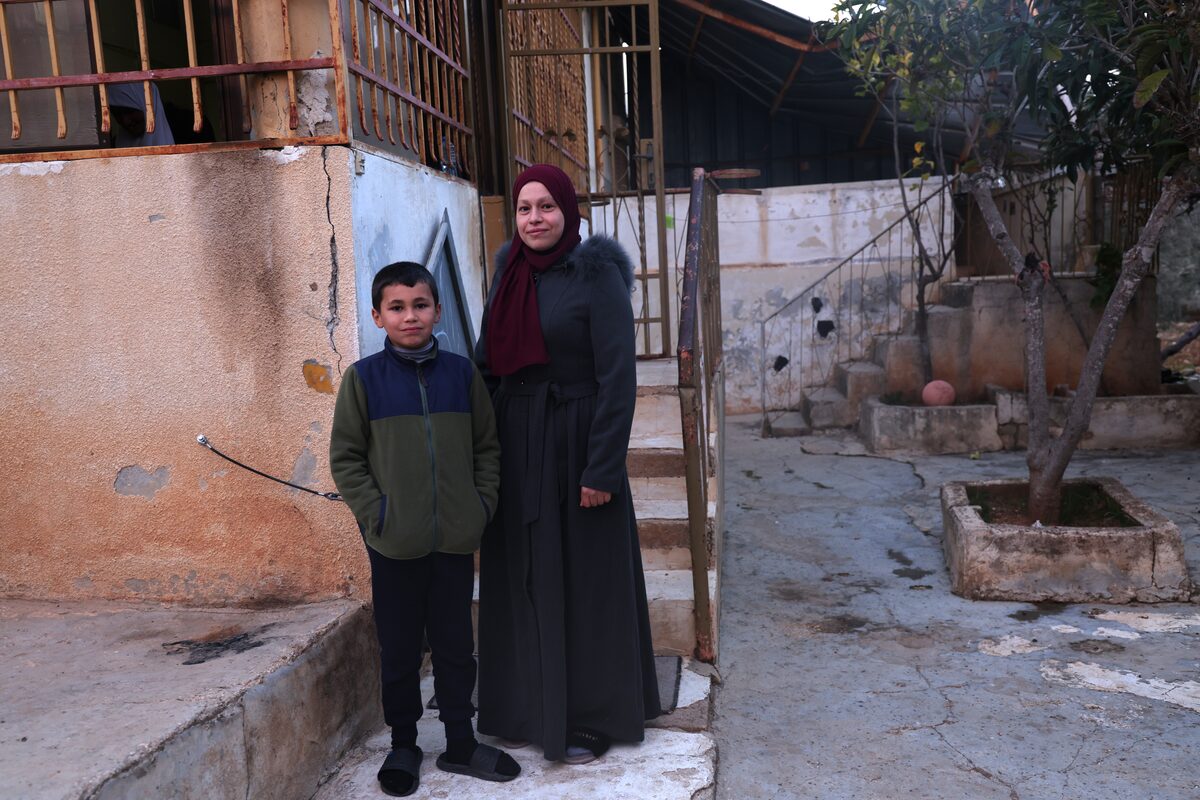
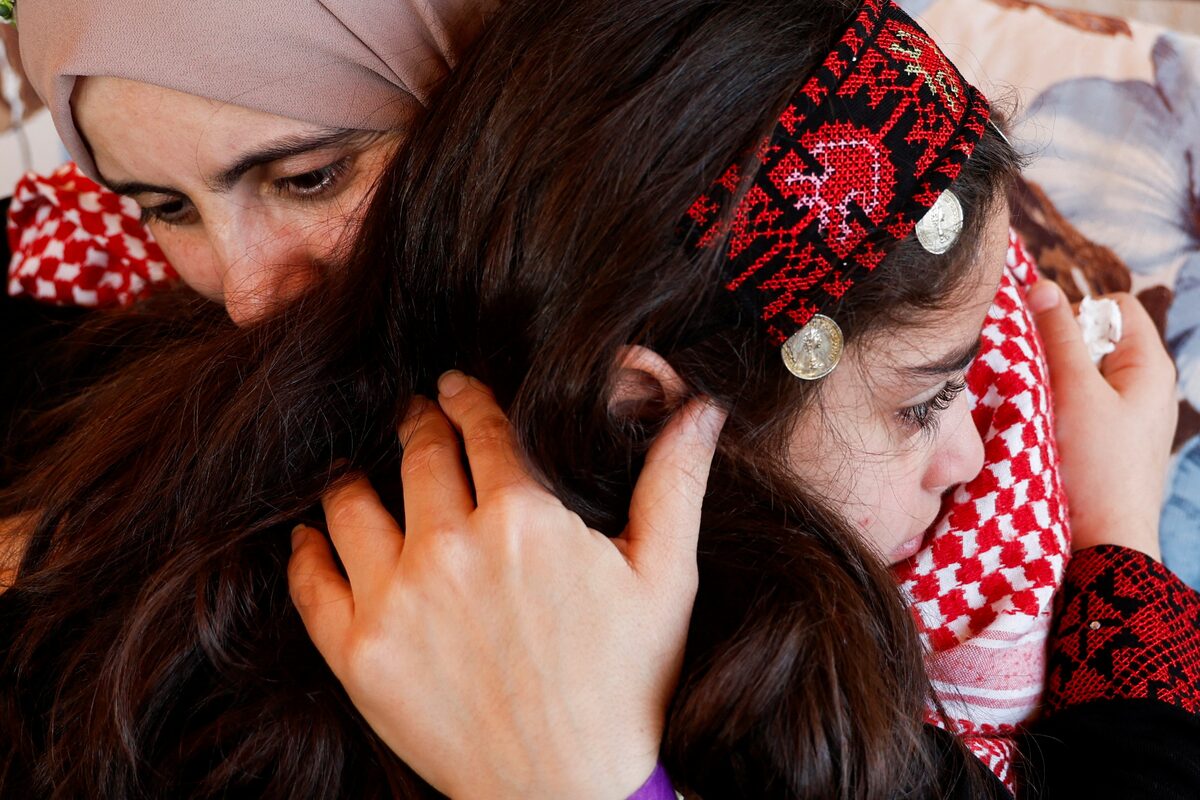
Earlier on the evening of Jan. 19, Sondos Foqaha was inside her home in nearby Sinjil, a small town northeast of Ramallah, when she got a text from a community group chat, warning that Israeli settlers were gathering across the road.
It was 7 p.m. She locked the doors, turned off the lights and hid in the kitchen with her 12-year-old daughter. Her eight-year-old son, too curious to keep away, kept watch. Within minutes, her house was surrounded by settlers, their faces covered with masks. A stone hurled through her front window. Then came a Molotov cocktail.
“He’s still a little bit scared,” Ms. Foqaha said, glancing at her son.
Ms. Foqaha and her children had rushed to put out the fire that had already worked its way up the curtains, and crawled over a cabinet. Her husband had been tending to his 86-year-old father, who was lying in bed, struggling to breathe because of the smoke.
She said villagers rushed to her home and scared the settlers off. And that same night, several of her neighbours’ cars and homes were also targeted. The Globe met two people whose cars were torched and visited a home whose owners say settlers had hurled rocks at the windows, shattering the glass.
The attack has changed their lives, Ms. Foqaha said. They are on edge and afraid.
“We don’t sleep. Our days are like nights and our nights are like days. We take shifts watching what happens.”
With reports from Abdel Naser Musleh

Kent Nishimura/Reuters
War in the Middle East: More from The Globe
The Decibel podcast
When reporter Janice Dickson went to Israel and the West Bank recently, the ceasefire – then only a week old – was already fragile. In Gaza, much-needed aid began to arrive, but not enough to meet demand. Meanwhile, Israeli families faced prolonged agony waiting for loved ones to come home. She spoke with The Decibel from Jerusalem about what she learned. Subscribe for more episodes.
Commentary
Marsha Lederman: A powerful documentary provides important context to Trump’s musings on Gaza
Izzeldin Abuelaish: Palestinians begin the important work of grieving
Ahmed Fouad Alkhatib: Palestinians have no future under Hamas