Depending on where you looked online, the confirmation hearings for U.S. President Donald Trump’s pick for defence secretary, Pete Hegseth, went very differently.
On Bluesky, the refuge for many on the left who have fled Elon Musk’s X, the hearings revealed a man who was grossly unqualified, a misogynist and serial abuser.
On Truth Social, the X facsimile owned by Mr. Trump’s media company, Mr. Hegseth was a patriot who “owned the libs” and would end the military’s woke DEI mindset. When he was officially confirmed, users rejoiced, reposting memes and AI-generated images of the ex-Fox News host smouldering like an uncanny valley Marlon Brando, an American flag in the background.

Several of Pete Hegseth's arm tattoos have been recreated more or less accurately in this Truth Social post, but the image of the U.S. Secretary of Defense shows telltale signs of being AI-generated.
This whiplash of contrasting reactions is a symptom of the deepening fragmentation of social media, where platforms are becoming increasingly aligned with political ideologies. And in recent years, a decidedly right-wing media ecosystem has flourished, attracting everyone from traditional Republicans to extremist far-right castaways.
When Mr. Trump was expunged from Twitter, Facebook and Instagram in early 2021, after praising the rioters who stormed the Capitol on Jan. 6, the President and his MAGA followers decamped to alternative social-media sites, which proudly eschewed the norms of other platforms, such as fact checking and rules against hate speech.
A parallel social-media universe took shape, including Truth Social, Gab and Parler (Twitter-like text-based platforms), Rumble (the YouTube alternative favoured by right-wing communities) and Kick (a livestreaming platform like Twitch, but without any semblance of community guidelines). Mirroring Mr. Trump’s own supporters, the users on these platforms formed a broad alliance: controversial pundits and legacy news commentators, Gen Z influencers, red-pilled meme warriors and crypto bros and suburban MAGA moms. The coalition’s beliefs may not always overlap, but at the centre of their universe is President Trump.

When the federal Liberals trolled Mr. Trump for his remarks on Canadian annexation, they did so on Elon Musk's X, as the President shared his own memes on Truth Social.
Meanwhile, more recently, some mainstream platforms are turning right-ward – or at least wanting to appease the President. On X, Elon Musk uses his account to amplify support for Mr. Trump, reposting memes taunting the Democrats to his 215 million followers, and sway policy decisions in Congress. And in early January, Meta CEO Mark Zuckerberg announced Facebook and Instagram were overhauling their content moderation policies – loosening restrictions on how users can speak about transgender people, immigrants and women, and ending its fact-checking program meant to curb misinformation.
Although the newer platforms have user bases a fraction of the size of their mainstream counterparts, they still can be incredibly influential. As authors Joan Donovan, Emily Dreyfuss and Brian Friedberg explain in Meme Wars: The Untold Story of the Online Battles Upending Democracy in America, conspiracy theorist and Trump ally Alex Jones kept an eye on 4chan – the controversial decades-old message board popular with right-wing trolls – understanding that the political energy in this otherwise obscure imageboard was “an early warning sign” of what was happening in the real world.
Communities on these smaller platforms, they write, “had been having a profound impact on American society for decades – mainstreaming fringe ideas through the sharing of memes, trolling celebrities and journalists and politicians, and generally getting up to all sort of planned mayhem – but were largely unknown to most Americans until they emerged from the wires of the internet and showed up on the Capitol steps that day.”
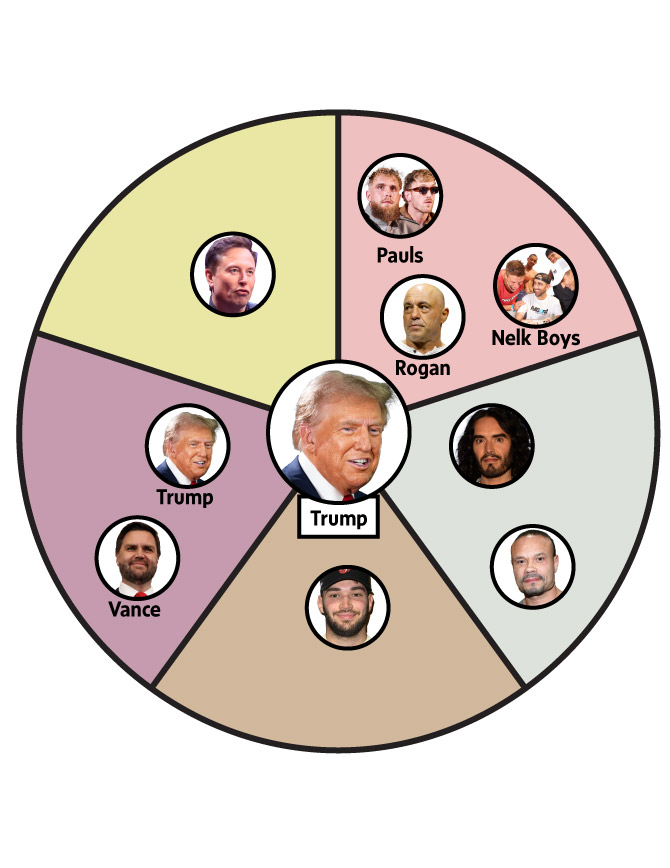
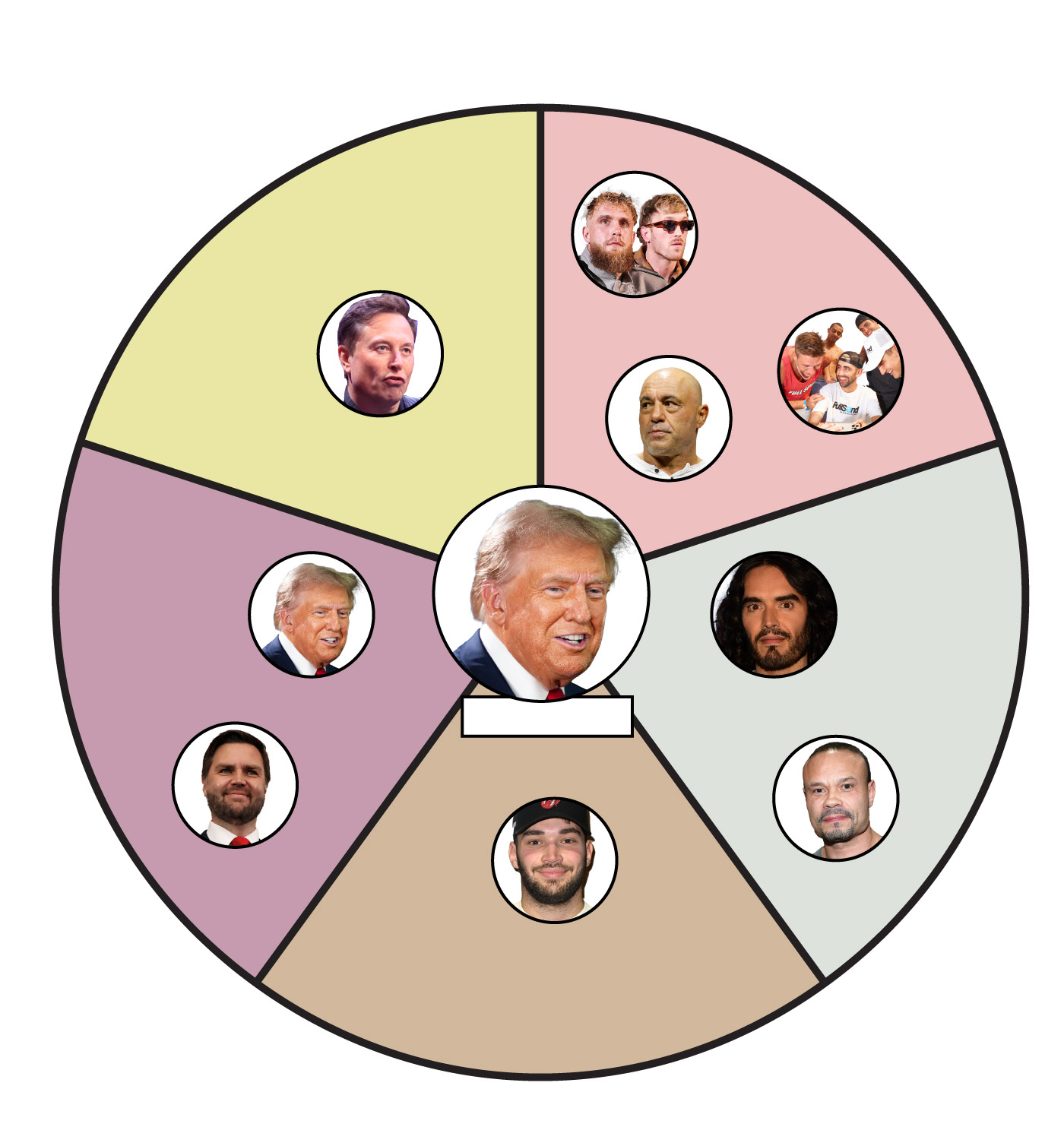
Here’s a breakdown of Trumpism’s online universe.

Trumpism’s online universe
Five social media platforms favoured by
the U.S. president and his supporters
X
YouTube
Pauls
Musk
Nelk Boys
Rogan
Truth
Social
Rumble
Trump
Brand
Trump
Vance
Bongino
Ross
Kick
The Globe and mail. Photos: Frederic J. Brown/AFP via
Getty Images, Al Bello/Getty Images for Netflix © 2024,
Dave Kotinsky/Getty Images for Fanatics, Matt Slocum/AP Photo,
Kena Betancur/AFP via Getty Images, Michelle Groskopf/The New
York Times, Gregory Payan/AP Photo, Rich Polk/Getty Images for
Politicon, Chip Somodevilla/Pool via Reuters
Trumpism’s online universe
Five social media platforms favoured by
the U.S. president and his supporters
X
YouTube
Pauls
Musk
Nelk Boys
Rogan
Truth
Social
Rumble
Trump
Brand
Trump
Vance
Bongino
Ross
Kick
The Globe and mail. Photos: Frederic J. Brown/AFP via Getty Images, Al
Bello/Getty Images for Netflix © 2024, Dave Kotinsky/Getty Images
for Fanatics, Matt Slocum/AP Photo, Kena Betancur/AFP via Getty Images,
Michelle Groskopf/The New York Times, Gregory Payan/AP Photo,
Rich Polk/Getty Images for Politicon, Chip Somodevilla/Pool via Reuters
Trumpism’s online universe
Five social media platforms favoured by the U.S. president and his supporters
X
YouTube
Jake and Logan Paul
Elon Musk
Nelk Boys
Joe Rogan
Truth
Social
Rumble
Russell Brand
Donald Trump
Donald Trump
JD Vance
Dan Bongino
Adin Ross
Kick
The Globe and mail. Photos: Frederic J. Brown/AFP via Getty Images, Al Bello/Getty Images for Netflix © 2024, Dave Kotinsky/Getty Images for Fanatics,
Matt Slocum/AP Photo, Kena Betancur/AFP via Getty Images, Michelle Groskopf/The New York Times, Gregory Payan/AP Photo,
Rich Polk/Getty Images for Politicon, Chip Somodevilla/Pool via Reuters
Truth Social
What it is: An X copycat doubling as Trump’s megaphone
Main players: Donald Trump, JD Vance, aspiring right-wing politicians and the alt-right media
Monthly users: 4.68 million

Truth Social gives U.S. President Donald Trump and U.S. Vice-President JD Vance a platform they control and can use to reach supporters.Evan Vucci and Thomas Padilla/AP
When Donald Trump first proposed 25 per cent tariffs on imports from Canada, he made the announcement on his niche Twitter-like platform, Truth Social, solidifying it as the President’s preferred destination for declaring new policies and executive orders.
The platform, which launched in 2022 in the aftermath of Mr. Trump’s expulsion from Twitter, is also his megaphone to amplify his unvarnished opinions on everything from the threatened TikTok ban to transgender athletes. It’s where he praises allies, airs grievances and reposts a staggering amount of memes and AI-generated images.
(AI slop is abundant on Truth Social; one image that went viral after the election showed an AI-generated portrait of Melania Trump with angel wings, surrounded by cherubic, blonde-haired children, captioned with the text “PROTECT OUR CHILDREN.”)

In this Truth Social meme, the asymetrical faces of the children are a giveaway that it was made through AI.
The platform’s trending feed – called “Hot Truths” – often features posts from the platform’s power users, including Sean Hannity, Charlie Kirk (the leader of the influential PAC Turning Point USA), alt-right activist Jack Posobiec and Republican congresswoman and firebrand Marjorie Taylor Greene. Sprinkled throughout the stream are everyday MAGA supporters on the front lines of creating content glorifying the President, which he often “re-truths.”
Of the conservative X rivals that have emerged – Parler, Gab and Gettr – Truth Social is the front runner, largely because of its proximity to the President. (He has a financial interest in its success, too: He owns roughly 58 per cent of the app’s parent company, Trump Media & Technology Group.)
Yet in comparison to X or Bluesky, its user base is tiny. According to Similarweb, a data firm that tracks online traffic, in December, Truth Social recorded 13.5 million total visits, compared to X’s more than 4.5 billion. But what happens on Truth Social does not stay on Truth Social.
“Trump has a lot of control over the ecology in conservative media. If he says something on Truth Social, news organizations will cover it,” says Josephine Lukito, an assistant professor at the University of Texas at Austin. “And his posts have a ripple effect. They make their way into Rumble, onto X, onto Telegram groups that are pro-Donald.”
Ms. Lukito, who has studied right-wing media through three presidential election cycles, says she’s also seen an increase in federal candidates joining Truth Social, and other alt-tech spaces, as a way to ingratiate themselves with Mr. Trump.
“Even if a candidate isn’t media savvy, they will still go out of their way to join Truth Social because they know that’s where the President is.”

Rumble
What it is: A Canadian-made YouTube alternative embraced by the far right
Main players: Dan Bongino, Russell Brand and Donald Trump. Jr.
Monthly users: 12.58 million

Former TV commentator Dan Bongino, conspiracy theorist Russell Brand and the President's son, Donald Trump Jr., are fixtures of the video platform Rumble.Jason Koerner/Getty Images; Tim Ireland/AP; Nic Antaya/NYT
Rumble was started in 2013 by Chris Pavlovski, an entrepreneur and business-school dropout from Toronto. Its early content was typical viral internet fodder – cute cats, home videos of kids being goofy. But the platform became a haven for users who were kicked off from, or demonetized on, YouTube for violating its community rules in the aftermath of Jan. 6. Around the same time, prominent conservatives Peter Thiel, Vivek Ramaswamy and JD Vance invested in the platform. Florida Governor Ron DeSantis proclaimed the site was a way “to stand up to Big Tech censorship.”
The platform gained more legitimacy when Donald Trump Jr. signed an exclusive deal in January, 2023, for his show, Triggered with Don Jr. It also inked deals with former Fox News host and Trump adviser Kimberly Guilfoyle and British comedian-turned-wellness conspiracy theorist Russell Brand.
On any given day on Rumble’s home page, you’ll find streams of Power Slap, a sport in which opponents smack each other until one of them gets knocked out, pseudo-science doctors shilling dubious health devices and deep dives into conspiracy theories. (Here, you can learn about an ancient but advanced civilization called Tartaria that built cities around the world, which were destroyed and their existence covered up by modern governments.)

Rumble's marketing caters to a base of users who, in several cases, were kicked off platforms such as YouTube for violating terms of service.
But the majority of the videos are about politics.
Every weekday at 11 a.m., Dan Bongino, the loud, charismatic ex-Fox News commentator and the host of Rumble’s most watched show, goes live for one hour. On his eponymous show, Mr. Bongino talks about the culture wars, the daily happenings at the Capitol, reacts to news featured in the mainstream media and hawks branded merch.
Another top streamer on Rumble is conservative comedian Steven Crowder, who arrived from YouTube after his channel was demonetized and temporarily suspended for using racist and homophobic slurs. Now that he’s been reinstated on YouTube, he cross-posts his videos across the platforms, which many of Rumble’s most popular influencers also do.
YouTube still dominates in video content – only 2 per cent of Americans got their news from Rumble in 2024, compared to 32 per cent on YouTube, according to Pew Research – but Ms. Lukito predicts Rumble will continue to grow and have an increasingly larger role in the right-wing media ecosystem.
As Ms. Lukito explains, alt-tech platforms, including Rumble, have become places for isolated young men to find online camaraderie – and where malicious actors, such as paramilitary groups, try to recruit members. She adds that, “for individuals who are seeking community, especially when they can’t verbalize or explain their support for Trump or are still seeking out a political identity, these spaces can be really appealing because they can provide this sense of community.”

Kick
What it is: A Twitch doppelganger with laissez-faire content moderation
Main players: Adin Ross and his army of young twentysomething gamer bros
Monthly users: 12.45 million

Adin Ross, banned from the Twitch platform for hate speech, now reaches a new streaming audience through Kick.Dave Kotinsky/Getty Images for Fanatics
To understand Kick, you first need to understand Twitch.
The video live-streaming platform launched in 2011 as a place for users to broadcast themselves playing video games. Twitch’s content has evolved, however, and now more than 30 million viewers each day can choose from live streams of everything from people DJing in their bedrooms, eating at McDonalds or watching election results roll in. Politics has become its own sub-genre, led by streamers who are mostly left-leaning, including Hasan Piker. (The 33-year-old Angeleno has more than 2.8 million followers on Twitch and streams for an average of eight hours a day.)
Kick was launched in 2022 by Stake, a gambling company, which positioned it in direct competition with Twitch, boasting its looser moderation policies around hate speech, harassment and sexual content. “Kick is seen as Twitch’s rowdier, more racist cousin,” says Nathan Grayson, founder of the video game and culture news website Aftermath, and author of the forthcoming book Stream Big: The Triumphs and Turmoils of Twitch and the Stars Behind the Screen.
Kick is where streamers who have been banned elsewhere end up, such as Adin Ross, the 24-year-old who was permanently banned from Twitch after repeatedly using hateful slurs. Mr. Ross isn’t a political commentator, but he often livestreams with controversial figures: self-described misogynist Andrew Tate, white supremacist Nick Fuentes and, last summer, Mr. Trump. On his Kick channel, Mr. Ross live-streamed with the candidate for more than an hour, which included gifting Mr. Trump a Tesla Cybertruck with a full MAGA wrap, and a Rolex. More than 450,000 people tuned in.
“Adin Ross has a really big audience, but they don’t come to him for politics. They come to him for either playing video games or getting up to ridiculous hijinks, and that was the audience Trump was targeting,” says Mr. Grayson. “People who feel disaffected, don’t like where the political system has gone and want to blow it all up.”
Since Mr. Trump’s appearance, former Republican primary candidate Vivek Ramaswamy also appeared on Kick with Ross. In early February, they talked about deporting migrants and censorship on social media – and, all the while, live-chat comments during the interview were peppered with racist attacks against Mr. Ramaswamy.
Mr. Grayson predicts that more Republican candidates could seek out live streams in future elections. “The strategy is shown to be effective and they’d be pretty silly not to. The blueprint is right there. So why not take advantage?”
Trump’s campaign believes it was effective. Dana White, the head of the UFC and long-time Trump ally, personally thanked Mr. Ross during an election night victory speech.


X
What it is: A new Republican playground
Main players: Elon Musk, and right-wing users he reinstated
Monthly users: 452.5 million

Elon Musk runs Mr. Trump's 'Department of Government Efficiency,' or DOGE, while also owning an array of tech businesses, including the social platform formerly called Twitter.David Swanson/Reuters
Under Elon Musk’s rule, X has become the tech billionaire’s political playground. During the presidential campaign, he posted a near-constant stream of pro-Trump content and boosted misinformation. He re-posted offensive memes and AI-generated videos mocking the Democrats. (One video featured a deepfake of Democratic candidate Kamala Harris saying “I was selected because I’m the ultimate diversity hire.”)
It seems he meant to single-handedly fulfill half of the promise he made when he offered to buy the platform back in 2022: “For Twitter to deserve public trust, it must be politically neutral, which effectively means upsetting the far right and the far left equally.” Weeks after his takeover, the app restored some 60,000 accounts previously suspended for policy violations, including those of white nationalists, neo-Nazis and conspiracy theorists.
Under Mr. Musk, more Republicans are flocking to the site. According to Pew Research Center, in 2021, only 17 per cent of users identified as Republican. In 2024, that number jumped to 53 per cent. And those Republican users who post about politics are more likely than their Democratic counterparts to cite their views being welcome on X as a major reason why they’re on the platform (54 per cent vs. 33 per cent).
This has all greatly shifted the content you see on X, according to media experts. “Far-right and Republican politicians have felt more open to say things that push the boundaries in terms of political and social acceptability,” said Shannon McGregor, an associate professor of journalism at the University of North Carolina at Chapel Hill.
As left-leaning users flee X, this new content is more likely to be amplified, adds Ms. McGregor, pointing to an analysis by the Washington Post that found Republican tweets go viral far more often than Democratic ones.
YouTube
What it is: The “manosphere” home base
Main players: Joe Rogan, the Nelk Boys, Logan and Jake Paul and Theo Von
Monthly users: 1.72 billion

The 'manosphere' magnates you might meet on YouTube include, clockwise from top left, Jake and Logan Paul, the Nelk Boys, Theo Von and Joe Rogan.Al Bello/Getty Images for Netflix; Michelle Groskopf/NYT; Jasper Colt and Saul Loeb/Reuters
Podcast studios were a major campaign stop for Mr. Trump and his Republican running mate JD Vance, as both candidates put in hours speaking with controversial, hypermasculine “manosphere” luminaries – Joe Rogan, Theo Von, Logan and Jake Paul – a strategy to court young men who usually don’t vote in elections. (The strategy paid off; in the 2024 race, white men under 30 overwhelmingly supported Trump, according to polls.)
Although their shows can be listened to on podcast apps, millions of people watch the interviews on YouTube. The platform’s recommendation algorithm – the site’s beating heart that drives 70 per cent of what people watch – has been scrutinized over the years for driving viewers from more mainstream videos to content promoting radical and violent ideas. An analysis of far-right chat rooms from the investigative news site Bellingcat found that YouTube was cited as the most frequent online cause for getting “red-pilled,” the Matrix-inspired term used for converting to far-right beliefs.
YouTube is massive, appealing to both right-leaning and left-leaning creators, but its algorithm does end up boosting more provocative right-wing voices. “YouTube is a place where you find a lot of those figures,” said Mr. Grayson, the journalist who covers streaming. “They’re able to reach larger mainstream audiences there and the YouTube algorithm prioritizes their content because it makes people angry, and that leads to further engagement. That decision was not partisan. It was just ‘more engagement means more money through ads.’ ”
Both Mr. Trump and Mr. Vance have appeared in videos and podcasts with the Nelk Boys, a group of creators led by Canadian Kyle Forgeard, who first became known for their prank videos. In the past few years, however, they’ve started speaking about politics and supporting the MAGA movement. They’ve attended UFC matches with Mr. Trump, visited him at Mar-a-Lago and made TikToks together on Air Force One.
“When politics eases into it like that, it’s a different entry point for people and those people are hard to reach,” said media researcher Ms. McGregor. “The millions of dollars that you would pay for a commercial during a Monday night football game, compared with spending an hour and not paying any money to be on a podcast that’s gonna be listened to by millions of people, that’s a really different ROI from a campaign perspective.”
The social order: More from The Globe and Mail
Lately podcast
Online content creators played a big role in Donald Trump’s return to power. What does their newfound access to the White House mean for the rest of us? Tech and culture writer Taylor Lorenz spoke with the Lately team about that. Subscribe for more podcasts and Lately newsletter updates from Samantha Edwards.
Commentary
Joel Westheimer: Bowing to authoritarianism in the age of tech plutocracy
Gus Carlson: In keeping TikTok, Trump is channelling his inner Sun Tzu