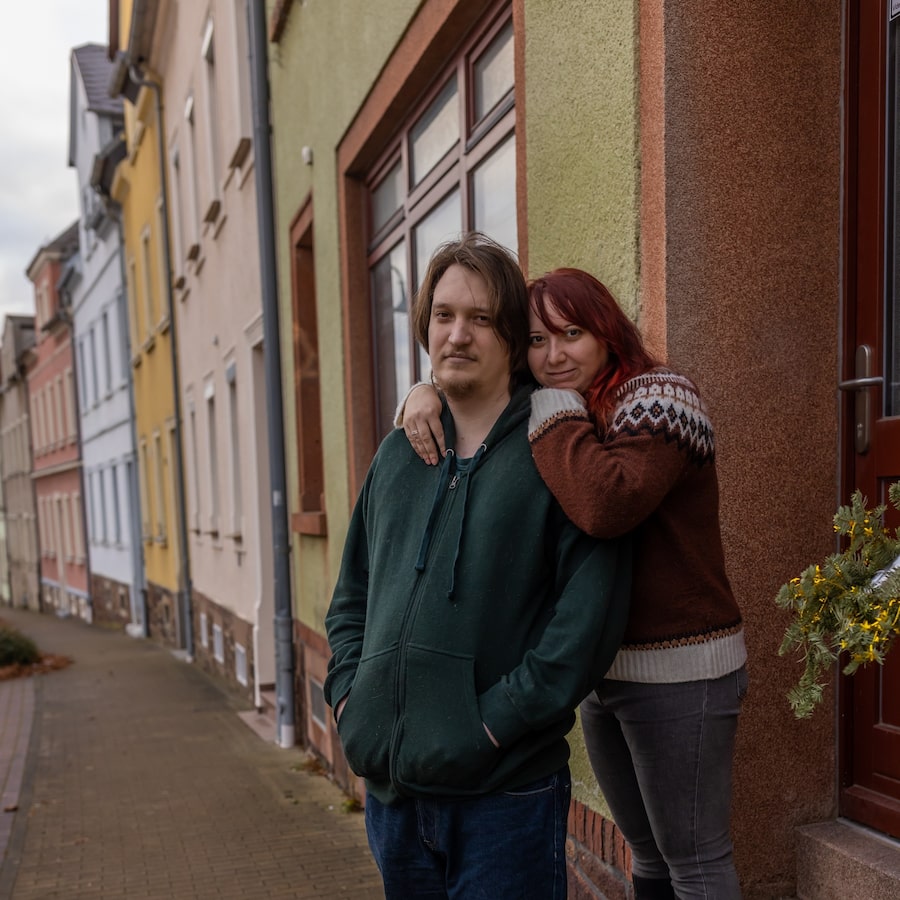
With the war in Ukraine now in its fifth year, more than six million Ukrainian refugees are still living abroad. The Globe and Mail has followed 19 people who left their homes and communities in the first weeks of the war.
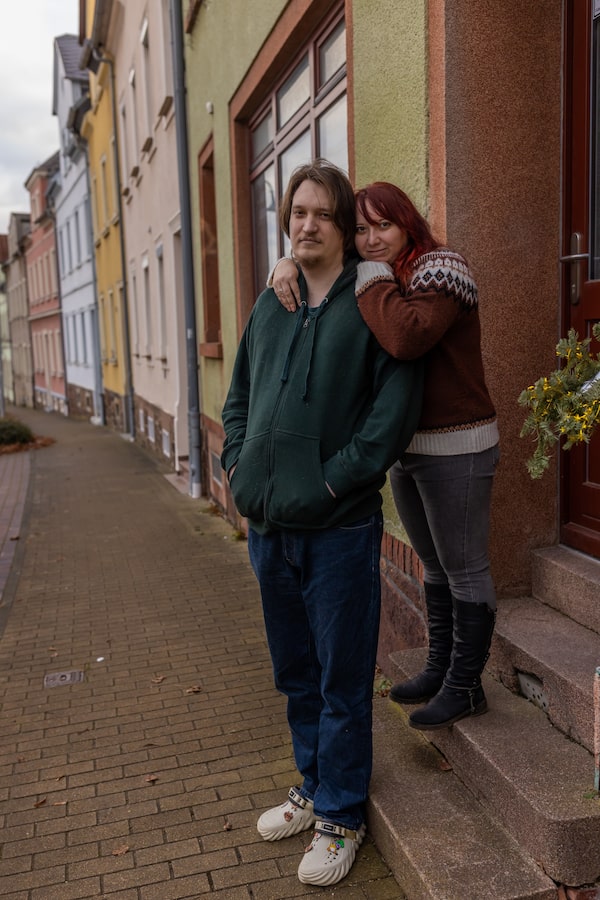
George Fedorov, 28, and his wife, Yevheniiya Fedorova, 35, fled the city of Odesa in southern Ukraine on Feb. 24, 2022.
They’re now living in the German town of Hartha. They still feel like outsiders – and George’s Russian citizenship doesn’t help.

Yevheniiya Fedorova got a Ukrainian trident tattoo in Germany, where she and her husband, George Fedorov, eventually settled after fleeing Odesa.
George felt a wave of fear as he walked into the Russian embassy in Berlin.
He’d come to renew his passport and worried that embassy staff might ask about his years in Ukraine or make him sign up for the Russian army.
The passport had dogged George ever since he and Yevheniiya fled Odesa four years ago as Russian bombs rained down on the city.
Everywhere they went – through Poland, Czechia and Germany – George had to show his passport and explain what he was doing in Ukraine.
German police pulled him off a train in Dresden and interrogated him for seven hours. They finally allowed him and Yevheniiya into the country under a special program that provides temporary asylum to Ukrainian refugees.
But George was still stuck. He wasn’t a Ukrainian citizen like Yevheniiya and he wasn’t going to get German citizenship any time soon. The Russian passport was his only piece of ID.
Luckily the Russian embassy’s staff didn’t ask him any questions about Ukraine and renewed the passport for 10 years. “I can’t get rid of it,” George said with a chuckle. “I have to be a citizen of somewhere.”

We first met George and Yevheniiya just after they’d arrived in the Polish border town of Przemysl in early March, 2022. They were camped out on the floor of an empty Tesco supermarket that had been transformed into a shelter for thousands of Ukrainians who were pouring into Poland.
George passed the time fiddling with a Rubik’s cube, while Yevheniiya knitted to ward off her anxiety. With each rapid stitch her fingernails flashed blue and gold, the colours of the Ukrainian flag. Her mother and brother sat nearby, trying to keep track of the family’s five cats, which had made the journey as well.
The family had no idea where they would go next, their few possessions packed into a collection of bags.
George had moved to Ukraine on an impulse five years earlier. He’d dropped out of St. Petersburg Polytechnic University and was looking for adventure and a chance to get away from Russia for the first time in his life.
When he saw a bus destined for Odesa, he hopped on. It wasn’t long before he married Yevheniiya, found a job with a Russian gaming company, Playrix, and decided to call Ukraine home.
Now he and Yevheniiya were looking for somewhere to start over.

George had this musical instrument – a gift from his wife that he didn’t really know how to play – when The Globe met him in Przemysl in 2022. Soon, they and their possessions would be on the move again.
They left the shelter in Przemysl a few days later, bound for a small town in Czechia on the advice of a friend of a friend. That didn’t work out, and they left after a week. Some other friends suggested Germany, so they boarded a train to Berlin, only to be hauled off in Dresden when police started checking passports.
From Dresden, they went to Leipsig, where a real estate agent found two affordable apartments in Hartha, about an hour away – one for George, Yevheniiya and the cats, the other one for her mother and brother.
Before German reunification in the 1990s, Hartha was a thriving centre for agriculture and industry. But it has fallen on hard times. Several factories have shut down, shops have closed, and the town’s population has dwindled from more than 10,000 in 2000 to around 6,500.
George and Yevheniiya relish the slow pace of Hartha, finding it a relief from the stress of the war back home. But they still feel like unwelcome foreigners.
George has continued working for Playrix, which closed its Russian operations in 2022 and is now based in Ireland. And Yevheniiya has dabbled in her old hobby of photography. Their German is far from fluent, and they have few friends in town. Yevheniiya has taken to using the name Jessica in the hope that it might be easier for Germans to pronounce.
Last summer they bought a three-storey building on Hartha’s main street for €85,000. There used to be a bridal shop on the main floor, which is still full of boxes and old furniture. There are two kitchens on separate floors, but most of the appliances have seen better days. And the heating barely works. But they love it and are slowly turning the building, and Hartha, into a home.

In Germany, where Yevheniiya painted these landscapes, her mother and brother would find a place to stay not far from them.
The war is never far away.
Yevheniiya’s brother, Nikita, has become withdrawn and refuses to speak German or attend the local school. His mother has enrolled him in an online Ukrainian program, but he’s falling behind and rarely leaves the apartment.
The family knows he’s been deeply traumatized by the war and the decision to leave Ukraine. “The past is actually haunting him, because we never asked him about what we were going to do,” George said.
Nikita’s mother doesn’t want to push her son too far. She’s trying to find a psychiatrist, but Nikita isn’t keen and his lack of German makes it difficult to seek help.

George has tried to maintain a relationship with his family in Russia.
When the war started, he barely spoke to his parents or his younger brother. He couldn’t stand their unyielding support for Russian President Vladimir Putin and their rants about Nazis in Ukraine.
He gave up talking to his father but found a way to communicate with his mother without delving into the war or politics. Then, a few months ago, his teenaged brother, Mikhail, started asking questions about Germany and the West.
“Something happened, and now he’s into the politics, so into the politics that he’s actually figured out that something’s wrong with Russia,” George said with a smile. “There was a month when he bothered me every day. ‘How can I get to Germany? How did you get to Germany? Can you help me get to Germany?’”

George, whose path to German citizenship is stymied by his Russian passport, recently fielded questions from his younger brother about how he could come here.
George and Yevheniiya have bonded with many locals over an issue that has riled up the community for months.
The regional government has bought an abandoned building in Hartha and plans to use it to house as many as 60 asylum seekers, mostly from the Middle East.
Hundreds of residents have signed a petition against the proposal, and thousands took to the streets last summer in a protest led by the local branch of the far-right Alternative for Germany, or AfD.
George and Yevheniiya signed the petition, along with many other Ukrainians in town. “It’s a really, really, really bad place to have a refugee camp,” George said, noting that the shelter would be next to a primary school.
He’s no fan of the AfD’s pro-Russian leanings but shares the party’s views on immigration. “Germany really has problems with migration,” he said.
When asked if it was strange for Ukrainian refugees to oppose accommodating other refugees, George was unapologetic.
“Ukrainians don’t have the refugee camp here. We have places to live, even if we need to bring our relatives here,” he said.
The shelter is going ahead for now, but its opponents haven’t backed down, including George and Yevheniiya.
War in Ukraine: More from The Globe and Mail
The Decibel podcast
Since the war began, Russia has been spiriting away young Ukrainians to training camps designed to turn them against their homeland. Reporter Mark MacKinnon spoke with The Decibel last year about a project, partly funded by Canada, that tracks the children so they can be brought home one day. Subscribe for more episodes.
Five years in focus
Ukrainian soldiers heal through dance as war enters fifth year
The tragic war in Ukraine has become tragically normal
Where is the conflict headed? These charts tell a grim story