
A Russian service member walks outside a school where volunteers deliver humanitarian aid in Ukraine on Tuesday.Alexander Ermochenko/Reuters
Ukrainian children being held in detention centres in Russian-occupied territory are being told how to behave around the former Russian soldiers who guard them, evidence of Moscow’s program to militarize the children, investigators say.
A pamphlet distributed to the children warns them not to “provoke the hero!” and says that every word they say could be “the last peaceful word of the day.” It instructs them not to sneak up on the soldiers from behind, as it could “trigger combat memories,” and warns them to keep hands visible and to avoid speaking foreign languages.
“If he shouts – do not argue, hide and wait,” the pamphlet says. “Don’t complain about heat, hunger or fatigue – unlike civilians, the hero knows what ‘hard’ really means,” it says. “Politeness saves lives – a smile to a counsellor is not weakness.” (The former Russian soldiers are referred to as counsellors.)
Carney accuses Putin of abducting thousands of Ukrainian children

This pamphlet distributed to kids tells them how to behave around the former Russian soldiers who guard them.Supplied
Since the beginning of its full-scale invasion, Russia has abducted Ukrainian children, taking them to facilities across Russia and occupied territory in Ukraine, and it is preparing them to fight against their own country. Children between the ages of 8 and 17 are said to be in these military camps.
The pamphlet was shared with The Globe and Mail by Hala Systems, a Lisbon-based technology company that uses AI to analyze open-source evidence about the detention centres where tens of thousands of Ukrainian children are being held. The bright yellow pamphlet with capitalized red instructions, had been distributed to children in the Strana Geroev (Country of Heroes) camp, which is located in Russian-occupied Crimea.
Hala Systems said in an analysis of the pamphlet that the presence of Russian soldiers who fought in Russia’s war against Ukraine was being used “to instill in children a perception of war as heroic and violence as a form of patriotic service.” The camp, according to Hala Systems, is one of Russia’s projects for the “patriotic upbringing” of children, which includes Ukrainian children who have been taken there. It’s supported by Russian state entities, the analysis said.

People hold a banner reading "No peace treaty without the return of Ukrainian deported children" during a rally in support of Ukraine in Paris on Aug. 24.STEPHANE DE SAKUTIN/AFP/Getty Images
Ashley Jordana, the director of law, policy and human rights at Hala Systems, said there have been reports indicating that people who worked at these camps had ties to Russia’s security services or had military backgrounds, but before the pamphlet was obtained, it wasn’t clear that those who served in Russia’s war against Ukraine were working as camp counsellors.
Ms. Jordana said part of the pamphlet’s objective is to tell children how to behave, but that it also points to a broader strategy, which is a “hybrid militarization mechanism that is being disguised as patriotic education.”
“The narrative in Ukraine has very much been focused on deportation and the forceful transfer of children and I think what’s been left behind a little bit is the exploration of how Russia is weaponizing children to build this new generation of fighters,” she said.
She said the issue of Ukrainian children who have been forcibly taken by Russia is often viewed as a humanitarian crisis, but that it’s also a national security threat to NATO, especially the eastern flank.

Individuals in formation are visible in a Maxar satellite image of the All-Russian Children’s Center "Change" in April, 2025, highlighted by Yale University's Humanitarian Research Lab. It is not confirmed that the activity visible is related to the training of children from Ukraine at this location.Maxar/Yale University Humanitarian Research Lab
Hala Systems’ legal assessment said that the presence of military personnel as counsellors at children’s camps violates international legal norms, including a number of articles of the United Nations Convention on the Rights of the Child.
“Additionally, this practice can be viewed as part of the militarization of civilian spaces, which is impermissible under international humanitarian law,” the analysis said.
“In some cases, such practices may be considered part of a broader state policy that may accompany war crimes or genocide – particularly when militarization involves forcibly displaced or deported Ukrainian children,” the analysis continued.
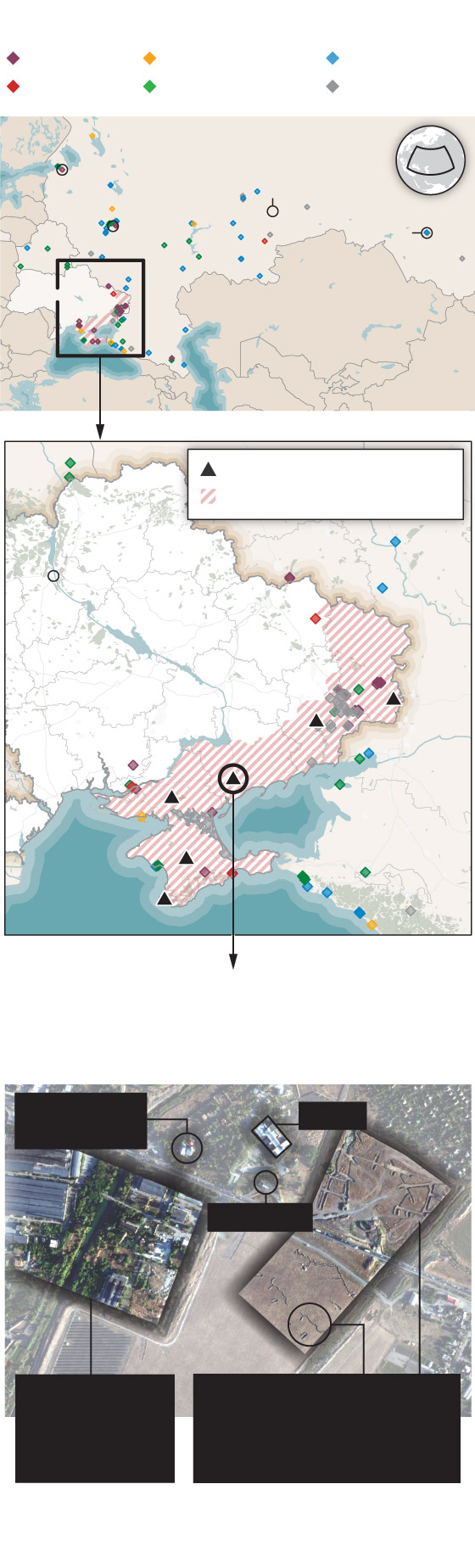
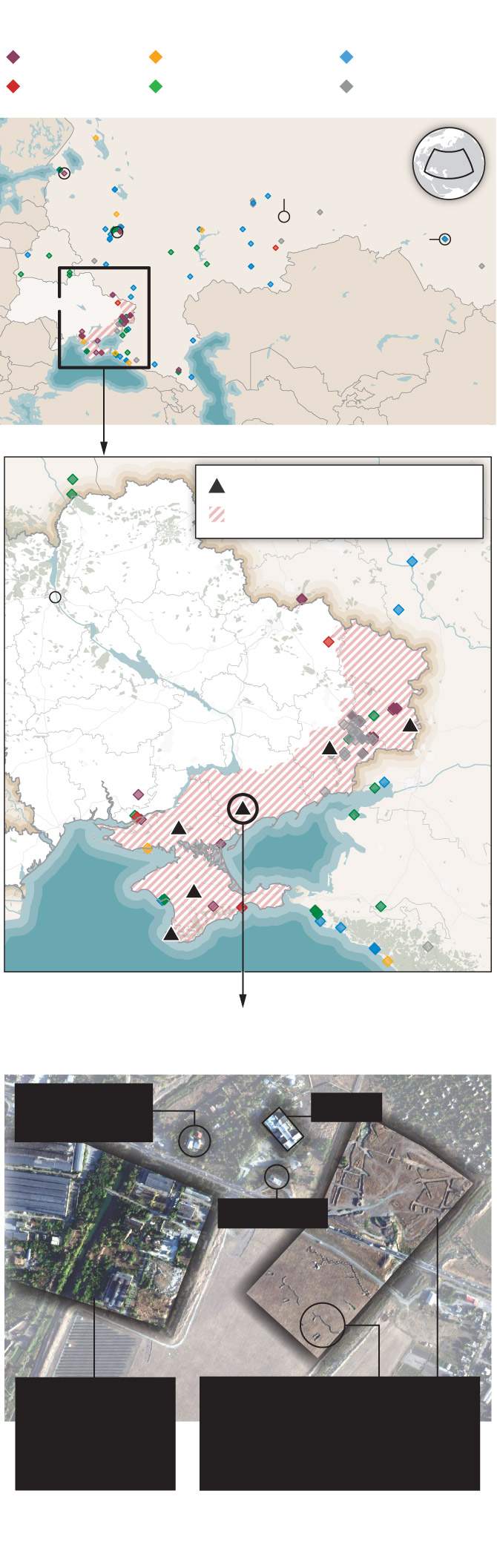
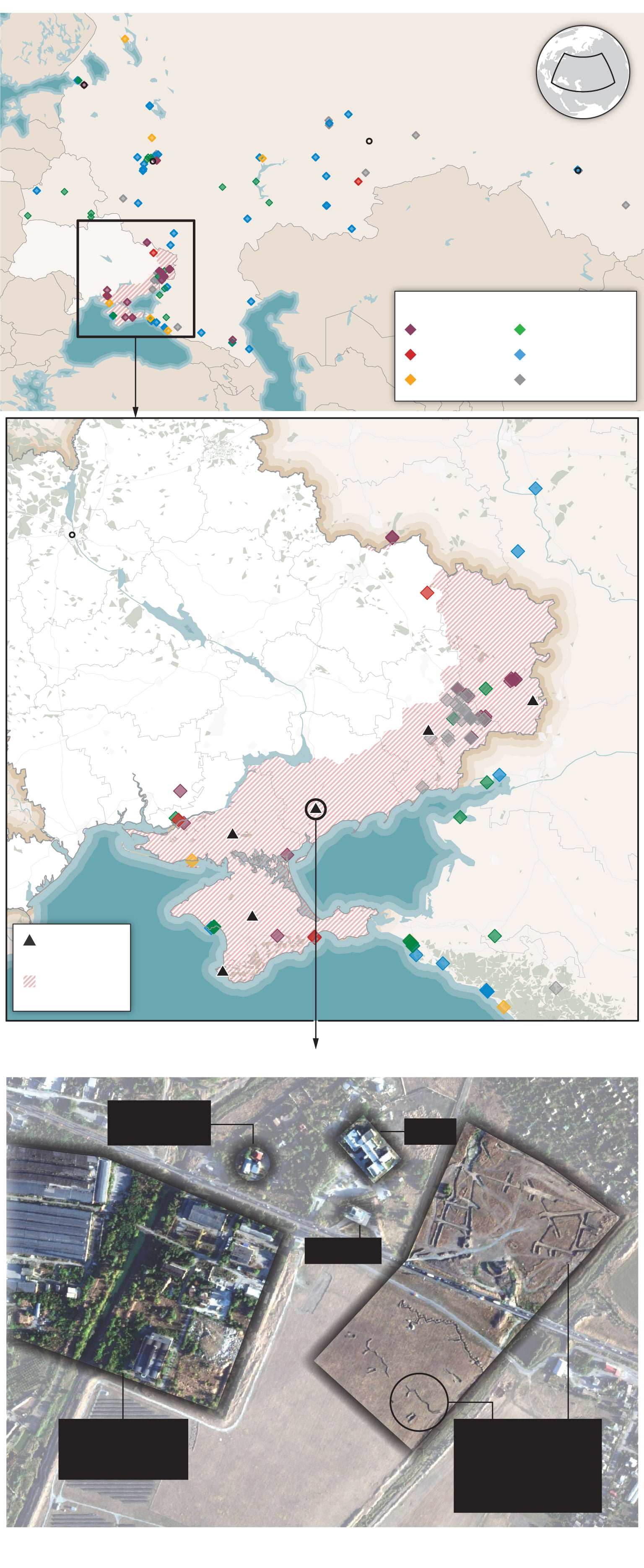
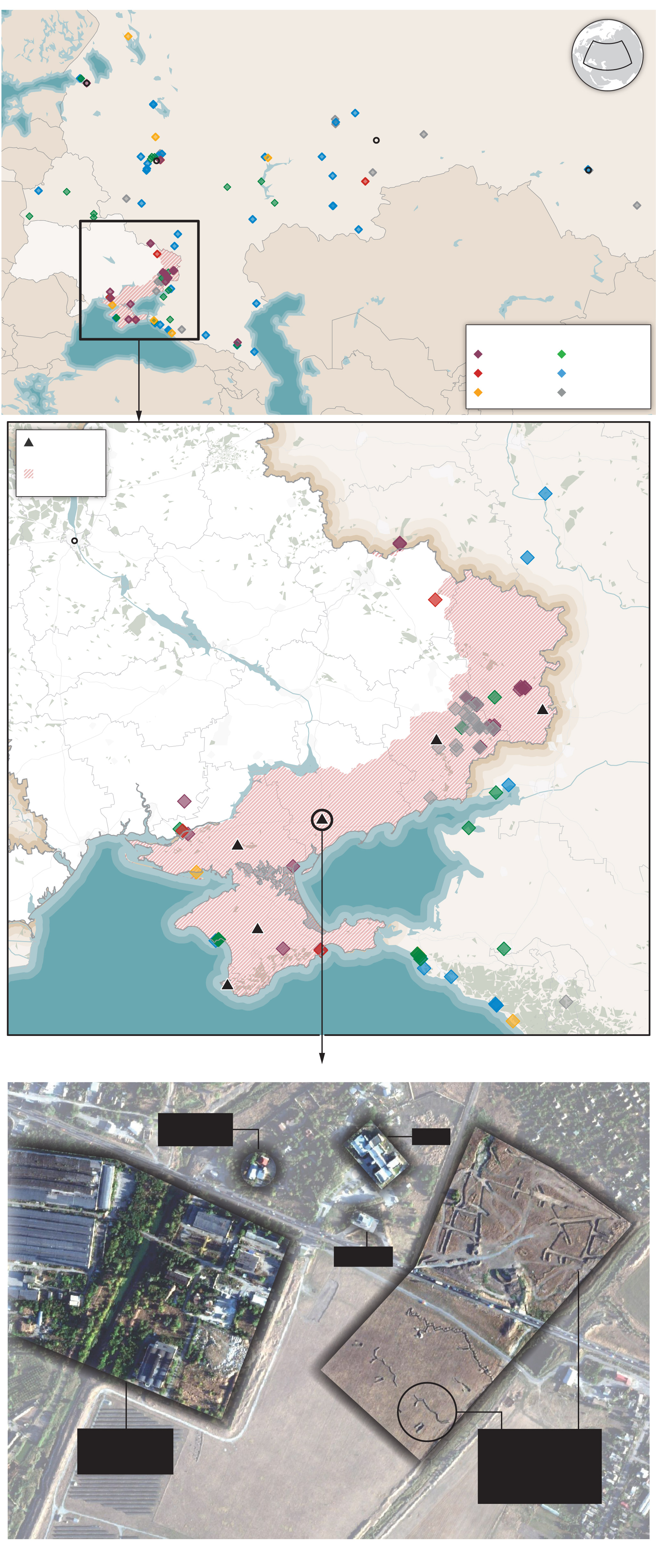
Last week, the Humanitarian Research Lab at the Yale School of Public Health published an extensive report called Ukraine’s Stolen Children: Inside Russia’s Network of Re-education and Militarization, which revealed that children from Ukraine have been taken to at least 210 locations in Russia and in occupied territory of Ukraine.
Satellite data shed light on Russia’s modern-day gulags for Ukrainian children
Detention facilities (previous used as):
School
Hotel/resort
Camp
Orphanage
Healthcare facility
Other
FINLAND
RUSSIA
Yekaterinburg
St. Petersburg
Moscow
Novosibirsk
KAZAKHSTAN
UKRAINE
Yunarmiya headquarters
Areas under Russian control
RUSSIA
Kyiv
UKRAINE
Donetsk
Luhansk
Melitopol
Kherson
Crimea
Sevastopol
Satellite photo of Russia’s ‘Yunarmiya,’
or Youth Army, facilities in Melitopol,
occupied Ukraine
Yunarmiya HQ, Melitopol
Church
Gas station
Refrigerator factory occupied by the Russian forces
Earthworks first visible in May 2022 appear to be trenches dug to train soldiers for combat situations.
MURAT YÜKSELIR / THE GLOBE AND MAIL, SOURCE:
HALA SYSTEMS; PLANET LABS PBC; OPENSTREETMAP
Detention facilities (previous used as):
Hotel/resort
School
Camp
Healthcare facility
Orphanage
Other
FINLAND
RUSSIA
Yekaterinburg
St. Petersburg
Moscow
Novosibirsk
BELARUS
KAZAKHSTAN
UKRAINE
Yunarmiya headquarters
Areas under Russian control
RUSSIA
Kyiv
UKRAINE
Donetsk
Luhansk
Melitopol
Kherson
Crimea
Sevastopol
Satellite photo of Russia’s ‘Yunarmiya,’ or Youth Army,
facilities in Melitopol, occupied Ukraine
Yunarmiya HQ, Melitopol
Church
Gas station
Refrigerator factory occupied by the Russian forces
Earthworks first visible in May 2022 appear to be trenches dug to train soldiers for combat situations.
MURAT YÜKSELIR / THE GLOBE AND MAIL, SOURCE:
HALA SYSTEMS; PLANET LABS PBC; OPENSTREETMAP

FINLAND
RUSSIA
St. Petersburg
Yekaterinburg
Moscow
Novosibirsk
BELARUS
KAZAKHSTAN
UKRAINE
Detention facilities (previous used as):
School
Healthcare facility
Orphanage
Camp
Hotel/resort
Other
TURKEY
RUSSIA
Kyiv
UKRAINE
Luhansk
Donetsk
Melitopol
Kherson
Sea of
Azov
Black Sea
Crimea
Yunarmiya
headquarters
Sevastopol
Areas under
Russian control
Satellite photo of Russia’s ‘Yunarmiya,’ or Youth Army, facilities in Melitopol, occupied Ukraine
Yunarmiya HQ, Melitopol
Church
Gas station
Refrigerator factory occupied by the Russian forces
Earthworks first visible in May 2022 appear to be trenches dug to train soldiers for combat situations.
MURAT YÜKSELIR / THE GLOBE AND MAIL, SOURCE: HALA SYSTEMS; PLANET LABS PBC; OPENSTREETMAP
FINLAND
RUSSIA
St. Petersburg
Yekaterinburg
Moscow
Novosibirsk
BELARUS
UKRAINE
KAZAKHSTAN
Detention facilities (previous used as):
School
Healthcare facility
Camp
Orphanage
Hotel/resort
Other
TURKEY
RUSSIA
Kyiv
UKRAINE
Luhansk
Donetsk
Melitopol
Kherson
Sea of
Azov
Black Sea
Crimea
Yunarmiya
headquarters
Sevastopol
Areas under
Russian control
Satellite photo of Russia’s ‘Yunarmiya,’ or Youth Army, facilities in Melitopol, occupied Ukraine
Yunarmiya HQ, Melitopol
Church
Gas station
Refrigerator factory occupied by the Russian forces
Earthworks first visible in May 2022 appear to be trenches dug to train soldiers for combat situations.
MURAT YÜKSELIR / THE GLOBE AND MAIL, SOURCE: HALA SYSTEMS; PLANET LABS PBC; OPENSTREETMAP
FINLAND
RUSSIA
St. Petersburg
Yekaterinburg
Moscow
Novosibirsk
BELARUS
UKRAINE
KAZAKHSTAN
Detention facilities (previous used as):
School
Healthcare facility
Camp
Orphanage
Hotel/resort
Other
TURKEY
Yunarmiya
headquarters
Areas under
Russian control
RUSSIA
Kyiv
UKRAINE
Luhansk
Donetsk
Melitopol
Kherson
Sea of
Azov
Black Sea
Crimea
Sevastopol
Satellite photo of Russia’s ‘Yunarmiya,’ or Youth Army, facilities in Melitopol, occupied Ukraine
Yunarmiya HQ, Melitopol
Church
Gas station
Refrigerator factory occupied by the Russian forces
Earthworks first visible in May 2022 appear to be trenches dug to train soldiers for combat situations.
MURAT YÜKSELIR / THE GLOBE AND MAIL, SOURCE: HALA SYSTEMS; PLANET LABS PBC; OPENSTREETMAP
The report says that children at these facilities “routinely undergo ‘re-education’ and, in many cases, are placed in programs of forced militarization that include, though are not limited to, combat and paratrooper training.”
“Children at some facilities have been engaged in the production of military equipment for Russia’s armed forces, including drones,” the report said.
The investigation found that Russia is “operating a potentially unprecedented system of large-scale re-education, military training, and dormitory facilities capable of holding tens of thousands of children from Ukraine for long periods of time.”
Prime Minister Mark Carney and Ukrainian President Volodymyr Zelensky co-chaired a session at the United Nations General Assembly on efforts to bring home Ukrainian children abducted by Russia.
The Canadian Press
Nathaniel Raymond, executive director of the Humanitarian Research Lab, said “we’re dealing with the single largest kidnapping since World War II.”
Mr. Raymond said governments are doing “almost nothing” apart from diplomatic and political pressure on Russian President Vladimir Putin - a man who has been indicted by the International Criminal Court. But he said it’s not clear how much the international community will do to bring these children back.
“This isn’t about Ukraine’s children alone. It’s about the special protected status that children have in the Geneva Convention. They are not hostages. They are not to be taken. They are not to be traded. And that is what international law says. And if we have a situation where Putin gets away with using these children as poker chips in a dangerous card game as leverage against Ukraine, then it means giving the green light in the wars of tomorrow to take children as hostages.”