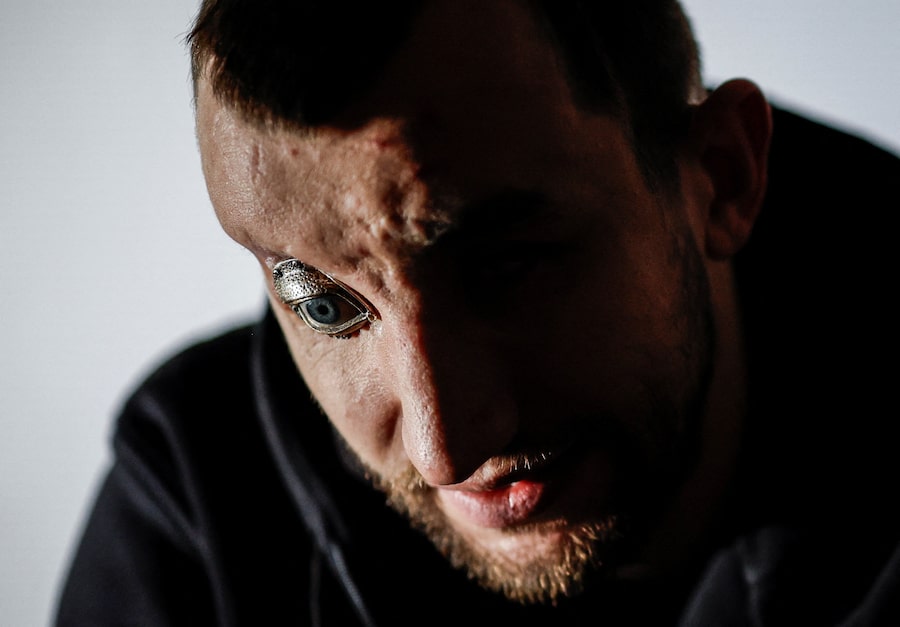

Ukrainian soldier Andrii Onopriienko ran into a challenge when he took up his new hobby of acting: having to learn his lines just by listening to them. The 31-year-old lost both eyes when two Russian anti-tank rounds ripped into his position in the eastern Ukrainian city of Avdiivka in 2023.
He memorized his part nonetheless. Like the other veterans in his Kyiv-based group of around 15 actors, Mr. Onopriienko has found healing and fulfilment on stage, after a friend told him of a theatre looking for injured veterans and suggested he join. He reluctantly agreed to take part.
“Yes, we might not have an arm, or legs, or eyes – but we aren’t giving up,” he said. Russia’s war, now entering its fifth year, has left countless Ukrainian soldiers wounded, with tens of thousands suffering one or more amputations.

An assistant at a rehab centre helps Mr. Onopriienko feed a horse. Now 31, he has adapted to life without his vision.
Some of those with life-altering injuries struggle to reintegrate into a society itself navigating how to absorb a generation of maimed men and women.
Coping methods vary. For Mr. Onopriienko and his fellow troops-turned-thespians, none of whom had ever acted before, it meant taking to the stage. Reuters followed the group, called Veterans’ Theatre, as they prepared for an avant-garde performance of an 18th-century Ukrainian parody of Virgil’s Aeneid.
“It’s rehabilitation and socialization,” said Mr. Onopriienko. “It’s ... positive emotions.”

The veterans will perform Eneida, based on one of the oldest literary works in the Ukrainian language. Subverting a Roman epic about the Trojan War, it imagines the losing side of that conflict as Cossacks.


Russia’s war has left deep scars across wide swathes of Ukraine and its population, with no end in sight despite a U.S.-backed peace push.
Yehor Babenko, 27, was wounded in the first year of fighting when Russian forces struck his base in the southern region of Mykolaiv. His face deformed by severe burns, he speaks by regulating a tube in his throat with one of two mangled hands that are missing all of their fingers.
That did not stop him from committing to months of taxing rehearsals full of dancing, twirling and tumbling.
Mr. Babenko, who began working as a veterans’ psychologist last year, said the transformative trauma of serious injury often compels people to seek meaning in something new. “I know a lot of cases where people opened up or tried things they never dared to try,” he said.


The director, Olha Semoshkina, told Reuters she had individually tailored the roles, which were heavily based around physical movement, to suit each veteran’s injury.
Taras Kozub, 53, lost his left arm after storming an enemy position on the southeastern front. Today, the folk music aficionado plays a hurdy-gurdy with a specially designed prosthetic appendage that attaches directly to the instrument.
Even Mr. Kozub concedes the adjustment to theatre was challenging, and not a remedy for every veteran. “The first thing I realized is that you can’t fool anyone while onstage,” he said. “It’s like you’re standing there naked.”
During the premiere in Kyiv, the veterans stomped and shuffled across the stage under bright neon lights, and to live musical accompaniment by Mr. Kozub and others. They received a boisterous ovation from members of the audience, some of whom cried or embraced.
Mr. Babenko says it was critical for his fellow comrades to understand that life does not simply end after a serious injury. “Sometimes, you understand it’s the opposite – that it just starts getting going.”
Video: Watch the Veterans’ Theatre at work
Watch excerpts from the production of Eneida. Note: It contains content some viewers may find distressing.
Reuters