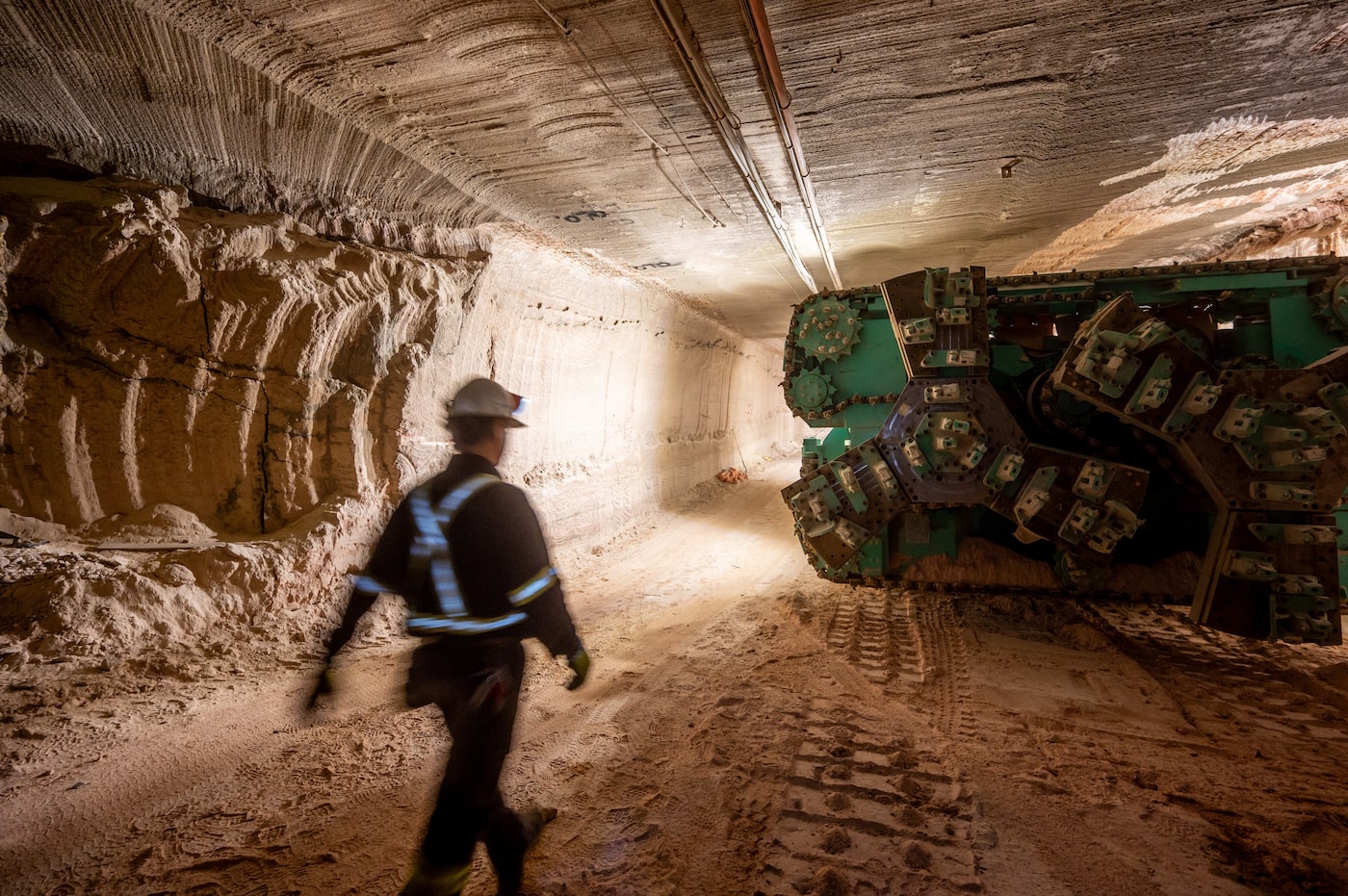
In Saskatchewan, 1,000 metres below the surface of the earth, in a cavern heated to a sweltering 27 C by geothermal energy, a machine is boring into the ground, searching for a compound that is critical to worldwide food production and crucial in Canada’s current trade battle with the United States.
Launched just a few weeks ago, this boring machine is hooked up to a fibre-optic connection, and operated from a climate-controlled office on the surface.
This single tunnel, called a face, was sunk at a cost of $30-million. And it is just one in a network spread across six mines owned and operated by Nutrien Ltd. NTR-T, Canada’s largest mining company and a major supplier of agricultural inputs worldwide. However, the company jewel – and a source of US$3-billion in net sales last year - was a single nutrient: potash.
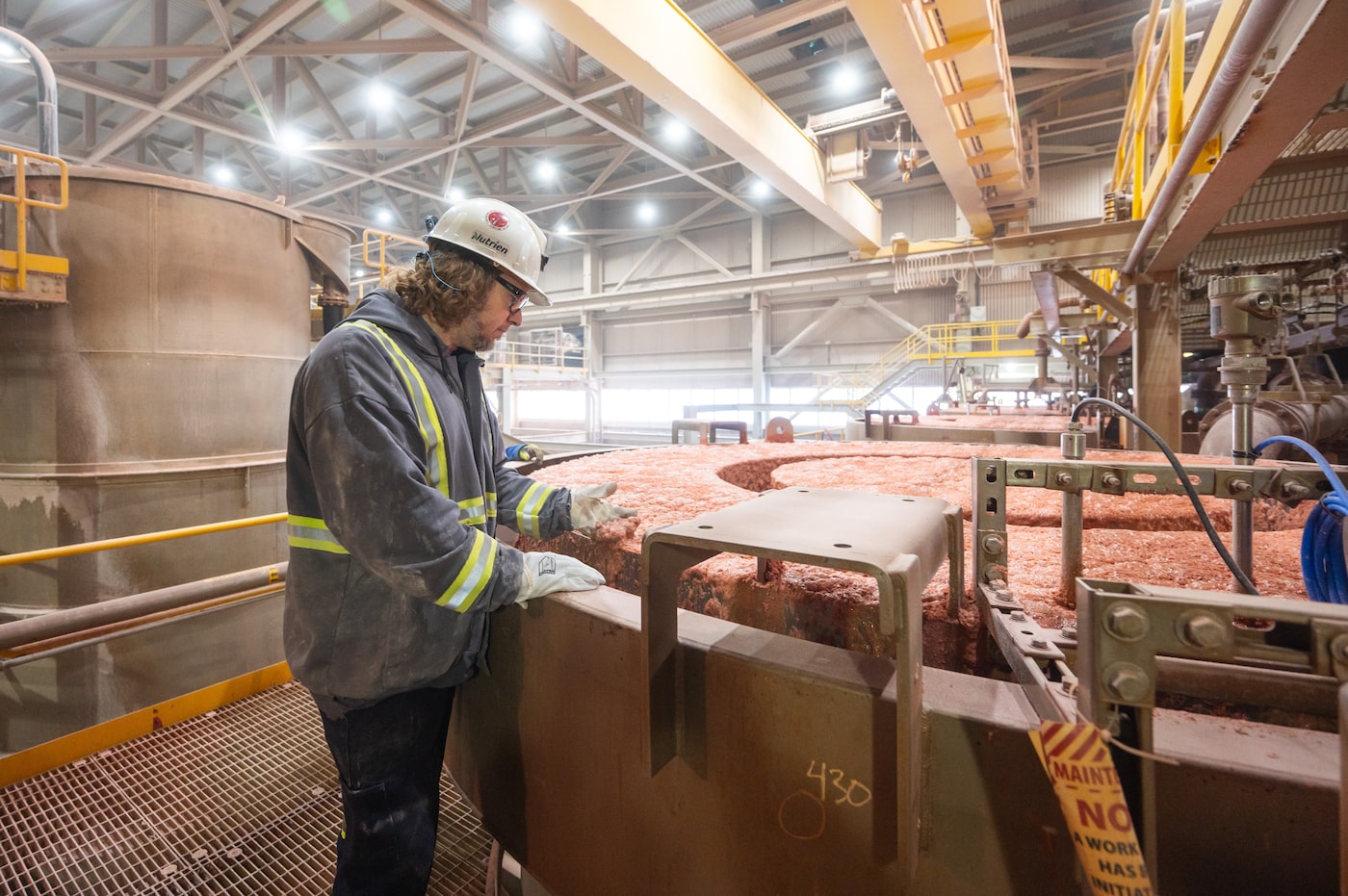
Potash is often a coral-pink collection of minerals, the most important of which is potassium – a key element for plant life and global food systems.
Since taking office in January, however, U.S. President Donald Trump has continuously threatened to levy a 25-per-cent tariff on Canadian goods and services. The U.S. needs nothing from Canada, he says.
But the U.S. needs Canadian potash.
More than 80 per cent of the potash used by U.S. farmers comes from mines in Saskatchewan. Canada is the king of potash. It possesses the largest potash reserves in the world – by a fat margin – and the largest production by volume. The U.S. cannot source most of its potash from elsewhere. Just two other countries have large potash reserves – Russia and Belarus – and these operations are significantly smaller than Canada’s and prone to geopolitical instability.
In economists’ terms, potash demand is largely inelastic. Potash prices can swing widely, but U.S. farmers have to buy roughly the same amount every year.
“The profitability of the [U.S.] is dependent on crop inputs that are affordable,” said Ken Seitz, chief executive officer of Saskatoon-based Nutrien.
The company is also the largest provider of agricultural inputs and services in the world, with more than 1,000 retail outlets in 45 U.S. states.
Should Mr. Trump’s tariff happen, Mr. Seitz is explicit: Nutrien will pass the costs through the supply chain and onto the American farmer.
But few farmers could afford it, especially those who grow corn, the U.S.‘s largest crop.
Facing the third year of a downturn in corn prices, those farmers are strapped for cash. The COVID-19 pandemic, the war in Ukraine and high natural gas prices pushed up fertilizer costs to historic highs. Costs have since dropped, but not at the same rate as corn prices. Few corn farmers have made a profit in years.
Yet these farmers remain a political powerhouse. For the past three presidential elections, farming-dependent counties – concentrated in the central U.S. – have consistently voted for Mr. Trump at rates significantly above the average U.S. voter. His popularity has grown with each election.
With Mr. Trump showing no sign of withdrawing his threat to impose a 25-per-cent tariff on Canadian goods, the Canadian potash producer is therefore expecting the American farmer to be a force that pushes back against that threat. Potash is Canada’s pink gold; it is a strong symbol of the country’s resource riches and could be a key lever in a looming trade war.
But Canada can’t count on U.S. farmers. Amid the corn rows, grain silos and Trump billboards that now characterize the Midwest, the sentiment is not panic, frustration or resistance. Not yet. It is jubilation.
The U.S. political landscape has been transformed and farmers, while they recognize the potential that their fertilizer costs could rise, are reluctant to take a stand against the proposed tariffs. President Trump is back and he will make America great again – regardless of the cost.

Along Interstate 57 in Shelby County, Ill., 'Trump 2024' is written on bales of hay. Rural Illinois, the national leader in corn production, is part of the American agricultural heartland and firmly in Trump country.Tytia Habing/The Globe and Mail
A barge carrying a mountain of pink Canadian potash winds down the Illinois River, a tributary of the Mississippi River - the lifeblood of some of America’s most important agricultural states, including Minnesota, Iowa, Illinois and more.
The soil in the Midwest is the best in the world, local farmers boast. It is rich, black and runs two to three feet into the ground. It is loaded with organic matter. The land is flat and rain is no stranger when the crops start growing – a confluence of conditions that make this land the agricultural American dream, and the foundation for growing corn.
The U.S. is the biggest corn producer in the world. The crop covers a land mass roughly the size of Germany (90 million acres) and in 2023 contributed US$62-billion to the country’s gross domestic product annually, employed 600,000 people and paid a total of around US$35-billion in wages. And of all the Corn Belt states, Illinois is the national leader. In 2023, Illinois corn contributed US$9.5-billion to U.S. economy.
However, the soil upon which this industry is built is missing one key ingredient: abundant potassium.
The Illinois corn farmer – like farmers in most of the Midwest – applies potash twice a year: once in spring before planting, and once in fall, after harvest.


The Growmark facility in Seneca, Ill., receives a barge loaded with Canadian potash in February, 2025. Growmark distributes potash and evaluates soil across the U.S. to formulate area-specific fertilizer formulas. Should Mr. Trump apply a 25 per cent tariff on Canadian goods in March, the rising cost of potash will be passed on to the farmers whose crops rely on it.Tytia Habing/The Globe and Mail
The potassium needs to be sourced from Canada because few other options exist, said Kreg Ruhl, vice-president of Crop Nutrients for Growmark Inc., a farmer-owned co-operative and distributor of potash.
“Can we get it from other places? Yes. To a meaningful degree? No.”
Certainly not in time for spring.
Russia only accounts for 10 per cent of the U.S.‘s potash supply and switching distribution channels would be logistically challenging.
Consider the barge of potash arriving at the Growmark warehouse.
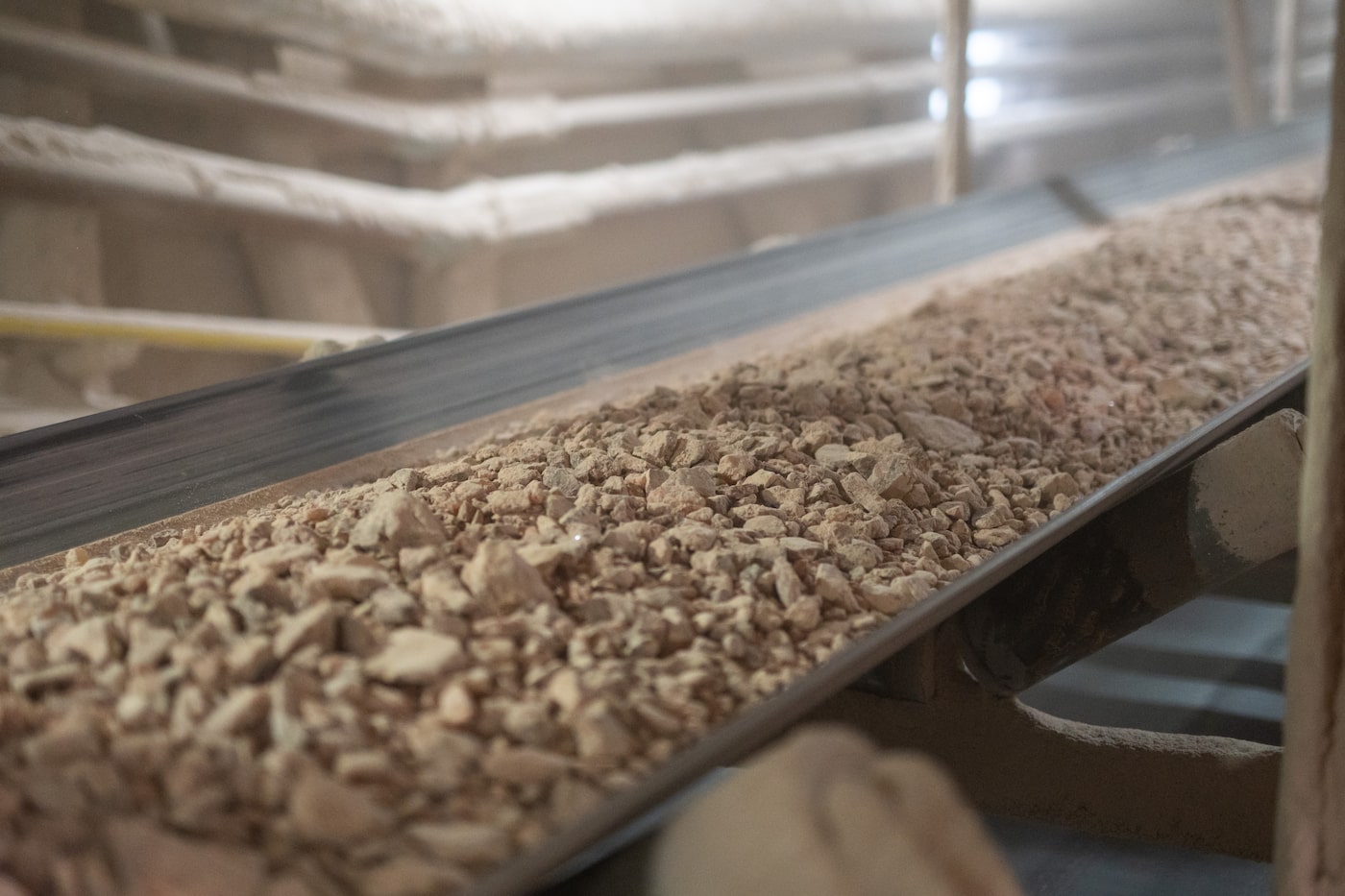
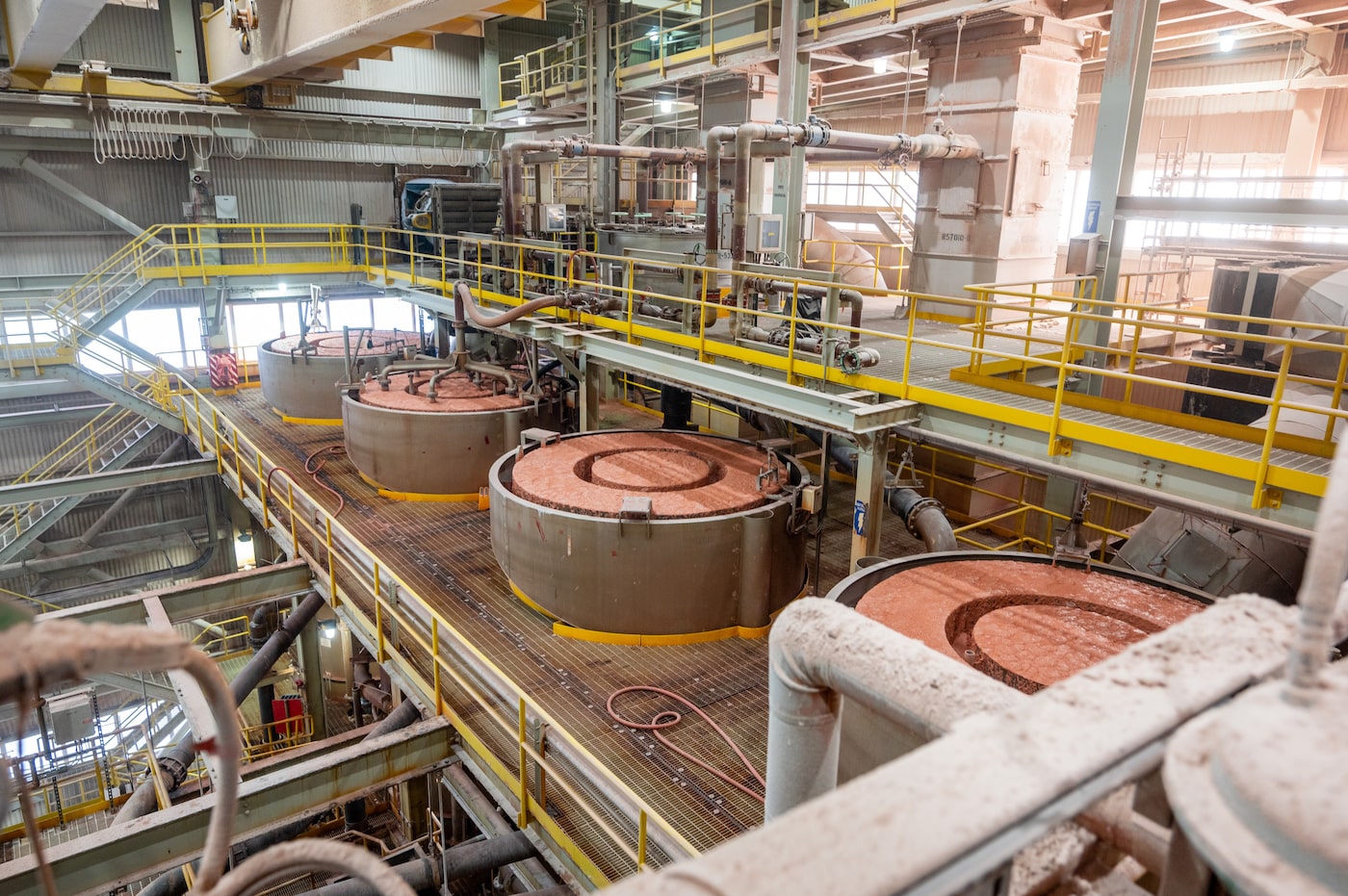
It started in a Saskatchewan mine. First the ore climbed through hundreds of metres of tunnels on an elaborate system of conveyor belts. Next, it whizzed up a mining shaft to a mill, where it was crushed, ground, deslimed and crystallized until, at last, it boarded a train. Then, it was loaded onto a barge and floated toward Seneca, Ill., to a warehouse owned by Growmark – the third-largest agricultural retailer in the U.S.

Canada’s potash legacy
Although potash is found worldwide, Canada was responsible for more than 30 per cent of global production in 2023. It is also home to the largest reserves with 1.1 billion tonnes. Saskatchewan sits atop high-quality potash deposits and has developed the mining infrastructure to exploit them.
SASKATCHEWAN
Lake
Winnipeg
Saskatoon
ALBERTA
MANITOBA
Regina
Potash
distribution
200 km
MONTANA
NORTH DAKOTA
World
3,000 km
murat yükselir and john sopinski/the globe and mail, source:
openstreetmap; USGS; natural resources canada

Canada’s potash legacy
Although potash is found worldwide, Canada was responsible for more than 30 per cent of global production in 2023. It is also home to the largest reserves with 1.1 billion tonnes. Saskatchewan sits atop high-quality potash deposits and has developed the mining infrastructure to exploit them.
SASKATCHEWAN
Lake
Winnipeg
Saskatoon
ALBERTA
MANITOBA
Regina
Potash
distribution
200 km
MONTANA
NORTH DAKOTA
World
3,000 km
murat yükselir and john sopinski/the globe and mail, source:
openstreetmap; USGS; natural resources canada

Canada’s potash legacy
Although potash is found worldwide, Canada was responsible for more than 30 per cent of global production in 2023. It is also home to the largest reserves with 1.1 billion tonnes. Saskatchewan sits atop high-quality potash deposits and has developed the mining infrastructure to exploit them.
SASKATCHEWAN
Lake
Winnipeg
Saskatoon
ALBERTA
MANITOBA
Regina
Potash
distribution
200 km
MONTANA
NORTH DAKOTA
World
3,000 km
murat yükselir and john sopinski/the globe and mail, source:
openstreetmap; USGS; natural resources canada
Growmark has also been explicit: The costs of any Trump tariff will be passed down the supply chain to the farmer.
This uncertainty around pricing makes business decisions difficult. And not just for the spring planting season, but moving forward into the fall.
In the seasons between growing crops, a team of 500 Growmark crop specialists across the nation sample farmers’ soil to formulate a custom ratio of the fertilizer holy trinity: nitrogen, phosphorus and potassium.
All three elements are essential to plant life and potassium – a macronutrient akin to protein, carbohydrates or fats in the human diet – is key to almost everything, including the movement of sugar within plants, plant metabolism and photosynthesis.
The element is the seventh-most-abundant in the Earth’s crust. Very little of that, however, is available for plant use. In extensive agricultural operations, potassium must be applied regularly. In the U.S. Corn Belt, where crops suck up nutrients at breakneck rates, it is typically applied twice a year: once after harvest, and once in the spring before planting.
However, a farmer cannot apply potassium with abandon. Fertilizer accounts for 45 per cent of operating expenses for U.S. corn farmers. Applying just the right amount, at just the right price and at just the right time can be the difference between turning a profit and losing money.
Crop specialists are currently analyzing soil. They will make recommendations. And retailers who distribute the potash will start making purchases in July and August.
These recommendations depend on accurate potash price projections. The balancing act is always tricky, but becomes near impossible when the price of fertilizer is volatile, Mr. Ruhl said.
Farmers will almost certainly pay higher prices. And this won’t be the first time in the past five years.
When war erupted in Ukraine in 2022, disruptions to Black Sea trade routes squeezed global potash and fertilizer supply. Subsequent sanctions on Russian and Belarusian products caused fertilizer prices to climb. Combined with COVID-era supply disruptions worldwide, potash prices climbed 480 per cent between 2016 and 2022. Phosphorus and nitrogen also increased in price.
Mining companies, distributors and retailers passed the costs along to the farmer. Even for fertilizers that aren’t mined, and which are therefore produced by many nations (nitrogen can be captured from the atmosphere, so the U.S. has domestic production), switching supply chains costs money and time as freight routes are altered. All of this is passed onto the farmer.
“When costs get added to our supply chain, they pile up on farmer fields,” said Mr. Ruhl.
But a 25-per-cent tariff on Canadian potash in 2025 is a different beast, he said.
In 2022, futures prices for corn increased sharply after Russia invaded Ukraine. A war in a global breadbasket – Ukraine – threatened to reduce food production and add uncertainty into supply chains. The war boosted fertilizer prices and corn prices. Farmers had a cushion.
Today, the story is different.

A poster of Donald Trump hangs on the back of a door at a farmhouse in Sidney, Ill.
The President scowls at the camera, his eyebrows arched. Underneath the photograph are the words “Never Surrender!”
This is a poster of President Trump’s August, 2023, mug shot, taken in Fulton County jail in Atlanta, Ga.
President Trump and this poster are a source of daily inspiration to Sarah Hastings and her family, who grow around 1,800 acres of corn and soybeans. It is a reminder that you can accomplish anything, she said, including go to jail and – a year and a half later – become President of the United States.
But Ms. Hastings doesn’t feel inspired when she looks at the graph laid out in front of her. It is a broad snapshot of her finances across the past 10 years. It measures the two most important variables: the cost of fertilizer and the farm-gate sales of her crops.
The lines are converging. In 2014, she spent about US$200,000 on fertilizer. In 2024, she spent about US$400,000. Simultaneously, the price for corn has dropped from an all-time high of more than US$8 per bushel in August, 2012. The war in Ukraine briefly boosted the price. However, prices have declined steadily over the past two and a half years. As of Feb. 24, the price of corn sat at US$4.70, a nearly 50-per-cent drop from the record.
And Ms. Hastings doesn’t expect better prices over the next few years.
With a background in bookkeeping and accounting, she knows what this means. Profits are shrinking, and her business – a multigenerational farm – is less viable, especially if tariffs mean she has to pay more for potash.
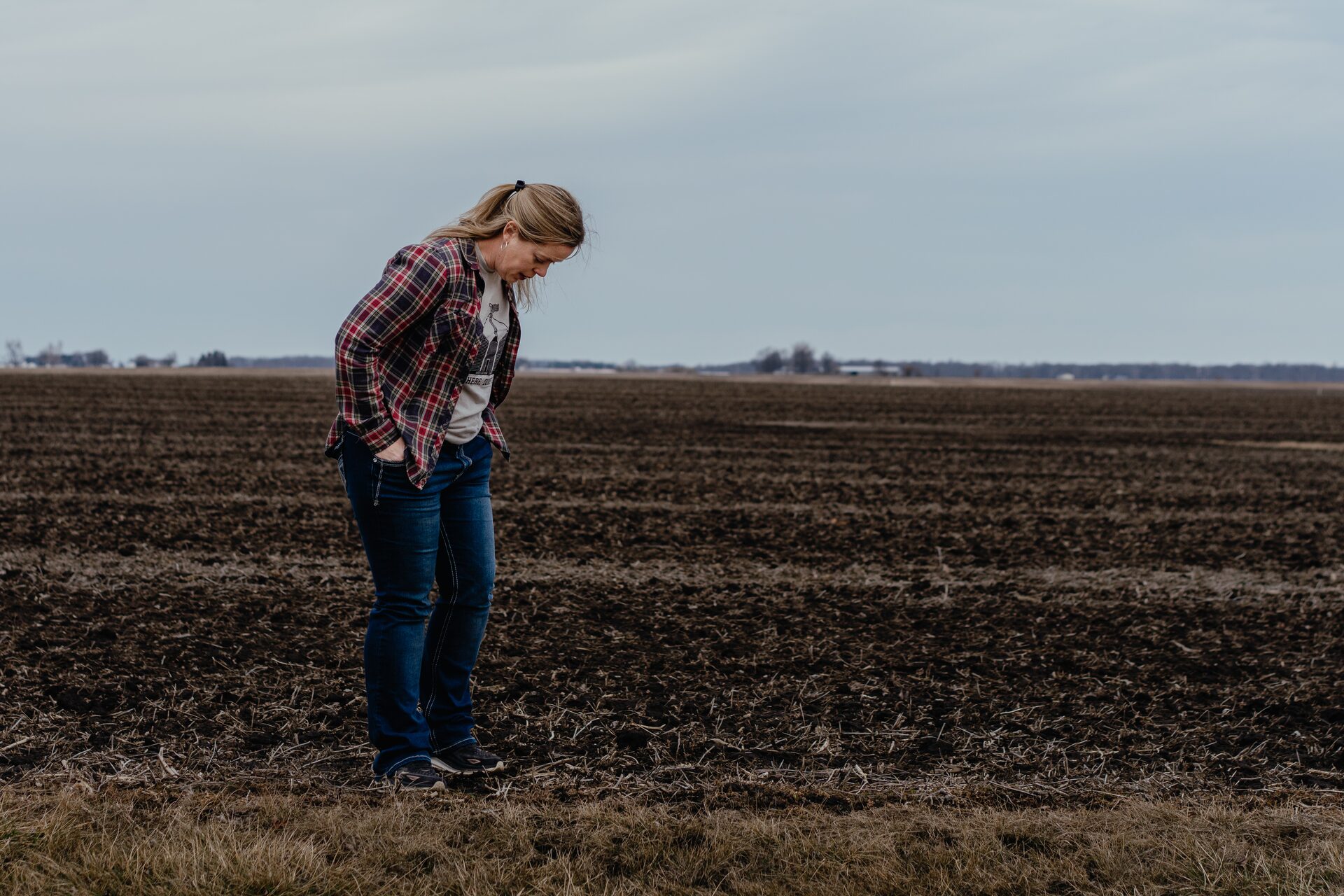
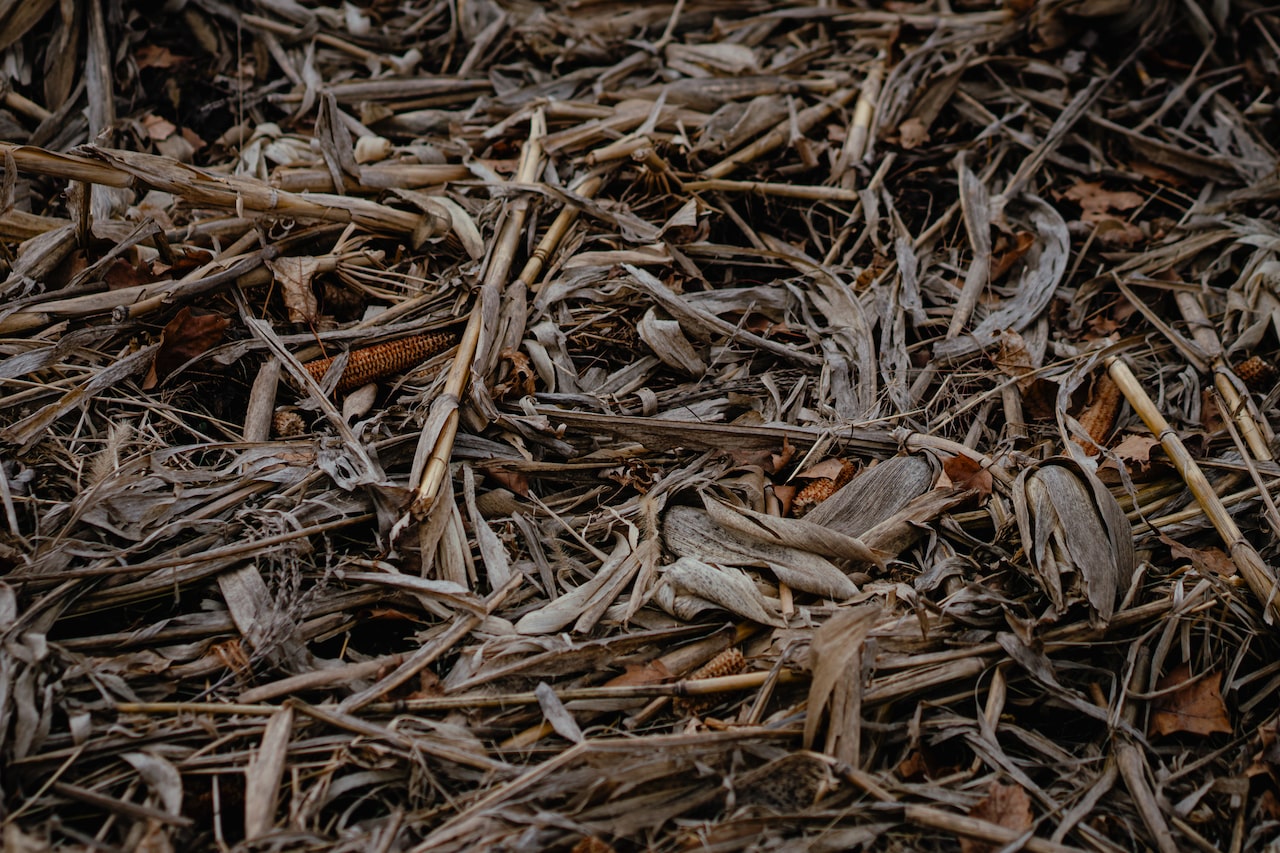
The farm has some options should the tariff happen. The family can be more targeted with fertilizer application. Or they could apply less fertilizer overall, and accept lower crop yields. With the price of corn as low as it is now, that might make financial sense. Underneath all this, Ms. Hastings, like other Midwestern corn farmers, has faith in her soil and its ability to grow a good crop – even with less fertilizer.
“It’s kind of amazing how our soils can compensate,” she said.
But every option is a risk, and the decisions made could have long-term consequences for the health of her land and her business. The uncertainty feels overwhelming to her at times, especially in a business such as corn farming, in which decisions made in spring determine her family’s annual income.
“You get one chance a year,” she said. “How many jobs do you get one chance a year?”
The Hastings family farm was among a number across the Midwest that suffered from President Trump’s first-term trade war with China. In retaliation for U.S. tariffs on Chinese imports, in August, 2019, the major importer of U.S. corn and soybeans closed its borders to U.S. agricultural products.
Washington distributed up to US$16-billion in financial aid to farmers most affected by China’s actions. The Hastings received some of that money.
It was a stressful moment for Illinois farmers, said Rodney Weinzierl, executive director of the Illinois Corn Growers Association. The vast majority of the farms in his region - like the rest of the corn belt - are family owned and operated, and multigenerational. Losing a major export market was a blow to business and livelihoods.
But farmers reaped some benefits, he said. Corn exports increased after the trade war ended and China – which had a reputation for renegotiating contracts once shipments arrived in port – realized the stakes and started playing by the rules. But that was “taken off the table when a new administration came in,” said Mr. Weinzierl.
Sarah Hastings’ husband, Brandon, seconds that thought. “They knew Trump is pretty serious about what he says.”

As a professional accountant by trade, Ms. Hastings knows profits are shrinking, and her business is less viable if they have to pay a 25 per cent tariff on potash.Jamie Kelter Davis/The Globe and Mail
This is one of the many reasons Mr. Weinzierl says Illinois corn farmers voted for Mr. Trump. The Environmental Protection Agency challenged corn growers during Joe Biden’s term as U.S. president by promoting electric vehicles and discouraging sales of ones powered by gasoline – mixed with ethanol from corn.
What the industry needs above all is access to new markets, he said. Total U.S. corn yields have increased more than 360 per cent since the 1950s. Increased efficiency and supply is driving low prices.
Livestock, a primary market for U.S. corn, is also making efficiency gains and thereby decreasing corn demand. Mounting competition from Brazilian and Argentinian corn doesn’t help matters, either.
Instead of finding new markets for corn, the EPA’s push for EVs threatened demand for biofuels, he said.
Around 45 per cent of total corn produced in the U.S. is turned into ethanol, according to the U.S. Department of Agriculture. Ethanol is made from fermenting starches of grains into what is called renewable fuel. Under the 2005 U.S. renewable fuel standard, all transportation fuel in the country needs to contain a certain proportion of the stuff. Today 98 per cent of gasoline in the U.S. contains ethanol, according to the U.S. Department of Energy.
The EPA’s focus on EVs was a short-sighted approach and failed to account for renewable fuels in the fight against climate change, said a February, 2024, letter signed by thousands of corn farmers across the country. The billions spent on EVs prioritized one sector above another, said the letter.

Tim Habing, a small-scale Illinois corn farmer, is among the few in his community who do not support Trump.Tytia Habing/The Globe and Mail
Tim Habing, a small-scale corn farmer in Effingham, Ill., is a minority in his community. He does not support Mr. Trump. He doesn’t think the President shares his values or represents the interests of farmers.
“I don’t really think he even cares about us. I think all we are is a vote to him.”
In fact, Mr. Trump’s tariffs are a stark example of the White House prioritizing other interests over the farmer, he said. And it’s worse than Biden administration’s investment in EVs.
President Trump has framed Canadian tariffs as a way of rebalancing a trade deficit and as a strategy to bring manufacturing (such as steel) back to America. He has also made misleading claims about fentanyl crossing the border to justify the tariffs.
But it’s hard to know if tariffs will bring manufacturing back, or if this is what the Trump administration really wants. At least the Democrats explicitly believed they were trying to help the planet, said Mr. Habing.
“I’m okay making less money if it serves the greater good... I just don’t want to go broke overnight.”

Potash, while categorized as a critical mineral by Ottawa, is not classified as such in the U.S.Matt Smith/The Globe and Mail
As President Trump continues to press ahead with his tariff threat, that is looking like more of a reality for Mr. Habing. He has yet to purchase his potash for the spring planting season.
He is also concerned about retaliatory tariffs from Canada and Mexico.
Canada is the top destination for U.S. ethanol exports. And Mexico, which Mr. Trump has also threatened with a 25-per-cent tariff, is the largest export destination for U.S. corn (double the second-largest market – Japan).
“Why are we tariffing Canada?” asked Mr. Habing. “I mean, what did they do to us?”
For now, the Illinois Corn Growers Association is joining other voices calling for an exemption for Canadian potash. Or, failing that, a recognition that fertilizer is an essential part of U.S. food production, and therefore entitled to the 10-per-cent tariff Mr. Trump says he will apply to Canadian energy and critical minerals. (Potash, while categorized as a critical mineral by Ottawa, is not classified as such in the U.S.)
Ms. Hastings would also like to see this exception. And while she does see fentanyl crossing the Canada-U.S. border as a justification for tariffs, she also doesn’t want to see Canadians hurt by tariffs. She has nothing against Canada and recognizes it is an important trading partner with aligned values. She wants businesses on both sides of the border to thrive.
As for her own business, as a farmer of a highly-homogenized global commodity, she knows she is often a victim of fluctuations in global trade and geopolitical instability. But she nonetheless believes in Mr. Trump’s long-term vision of an America that is great again – even if it hurts her in the short term.
“We live by the sword,” she said. “And we die by the sword.”

Eleven potash mines spread across Saskatchewan are drilling into the ground in a race to extract Canada’s pink gold, a vital nutrient for a world facing food insecurity.
Nutrien, while the biggest miner of potash worldwide, isn’t the only player. Canada’s bountiful deposits have enticed a United Nations of mining companies, including U.S.-based Mosaic Co. MOS-N and Compass Minerals International Inc. CMP-N, German fertilizer producer K+S AG and – most recently – the world’s largest mining company by market capitalization: Australian miner BHP Group Ltd. BHPLF
The global masters of iron ore, copper and metallurgical coal see Canadian potash as the next frontier.
Giant BHP is building one of the world’s largest potash mines, the $18-billion Jansen mine, two hours outside Saskatoon. When stage one of the mine comes online in late 2026, it will produce 4.4 million tonnes of potash per year. When stage two is complete in 2029, the mine will churn out 8.4 million tonnes per year.
It is the biggest single investment in Saskatchewan’s history. It is also the biggest investment in BHP’s 140-year history. And there’s a reason BHP chose Canada, said Canadian-born CEO Mike Henry in an interview with The Globe and Mail’s Report on Business magazine.
Canadian potash is emblematic of valuable growth, which is BHP’s priority moving forward.
Potash is needed for food production. And agriculture worldwide – facing rising living standards and a rising demand for calorie-high diets – will need to innovate. Fertilizer will fuel this innovation.
Changes to global agricultural practices will drive growth for Nutrien, agrees Ken Seitz.
Sophisticated agricultural markets such as the U.S. are important to the business, but there is fast-growing demand elsewhere, too.
While U.S. farmers overwhelmingly need Canadian potash producers, the U.S. buys less than one-third of Nutrien’s potash sales volumes.
For more than 50 years, Nutrien has diversified its trade, building sophisticated supply chains to reach over 40 markets, said Mr. Seitz. Growth is offshore in large, developing agricultural markets such as China, Brazil and Southeast Asia.
Mr. Seitz has visited Washington a number of times over the past few months, trying to impress upon Mr. Trump’s administration the importance of affordable Canadian potash to his farmers. Because potash isn’t just a product; it is the key to growing affordable food.
“This message is about the importance of domestic food security.”
Editor’s note: A previous version of this article included incorrect prices for corn. This version has been corrected.