Three years ago, Premier Danielle Smith passed her first electoral test as leader of Alberta’s United Conservative Party.
In a hotly contested provincial election, her UCP strode to victory over Rachel Notley’s Alberta NDP, forming a 49-seat government with an 11-seat gap over the New Democrats.
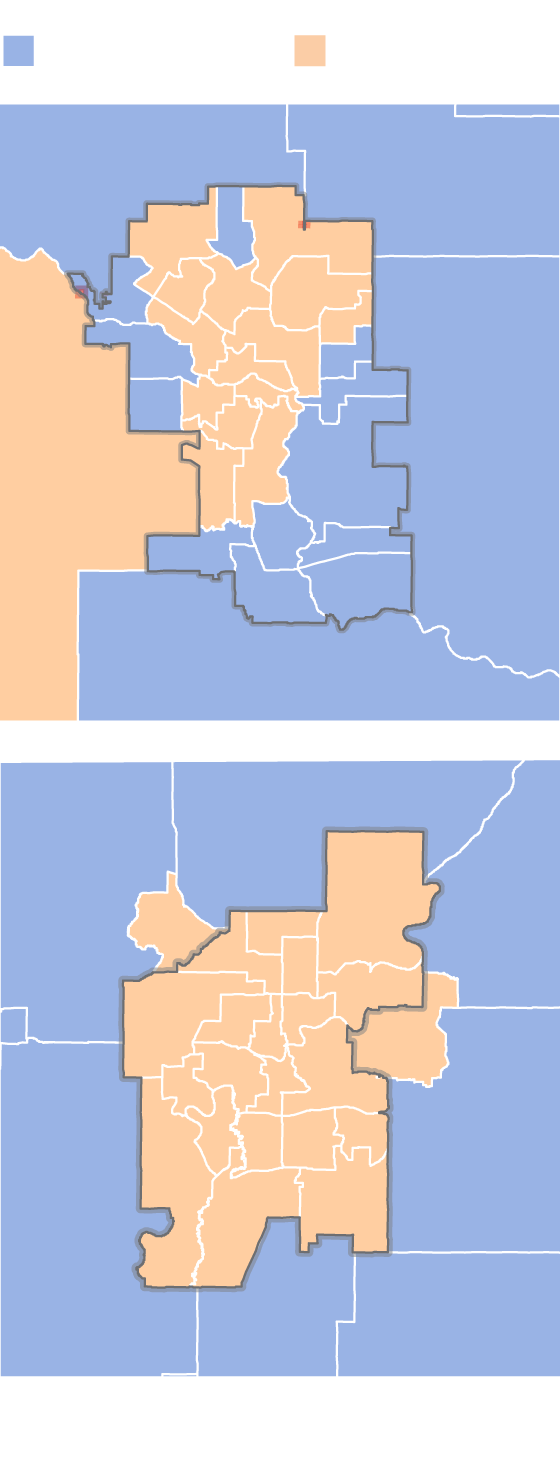
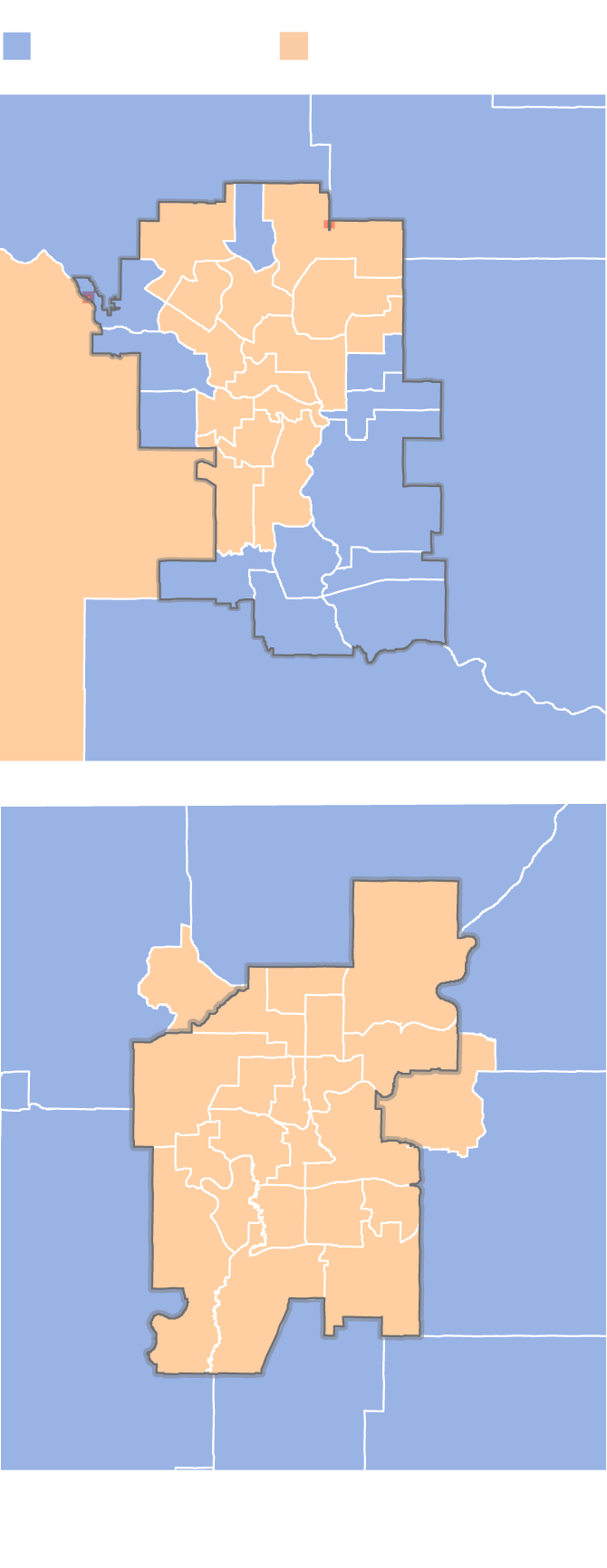
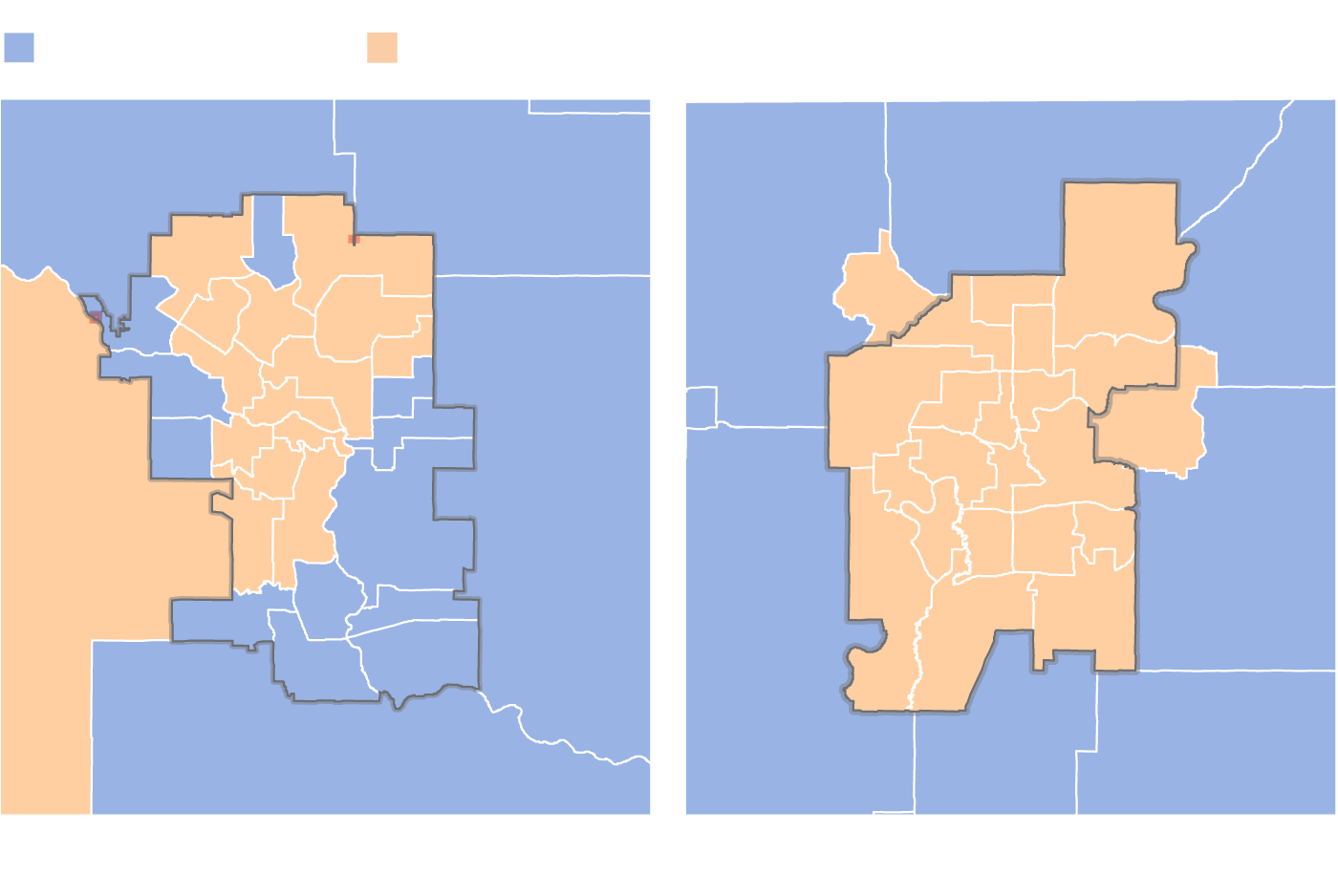
The UCP swept the province’s rural ridings, while the NDP dominated in Edmonton. Calgary, widely regarded as the key to winning government, saw voters split down the middle.
The 2023 electoral map showed how dramatically Alberta’s politics have shifted since 2015, when the NDP broke the Progressive Conservative’s 44-year unbroken run of government.
Over the past decade, Alberta voter preference has become increasingly defined by geography. The province’s electoral map is awash in rural blue, with a cluster of orange support in Edmonton, while Calgary features a bundle of support for the two parties. (In 2024, Naheed Nenshi was partly chosen to succeed Ms. Notley as NDP leader in hopes his popularity as Calgary mayor would translate to gains in the province’s largest city.)
Elected UCP in 2023
Elected NDP in 2023
Airdrie-Cochrane
Airdrie-East
CALGARY
Banff-
Kananaskis
Chestermere-
Strathmore
Highwood
Lac
Ste. Anne-
Parkland
Morinville-
St. Albert
EDMONTON
Strathcona-
Sherwood
Park
Drayton
Valley-
Devon
Leduc-
Beaumont
Maskwacis-
Wetaskiwin
MURAT YÜKSELIR / THE GLOBE AND MAIL,
SOURCE: ELECTIONS ALBERTA
Elected UCP in 2023
Elected NDP in 2023
Airdrie-Cochrane
Airdrie-East
CALGARY
Banff-
Kananaskis
Chestermere-
Strathmore
Highwood
Lac
Ste. Anne-
Parkland
Morinville-
St. Albert
EDMONTON
Strathcona-
Sherwood
Park
Drayton
Valley-
Devon
Leduc-
Beaumont
Maskwacis-
Wetaskiwin
MURAT YÜKSELIR / THE GLOBE AND MAIL,
SOURCE: ELECTIONS ALBERTA
Elected UCP in 2023
Elected NDP in 2023
Airdrie-Cochrane
Airdrie-East
Lac
Ste. Anne-
Parkland
Morinville-
St. Albert
CALGARY
EDMONTON
Banff-
Kananaskis
Chestermere-
Strathmore
Strathcona-
Sherwood
Park
Drayton
Valley-
Devon
Leduc-
Beaumont
Maskwacis-
Wetaskiwin
Highwood
MURAT YÜKSELIR / THE GLOBE AND MAIL, SOURCE: ELECTIONS ALBERTA
As Alberta residents look ahead to the 2027 provincial election, the electoral map has undergone a scheduled redrawing – a tried-and-true process designed to be free from political influence.
But in March, the group responsible for the redraw tabled two different maps, giving Ms. Smith’s government a choice.
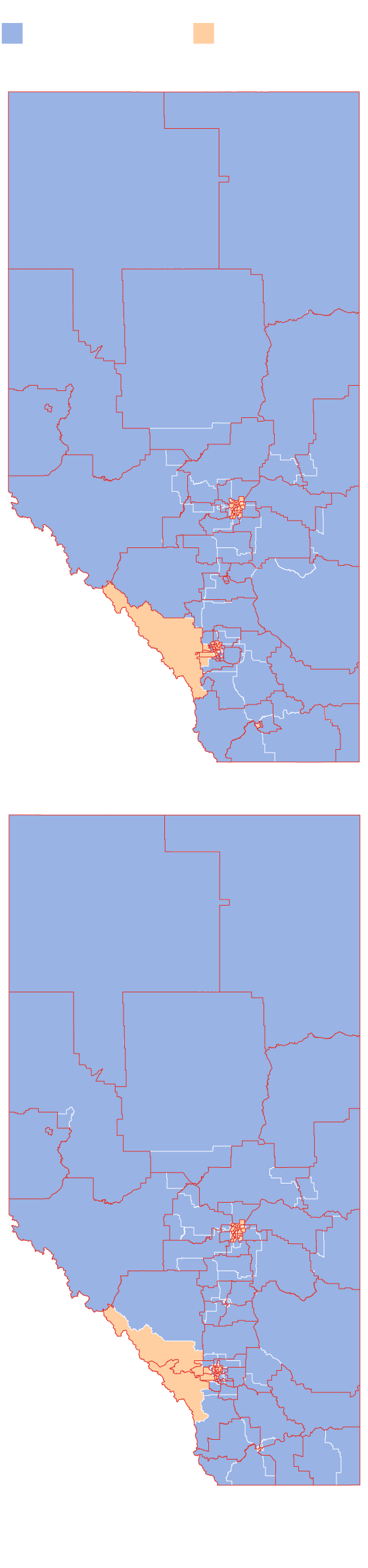
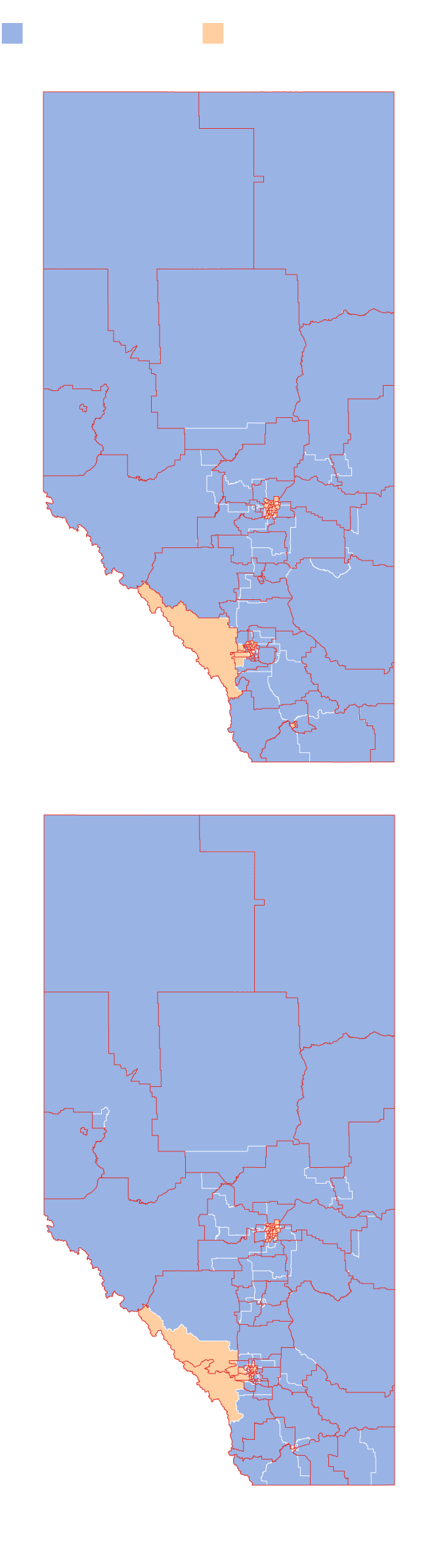
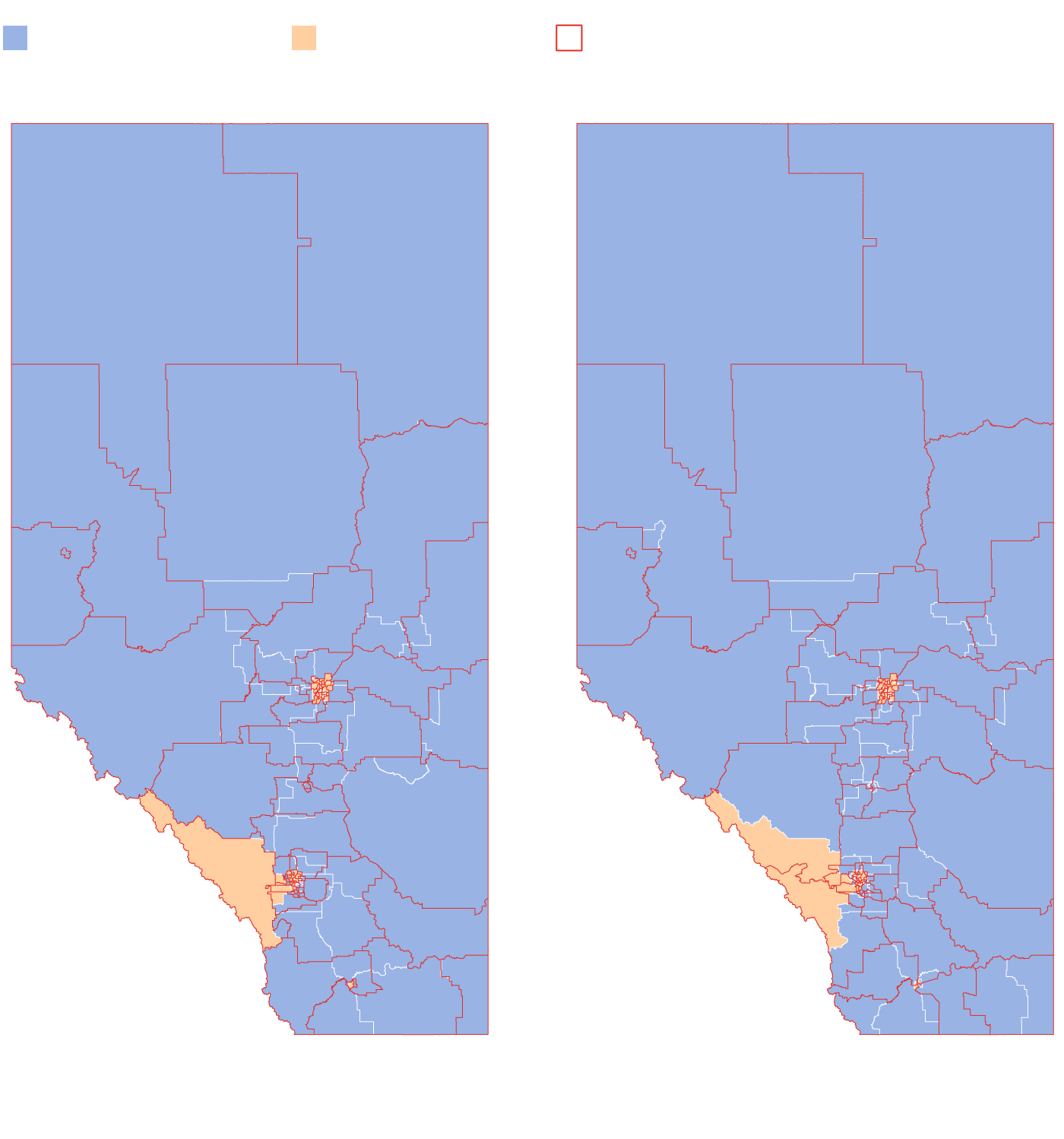
One map, co-signed by three boundary commissioners – the UCP-selected chair and two NDP-selected members – accounted for Calgary and Edmonton’s steep population growth by adding a handful of new urban seats and removing two rural seats. It was called the majority report.
The other, known as the minority report, was endorsed by the remaining two UCP-selected members, who contended that Alberta should avoid centralizing power in its cities. The authors leaned on ridings that blended urban and rural communities, defending their map as a balm for urban-rural polarization.
If approved, that map would dramatically increase the electoral influence of the UCP heartland.
Christopher Cochrane, an associate professor at the University of Toronto who studies electoral districts, said the mere presence of duelling maps was unprecedented: “I’ve never seen anything like that.”
Elected UCP in 2023
Elected NDP in 2023
MAJORITY REPORT
MINORITY REPORT
MURAT YÜKSELIR / THE GLOBE AND MAIL, SOURCE:
ELECTIONS ALBERTA; ALBERTA ELECTORAL
BOUNDARIES COMMISSION
Elected UCP in 2023
Elected NDP in 2023
MAJORITY REPORT
MINORITY REPORT
MURAT YÜKSELIR / THE GLOBE AND MAIL, SOURCE: ELECTIONS
ALBERTA; ALBERTA ELECTORAL BOUNDARIES COMMISSION
Elected UCP in 2023
Elected NDP in 2023
Proposed riding
MAJORITY REPORT
MINORITY REPORT
MURAT YÜKSELIR / THE GLOBE AND MAIL, SOURCE: ELECTIONS ALBERTA;
ALBERTA ELECTORAL BOUNDARIES COMMISSION
In the end, Ms. Smith picked neither.
Instead, she formed a committee dominated by UCP MLAs that will oversee the new redraw. While the group will be advised by another independent panel, the new plan gives her government permission to intervene in the process.
The move has resulted in accusations of partisan gerrymandering – the U.S.-style tactic of manipulating electoral maps to create an artificial political advantage.
Now, with a charged political atmosphere swirling, the government-led committee will start the redraw armed with the boundaries report and its duelling maps.
According to a new Globe and Mail analysis, those two maps would have dramatically different effects on the electoral horse race.
Transposing voting-area results from the 2023 provincial election, The Globe found that under the majority’s proposed map, the UCP’s hold on the legislature would narrow to a seven-seat gap from 11, largely because of ridings added to Edmonton and Calgary.
The minority map, meanwhile, would upend Alberta’s competitive political landscape. It would limit Calgary’s influence as a battleground city, chip away at NDP support in Edmonton and virtually wipe out all political competition in Alberta, giving the UCP a 21-seat cushion over the NDP, whose headcount would be reduced to 34.
In its analysis, The Globe selected a handful of ridings that show dramatic changes under the majority and minority recommendations.
The minority proposed the same model of splitting ridings into sweeping urban-rural hybrids for Red Deer, Alberta’s third-largest city, also currently a two-riding city. Red Deer Mayor Cindy Jefferies has criticized the proposal because it could lead to the city having no urban representation in the legislature.
The minority described the idea as a model to “improve understanding of shared challenges” between urban and rural communities, a consistent motivation in their proposals.
Jonathan Cervas, a professor at Carnegie Mellon University who has advised redistricting processes in Pennsylvania, New York and Wisconsin, called pushes for rural representation amid rapidly growing urban populations “classic U.S. stuff.”
Prof. Cervas suggested the minority maps are an “attempt for the conservatives who live in rural areas to try to hold on to the political power that they used to have.”